


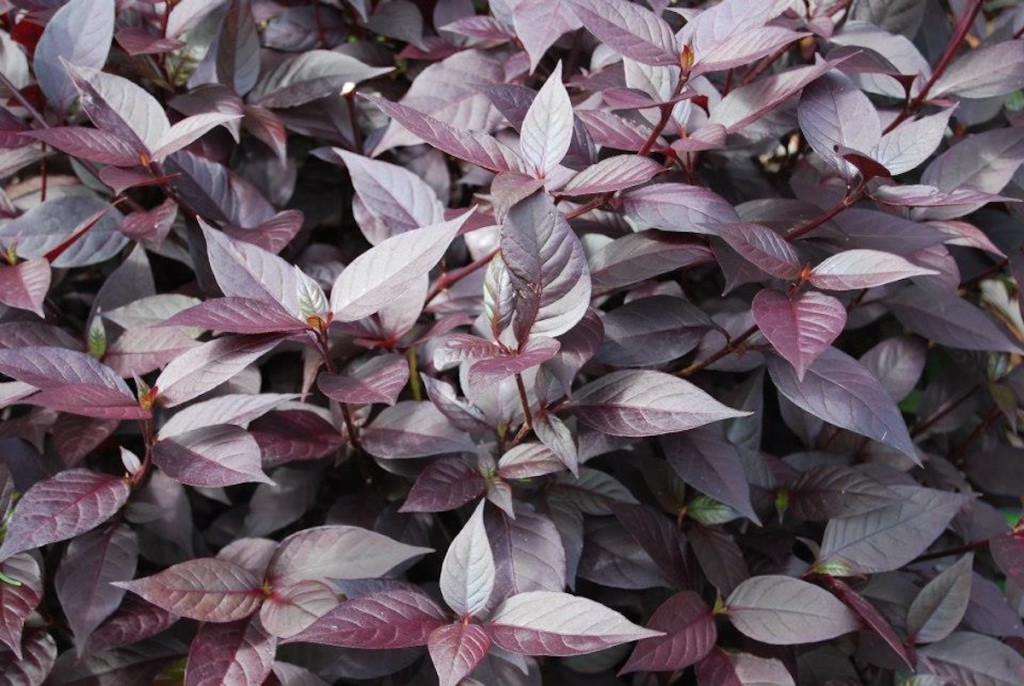

Alternanthera is a plant that is not often seen indoors, but is frequently used as ornamental foliage in planters, where it is fairly easy to care for. Although it is a mild-weather perennial that cannot survive Canadian winters, there is no reason to condemn it when the cold weather sets in: it can survive in our homes. If you have success with coleus, why not save your alternanthera in the fall?
Origin
There are just over 80 species of Alternanthera in the Alternanthera genus. This genus belongs to the Amaranthaceae family, a family that is rarely seen in our homes. The best-known indoor Amaranthaceae plant is the iresine, with its colorful foliage.
Alternanthera sp. is fairly widespread throughout the world. Most specimens come from tropical and subtropical regions of the Americas, but they are also found in Asia, Africa, and Oceania… so almost everywhere except Europe and North America! There are both terrestrial and entirely aquatic specimens.
Alternanthera are ornamental plants that can be used for a variety of purposes: ground cover, border plants in gardens, in planters, aquarium plants for certain species, and also in mosaiculture. They are fairly easy to grow outdoors, which explains their widespread use… but this also makes them invasive plants, mainly in humid and warm environments.
… but Not Only in Tropical Environments!
I was very surprised when my research led me to a report on A. japonica, an invasive alternanthera in Point Pelee National Park in Canada. The species, which is not particularly hardy, also baffles the ecologists who study it: how can it survive our winters, which are much harsher than those in its country of origin? The hypothesis put forward by the national park team is that it is the seeds, which it produces by the hundreds, that survive the cold without too much damage and germinate the following spring.

Description
All Alternanthera species are herbaceous plants that never produce bark. Depending on the species and climate, they can be annuals and die after producing seeds, or perennials; if there is a variation in temperature, as in tropical climates, the plant may also lose some of its leaves during the colder months.
Alternanthera plants vary in habit: those that are more like ground cover are prostrate and take root when their stems eventually touch the ground, while others are more erect and can even form subshrubs. Ornamental cultivars are often small, rarely exceeding one meter in height, with a compact and dense habit.
The leaves are opposite, two per node, oval in shape and slightly pointed at the tip. They come in a wide variety of colors, which is why this plant is so ornamental. It is not uncommon for new shoots to appear slightly bristly.
Alternanthera sp. is not grown for its inflorescences, which I find absolutely charming. The plant produces small spikes adorned with several 5-tepal inflorescences, grouped together to resemble white pompoms. They are found both in the leaf axils and at the ends of the stems.

Varieties
Most ornamental cultivars available commercially are complex hybrids, mainly of A. dentata and A. brasiliana. It is difficult to trace the clear parentage of each cultivar, especially since some names are so often interchanged that they have almost become synonymous (such as A. dentata and A. brasiliana, which are the basis of the hybrids, but which are also very similar morphologically and therefore confused). Finally, we hear about A. ficoidea, but more often in reference to variegated cultivars than to the species itself; A. ficoidea is therefore a term that is used indiscriminately in the horticultural world.
More Common Cultivars
Here are some of the most common cultivars, in shades of pink, green, white, and purple:
– A. ‘Party Time’: green foliage with varying shades of fuchsia pink. In the case of this plant, the brightly colored photos are not fake, and the plant really does appear to be painted in its delightful vivid hue—I know, it looks like it’s fake!
– A. ‘Brazilian Red Hots’: a magnificent, slightly rarer plant (i.e., I haven’t gotten my hands on it yet, but I can’t wait to find it) with reddish foliage edged in the same fuchsia pink as ‘Party Time’.
– A. ‘Grenadine’: another rather striking cultivar. Here, the reddish leaves have fuchsia veins, reminiscent of an iresine with smaller leaves and a more compact habit.

– A. ‘Yellow Form’: cultivar with entirely chartreuse leaves.
– A. ‘White Carpet’: green cultivar variegated with white. The leaves also appear more rounded and smaller than those of other cultivars.

Even More…
– A. ‘Little Ruby’: dark red to purple foliage. The color may vary slightly depending on the crop, being darker or slightly greener, especially on new stems.
– A. ‘Purple Knight’: easily confused with other cultivars, ‘Purple Knight’ boasts even darker foliage, deep purple, almost black and metallic. Its doppelganger, the ‘Purple Prince’ cultivar, is smaller in size but sometimes has less dark foliage.

– A. ‘Red Threads’: this variety has particularly thin leaves, reminiscent of grasses. They are purple-green in color with a darker mauve underside. The leaves tend to curl in on themselves, giving the plant an entirely purple appearance.

OUC – Other Unidentified Cultivar
(Well, we’ll come back to the acronym later.)
This summer, I went to the garden center and found a tiny alternanthera with soft green foliage variegated with pink. The leaves were unusual: they were pointed, serrated, irregular, and particularly dense on the plant. My hypothesis is that it is a mutation, due to a malformation or a virus—despite this dramatic hypothesis, the plant was very pretty.
To date, I have still not been able to put a name to the cultivar, despite several relatively thorough searches.

Growing Tips


Light
Alternanthera plants prefer direct sunlight, but can survive in bright light. Too little light will quickly cause the plant to become spindly, with long stems but less foliage.

Watering
Water it as soon as the soil begins to dry out. Alternantheras do not tolerate drought for long and may begin to wilt sadly, even when the soil is still slightly moist. Although they sometimes recover from mistreatment, it can quickly prove fatal.

Atmospheric Humidity
Alternanthera sp. prefers high atmospheric humidity. Indoors, it may be a good idea to place it in a plastic bag during the winter if the air in your home is particularly dry.
A Brief Aside on the Difficulty
I was surprised to see that, in his book on indoor plants, the Laidback Gardener describes Alternanthera as demanding to grow. In a burst of pride, I would like to point out that I consider them to be of medium difficulty (hence the final comment at the beginning of the article, describing them as medium to demanding to grow).
Humidity is a good example: Alternanthera plants do appreciate atmospheric humidity and can suffer from dry conditions, but I have never personally had to give my own plant any special treatment. On the other hand, it’s true that my apartment is a little more humid than average: in addition to my collection of houseplants, I also collect water damage…
That said, it’s true that Alternanthera are not suitable for forgetful gardeners! They grow quickly, drink a lot of water, and do not tolerate drought. I would say that’s their main challenge. In that sense, watering them is very similar to watering peace lilies or coleus; in my case, I have no trouble keeping these two thirsty plants alive, so I have no problem with Alternanthera.


Soil and Potting
No special requirements; any potting soil for indoor plants will do without too much fuss. As for repotting, since the plant grows quickly, it is not uncommon to have to repot it at least once a year, maybe even more. Fortunately, it recovers quickly from the shock of transplanting.

Fertilizer
It can be fertilized with an all-purpose fertilizer during the growing season.

Temperature
It is best to avoid going below 10°C (50°F).
And Outdoors?
Alternanthera sp. is a very simple plant when grown outdoors. It tolerates heat and humidity without complaint. It grows quickly in direct sunlight, but also thrives in partial shade. However, it does need to be watered sufficiently, which can be difficult for plants in planters (hanging planters tend to have very little substrate relative to the abundance of plants growing in them). While it is easier to water good quality soil, alternantheras tolerate all types of soil, even rock gardens. Obviously, they do not tolerate frost.

Maintenance
To maintain a dense and attractive appearance, it is necessary to pinch back the alternanthera frequently and prune any stems that are too long or bare. The plant will grow back quickly and will be all the more beautiful for it.
I should add that even with the best care, this plant loses its leaves at a visible rate. There’s no need to worry when it replaces them just as quickly… but frequent sweeping is a must!

Propagation
Like many fast-growing plants, it is easy to take stem cuttings in water or soil. Roots should appear as early as the second week after cutting!
You can also layer long, prostrate stems.
Finally, the plants can produce viable seeds, but the seedlings will not necessarily be the same as the parent species.


Problèmes
- Pale leaves, dull color: probably a lack of light. If possible, gradually increase the amount of light exposure.
- Significant loss of basal leaves: this mainly occurs due to a lack of watering, but can also occur in cold conditions or when the plant is exposed to a cold draft (e.g., from an air conditioner). In general, Alternanthera plants are quite dramatic when they are thirsty, so it is easy to spot them and water them before it is too late.
- Spots on foliage: Alternanthera is affected by a few fungal diseases. You can remove severely affected foliage and/or treat it with an antifungal agent. Personally, I find that the simplest solution is to cut back the affected stems: they should grow back quickly if the plant is healthy enough.
Insects
Common pests can disturb our beloved plants: mealybugs or scale insects, thrips, spider mites, and aphids.

Toxicity and Other Chemical Anecdotes
In general, Alternanthera sp. is not considered toxic to humans or animals. However, some sources suggest that it may be irritating to certain herbivorous animals… or even intoxicating! This phenomenon has not been well documented scientifically, but it has been observed that some animals grazing on pastures of Alternanthera become more lethargic, and the same effect has been seen in aquatic fauna in areas invaded by A. philoxeroides.
On the other hand, some species of Alternanthera are toxic to other plants. This is surprising, since it is a classic choice for floral arrangements—however, species cultivated for their ornamental foliage do not seem to pose this problem, but other Alternanthera (such as A. philoxeroides) are allopathic. This means that the plant secretes substances that inhibit the growth of other surrounding plants. This characteristic obviously duplicates its potential to invade environments.

Conclusion
Now that fall is approaching, don’t wait until the nights drop below 10°C to check your planters: if you find any alternanthera with purple, chartreuse, or pink variegated foliage, pot them up and bring them inside for the winter. They will be delicate but highly ornamental houseplants, whose dense, overflowing growth will brighten up corners even during the darkest months. If peace lilies and coleus hold no secrets for you, why not take up the challenge?
