
As I wrote in my article on growing scented-leaved pelargoniums, I had a lot of fun trying to list all the possible scents for this plant with its many cultivars. I was overcome with curiosity and had to try, or rather smell, the plants myself, especially those whose scent puzzled me. Chocolate, really? Okay, cocoa is a plant, but we can all agree that the smell of chocolate is still rarer in nature than the smell of lemon or a floral fragrance reminiscent of jasmine!
Preparations
First of all, we had a problem with sample availability. Apart from lemon geranium, we all agree that scented-leaved pelargoniums are not exactly easy to find! (No offense to anyone—I myself have a good old P. citronellum that fills me with joy.)
My research finally led me to the Richters Herbs website, which sells hundreds of edible plants, including about thirty different pelargoniums. I tried to convince my better half to take a trip there, in Ontario, but the prospect of driving nearly six hours to smell plants didn’t appeal to her, so I had to settle for ordering online. (Besides, we didn’t have enough time this summer to organize a trip—it was more reasonable.)
The last problem was that, despite a massive fundraising campaign, no one really wanted to finance such a silly project as buying pelargoniums to see if they really smell the way they claim to smell. So no, I didn’t buy thirty new plants, I limited myself to six, being the paragon of reason that I am (I’m writing this for my mother, who, when she comes to my house, always says it looks like a botanical garden… and she’s right). With the three pelargoniums I already had at home, I estimate that the sample of nine specimens is representative of the approximately 200 species and hybrids of scented pelargoniums.

Absolutely Objective Methodology
The selection process was taken very seriously. I looked at every plant in the Richters catalog and first eliminated those with a lemon scent (I already have one) and those with a lemongrass scent (everyone already has one). Then I tried to see if any had distinctive foliage. Listen, I’m not too bad at distinguishing between cultivars, but still: I need at least one small distinguishing feature to separate P. quercifolium ‘Pretty Polly’ from P. quercifolium ‘Fair Ellen’. And then, after the experiment, I’m the one who has to keep them, so I might as well choose plants that are pretty!
The selection process was then refined through various testimonials from experts with real-life experience, i.e., I went to blogs and social media and looked at what people were saying about the scent of pelargoniums. When people expressed disappointment or used words such as “subtle,” “sort of,” or “you have to imagine it,” I eliminated the plant, until only six remained. So I asked my highly scientific question: “Do you really smell what you say you smell?” and gathered my sample of scented-leaved pelargoniums.
For the ones I ordered online, I repotted them and let them acclimate first, to give them a chance. The priority of a plant in survival mode is probably not to give off the most beautiful minty scent, right? Once everyone had acclimated to the hot, humid climate on my terrace, I was able to move on to testing.
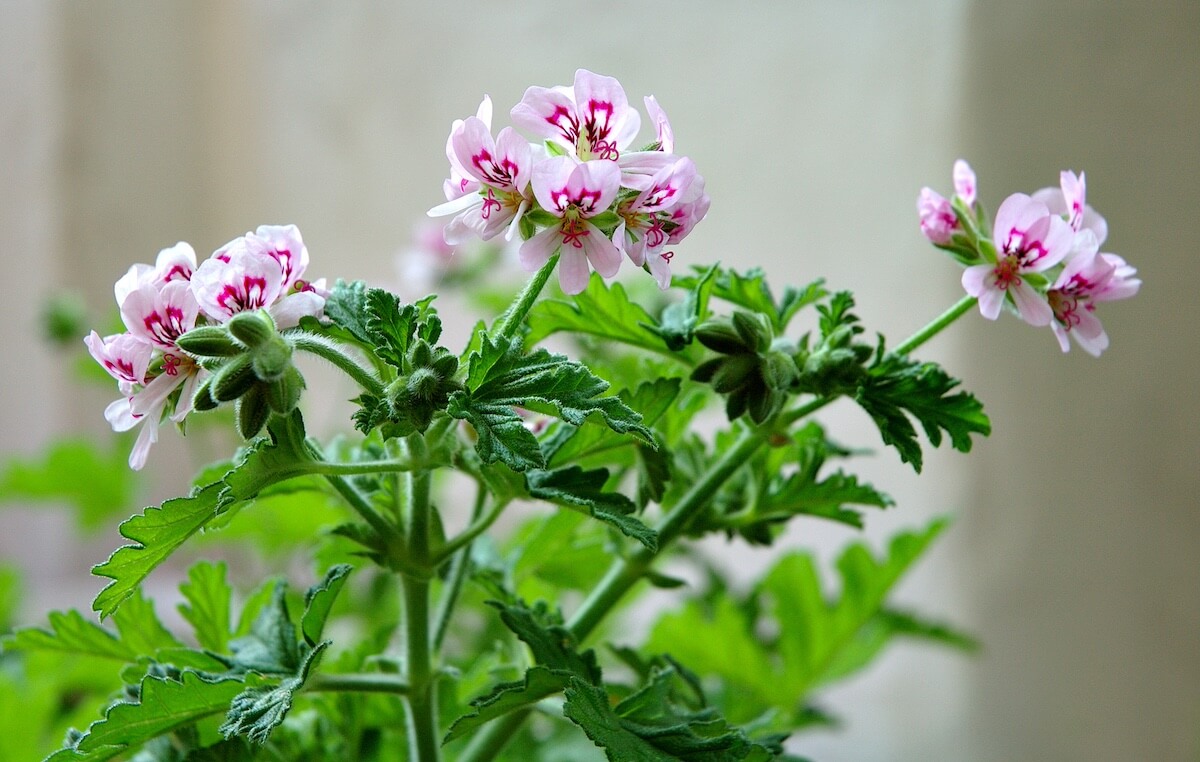
1) Pelargonium ‘Citrosum’
Let’s start at the beginning! I bought this plant a few years ago. It was the end of summer, and the plant was on sale: it was overflowing from a tiny pot, but it still looked great! After repotting, it quickly adapted to its new home and has been trouble-free ever since. This summer, for the first time, it even bloomed.
It is a good-sized pelargonium, whose upright stems become woody over time. The foliage is light green, divided and serrated, with a rough texture. The small flowers are a soft lavender color and are rather discreet.
When you rub the foliage, the plant gives off a lemongrass scent. The fragrance is very strong: just touching it is enough to spread the sweet smell throughout the room.
Can you really smell what you say you smell? 100%.

2) P. crispum x domesticum ‘Mosquitaway Senna’
How can you resist its compact habit and abundant two-tone pink and purple flowers, just as you would expect from a cross between a scented pelargonium and an angel’s wing pelargonium? That said, after flowering, the plant is much more ordinary: just another pelargonium with green serrated foliage. And I can’t guarantee that it will flower again easily!
The scent that is released when you rub the small velvety leaves is sometimes described as lemongrass (since it repels insects, ahem), sometimes as lemon, which makes sense since it is a descendant of P. crispum, known for its lemony scent.
Do you really smell what you say you smell? Debatable. The scent is more lemony than lemongrass, but it’s not particularly strong either.
Bonus question: does it repel insects? The answer is definitely clearer: no.
(Unfortunately, I don’t have a photo of this plant. It died long before I had the idea to write this article.)
3) P. radens ‘Skeleton-Rose’ (syn. ‘Dr Livingstone’)
A first plant acquired not for its fragrance, but for its appearance, ‘Skeleton-Rose’ is a unique cultivar whose divided leaves are indeed skeletal. I associate it with P. ‘Citrosum’, as it is also easy to grow and fairly fast-growing, especially considering the small size of its leaves. Its flowers are light lavender, almost white. It may be a sampling bias, but the plant has only produced one flower for me, whereas other pelargoniums tend to have several flowers per cluster. (What? A sampling bias in this article, which is so serious it could be published in New Phytologist? How disappointing!)
Do you really smell what you say you smell? This pelargonium is supposed to give off a scent somewhere between lemon and rose. To my mind, it leans much more towards lemon than rose, which I don’t smell at all when I rub (with difficulty) the delicate leaves of ‘Skeleton-Rose’. It’s not the strongest scent either.

4) Pelargonium ‘Peacock’
Let’s start with the first of a series of new plants that arrived from my online orders! This one was selected for its foliage, with beautiful leaves that are cut and rounded in shape, speckled with white or cream-colored spots. Interestingly, unlike many other plants whose new leaves are colorful and gradually become duller, this one seems to be the opposite: the leaves on the new stems appear greener and, as they grow, reveal pretty random white spots, giving this pink-flowered plant a beautiful appearance.
The stems are quite vigorous. Although its parentage is unknown, it is probably a derivative of P. graveolens or P. capitatum, both known for their bushy habit. The leaves are soft to the touch. When rubbed, they are supposed to give off an intense rose scent.
Can you really smell what you say you smell? For a plant that boasts an intense rose scent, I’m rather disappointed. The smell of lemon is very present. However, after the lemony wave, there is a floral scent that does indeed resemble rose; it’s subtle, but it’s definitely there.

5) P. fragrans ‘Nutmeg’ variegata
This attractive pelargonium has a fairly compact habit and upright branches that eventually bend with age. Its main attraction is its unevenly variegated foliage. When the plant arrived, I was disappointed that the variegation was more suggested than present, but over the summer it intensified on the main branch. The stems where the variegation is weaker need to be pruned, as is usual for variegated plants. The flowers are supposed to be white and the foliage, when crumpled, is supposed to smell of nutmeg.
Can you really smell what you say you smell? Actually, yes! The scent is distinct and strong. A very satisfying discovery, especially for such an attractive plant!

6) Pelargonium ‘Mrs Taylor’
When I saw the description of this pelargonium, I was skeptical: its scent is described as “pungent,” which means fragrant… but not necessarily in a positive way. After some research, it turns out that there is a whole category of scented pelargoniums whose fragrance is described in this way, accompanied by other adjectives such as “woody” or “musky.”
The ‘Mrs. Taylor’ cultivar, another complex hybrid with unknown parentage, has lobed, rough foliage reminiscent of P. ‘Citrosum’ or ‘Peacock’, with generous, rounded leaves on good-sized stems. The plant has a bushy habit, covered with dense foliage. Its main feature is that it is one of the few scented pelargoniums to produce red flowers.
Can you really smell what you say you smell? Well, it’s hard to say, as the scent is rarely described. I’ll start by saying that it does indeed give off a scent (so yes, the leaves are “pungent”). This scent is not particularly pleasant, but it’s not fundamentally unpleasant either. Woody, certainly, musky too—and a little damp, if I may say so.

7) Pelargonium x scarboroviae ‘Strawberry’
This horticultural hybrid appears to be related to P. capitatum and P. radens. It has inherited its parents’ jagged shape (radens) and rounded, velvety foliage (capitatum). The “x” in its name means that it is an interspecific hybrid (between two distinct species of the same genus), and the term “scarboroviae” is a tribute to Scarborough—it does not refer to a mysterious P. scarboroviae found in the United Kingdom.
Beyond its compact habit and small, soft-to-the-touch leaves, the plant can be adorned with pink flowers with purple stripes. Unlike other scented pelargoniums, the flowers are large and showy, adding to the plant’s appeal. When crushed, the leaves are supposed to give off a strawberry scent.
Can you really smell what you say you smell? No. Not only is the plant not as easy to grow as others and loses more leaves than it creates, but its scent is also very subtle, and there is no hint of strawberry.

8) Pelargonium ‘Chocolate Mint’
This pelargonium has two main attractions: its chocolate-scented mint aroma and the color of its leaves. Its broad, rounded, dark green foliage features a contrasting brown area (hence its name, “chocolate mint”). The attractive leaves appear so large that the stems are prostrate under their weight. The internodal space is quite large.
There is some confusion about its parentage; some link this cultivar to P. quercifolium, because the shape of its leaves is somewhat reminiscent of oak leaves, while others link it to P. tomentosum, the original mint-scented pelargonium. It is probably a hybrid of the two. Can you really smell what you say you smell? I’m sorry, but no. As for chocolate, I didn’t believe it. Most websites that sell this popular cultivar mention that it takes a little imagination to detect the smell of cocoa. The name really comes from the brown-purple color of the foliage. However, the characteristic icy mint scent is also missing: on the contrary, it is one of the cultivars with a woody scent that is not necessarily pleasant.

9) Pelargonium crispum ‘Cinnamon’
A delicate plant with crinkled, wavy leaves, slightly nondescript, whose flowers are known for their bright pink color. Since it is a cultivar of P. crispum, it has a lemon scent with a hint of spicy cinnamon. The stems of the plant would eventually become drooping, had it not promptly died during its first summer. Rest in peace, ‘Cinnamon’, I will probably forget you in a month or two.
Did you really smell what you said you smelled? Well, no! I didn’t smell anything that resembled cinnamon, strong or sweet. Even being generous, I couldn’t distinguish your scent from ‘Mosquitaway Senna’ and ‘Strawberry’ of this world. It’s a shame, because I love cinnamon!

A Brief Aside on Culture
I have only spent one summer with most of the plants on this list, but I can already see some trends emerging. First of all, I would like to point out that I have only encountered one specimen of each of the cultivars in question: it is possible that this specimen was more fragile or had been weakened by the journey. Perhaps I came across a specimen that gave off a less vigorous scent? I will nevertheless venture a few comments on cultivation.
P. ‘Citrosum’ is particularly easy: it grows quickly and can be propagated from cuttings without any problems. ‘Skeleton Rose’ is similar, but grows much more slowly—which is normal, as its thin leaves have less surface area for photosynthesis. I would say that these are the easiest of the bunch.
General Rule
The broad-leaved species are doing well and tolerate drought better, as I did not water regularly during the particularly hot summer of 2025. As a result, ‘Peacock’, ‘Mrs. Taylor,’ and ‘Chocolate Mint’ did not suffer too much from the drought and are doing very well for me. The only downside is that the spots on ‘Chocolate Mint’ have disappeared: it is now indistinguishable from ‘Mrs. Taylor’. This may be a weakness of the specimen rather than the species, as I have seen photos online of clearly two-toned plants.
Smaller-leaved species tend to be less drought-tolerant. I had to do quite a bit of pruning of the dried leaves of these plants, which otherwise have a very dense and attractive habit. I wouldn’t describe them as difficult plants, but they do need a little more attention. P. fragrans ‘Nutmeg’ variegata grew very quickly, which is surprising for a variegated plant.
Unfortunately, two species died, both of which are derivatives of P. crispum: ‘Cinnamon’ and ‘Mosquitaway Senna’. I therefore conclude that P. crispum is a little more fragile. In addition, ‘Strawberry’ is not looking good at the moment and may also die, as its small leaves are drying out even though I have started to make sure it is well watered.

Conclusions From the Experiment With Scented-Leaved Pelargoniums
According to the data collected, we can see that there is a certain degree of inconsistency in the olfactory accuracy of scented pelargoniums. While citrus-related scents (lemon, lemongrass, and other derivatives) are powerful, they tend to dominate the other desired aromas. Despite the use of Pelargonium oil as a substitute for rose essence, the scent of most of the species studied tended more towards lemon than floral, although a hint of rose was clearly present. A pleasant surprise was the scent of nutmeg, which easily stood out from the other musky and woody scents of the “fragrant” pelargoniums. Mint chose not to make an appearance. Finally, there was great disappointment for some fantasy scents, such as strawberry and cinnamon, which were also absent.
That said, the large-leaved cultivars of scented pelargoniums are plants that combine aesthetics and fragrance. Only time will tell if they are easy houseplants, but after spending a scorching summer where they had to battle drought and squirrels, I can say that they demonstrate a satisfying tenacity, which makes them pleasant plants to grow, whether they have a distinct fragrance or not.
Odkar je RTBet prišla na trg, jo kar opazujem, pa moram re?i, da sem pozitivno presene?en. Ko slišiš, da je še nova, pa da je lastnik ta Rabidi NV https://rtbet-slovenia.com/, ki ima že izkušnje, ti takoj da neko zaupanje. Licenca Curaçao je pa itak standard, ki ga poznamo. Kar mi je vše?, je ta ob?utek, da so res pazili na detajle, ko so delali to spletno stran. Vse deluje gladko, hitro se nalaga, pa barvna shema je prijetna. Tudi ?e si malo bolj tradicionalen igralec, te ne bo strah te “nove” tehnologije, ker je vse tako logi?no postavljeno.
My sister and I used to swear by ‘Rober’s Lemon-Rose’ among scented Pelargoniums and I think your experiment would detect the rosiness along with the citrus. Give it a try.
This is sort of what I would expect from such an experiment. Of course, it does not change my opinion of scented geraniums. Some smell like they should while others do not. I still find them to be appealing regardless of their aroma.
Interesting experiment. I have a small collection of scented pelargoniums too and have found in many cases a lot of imagination needs to be used regarding their described scent. However, it’s important to point out than men and women’ interpretation of scent is quite different as is an individuals ability to detect scents. One of my favourites for scent is Prince of Orange where I can detect a lovely citrus scent but my husband (who has a better overall sense of smell than I do) can’t.
I loved this piece. A place in the States, called Logee’s used to have an extensive supply. That’s where most of mine have come from. Also Etsy where I bought my apple-scented cultivar, which has produced beautifully for two years and overwinters nicely in full-sun inside in zone 7A. My oak- licensed is also lovely. I put those leaves in my pillowcases. And my Prince Rupert, variegated leaf, rose scent is also wonderful. I probably won’t order from Richters bec they are in Canada but will surely peruse that catalog.