


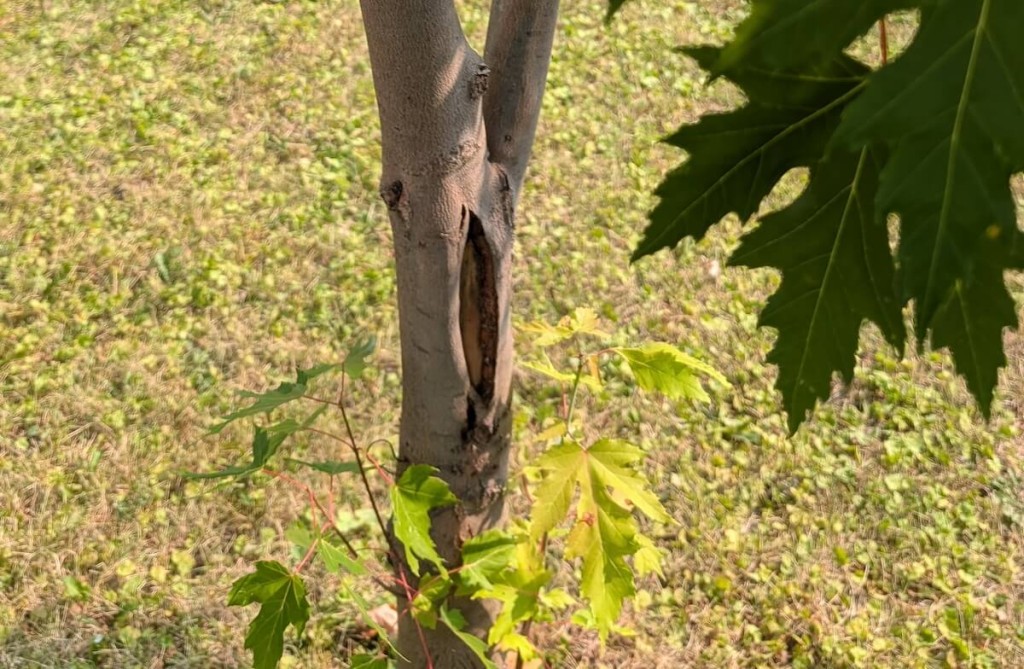
Three years ago, I moved a small maple tree about 30 cm tall that had grown in a flower bed. For the first few years, everything was fine and it thrived. However, this spring, I noticed that the bark was split in a few places, but only on one side of the trunk.
Should I leave it alone and hope it survives, or is it beyond repair?
Sonia Houle

Answer
It is far from irreparable. Trees have a great capacity for survival and, in most cases, they manage to recover from this type of injury.
What you are seeing is probably winter burn, also known as sunscald. The problem occurs mainly in young trees or those with thin bark, when the trunk is exposed to direct sunlight in the middle of winter while the tissues are still dormant and frozen. The resulting crack is called frost crack.
Under the effect of the sun, the bark warms up and the cells of the phloem and cambium, two essential tissues located just under the bark, reactivate slightly. The phloem acts as a downward pipe, transporting sugars from the leaves to the roots, while the cambium is the thin layer that produces new wood and bark. However, when the temperature drops suddenly at sunset, these cells, still full of water, freeze and burst, causing localized tissue necrosis. Over time, this weakened area can split, giving rise to the characteristic frost cracks that can be seen in the spring.
However, frost often only reveals an existing weak spot inside the trunk. A small injury sustained during transplantation or mechanical shock can allow microscopic fungi to enter the wood, creating a more fragile wood grain. In winter, when the water contained in this weakened wood freezes and expands, the internal pressure causes the bark to crack. Winter burn triggers the problem, but it is the internal weakness that allows it to occur.

Is It Serious?
As a general rule, frost cracks do not kill trees, at least not immediately. These lesions are often mainly cosmetic, except in more severe cases. However, a wound in the bark can become a gateway for fungal infections or insects.
Obviously, if the crack completely encircles the trunk, the cambium and phloem can no longer ensure the circulation of water and nutrients between the roots and the foliage, and the tree will eventually die.
In addition, a tree that is already weakened—for example, due to drought, inadequate soil, or other environmental stress—will be much more vulnerable and more likely to succumb to this type of injury.
What Can Be Done to Help the Tree Heal?
It is important not to paint or “dress” the damaged area with pruning paint or a waterproof product. For a long time, it was believed that these products prevented fungi and insects from settling there. However, we now know that, on the contrary, they create a damp, stagnant environment that promotes infection.

When a tree suffers an injury, it immediately activates its natural defense mechanism: it seals the affected cells with protective compounds present in the sap, which physically and chemically repels potential invaders. It then forms a callus around the affected area, which gradually grows to isolate it. This is not a complete cure, but rather a compartmentalization: the tree quarantines the wound to maintain its overall health.
In the spring, you can remove only the bark that has already come loose, using a clean, well-sterilized knife. Afterwards, the ideal solution is to improve growing conditions in order to reduce stress factors. The simplest way is to apply a 5-10 cm (2-4 inches) layer of organic mulch around the base (avoiding direct contact with the trunk). This reduces temperature variations at the roots and retains soil moisture. During dry periods, deep but infrequent watering will help the tree recover more quickly.
Also watch for signs of infection or insects in the crack, and consult an arborist if the situation worsens.
How to Avoid Winter Burns
In most cases, trees recover very well from this type of injury. However, there are a few simple ways to prevent winter burns.
In addition to using mulch at the base of the tree and ensuring adequate watering for a year or two after planting—or during prolonged droughts—you can protect the trunks of young trees exposed to the sun in winter. In the fall, you can install a protective film or white sunscreen on the south or southwest side of the trunk, then remove it in the spring.

It is also best to avoid fertilizing at the end of the season, especially with nitrogen-rich fertilizers, as they stimulate late growth that does not harden before winter, making the tissues more vulnerable.
Finally, in a situation like yours, where a transplanted tree suddenly goes from shade to full sun, it is best to protect its trunk or shade it temporarily, for example by keeping shrubs or large perennials around it. Conversely, avoiding suddenly clearing a sensitive tree can also prevent winter sunburn.
However, your best bet is to avoid damaging the base of the trunk (with lawnmowers, trimmers, etc.), as this is often what triggers the problem in the first place.
A Little Patience
These cracks don’t worry me at all. For now, there’s little to do except pamper your tree: a good layer of mulch, deep watering during prolonged droughts, and lots of patience.
And then, between us: who doesn’t have a few scars, signs of a life well lived?