


It’s very rare that I start early seedlings indoors before April. Yes, there are a few annuals and perennials that need to be sown several months in advance if you want to get results in the first year, but that’s just it: it’s so much work that most of the time I prefer to fall back on plants that are easier to grow.
I do sometimes start a few pepper plants in March. But in truth, I often wait until early April, at the same time as my tomatoes, and accept that the harvest will be a little later. There are also vegetables such as broccoli and cauliflower that need to be sown earlier, but I haven’t grown them for a long time. The cabbage white butterfly (and its caterpillar, the cabbage moth) put an end to my love of Brassicaceae. Installing insect nets on my terrace… no, thank you!
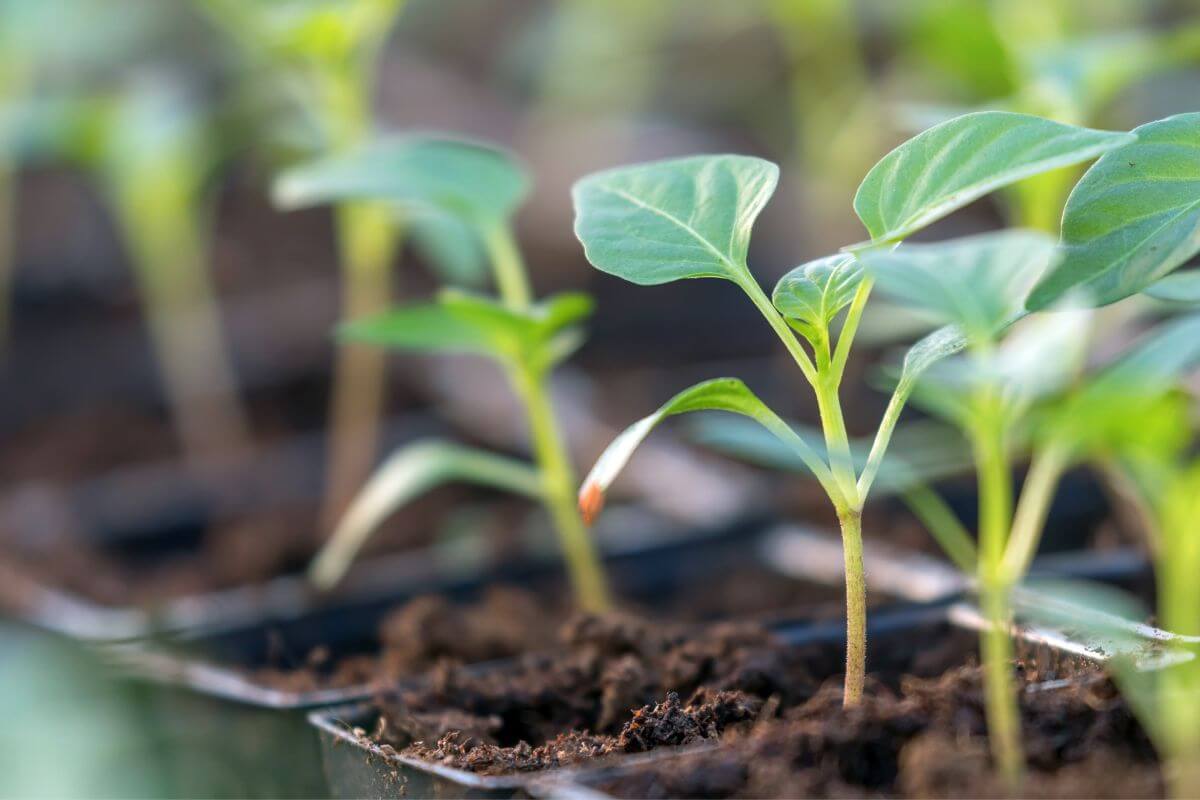
Despite this, every year I hear people talking about their completely stunted tomatoes sown in February, or I see photos of cucumbers taking over an entire shelf in the middle of winter. Clearly, some gardeners sow indoors too early and things go wrong for them.
That said, let’s be honest: some people sow early and are very successful. It is indeed possible to sow annuals, perennials, vegetables, or herbs indoors well before March and get good results. But it’s not for everyone. In fact, many greenhouse growers and market gardeners do it simply because they depend on early harvests for their income.
So how do they do it?
The problem with early sowing
First, let’s look at why seedlings started too early indoors are usually doomed to fail.
The first factor, unsurprisingly, is light. In winter, our interiors are dim: the sun is low on the horizon, the days are short, and the light is filtered by windows. Without adequate artificial lighting, the plants become spindly, their leaves turn pale, and their growth suffers.

Another important factor is temperature. Our homes are simply too warm to produce good seedlings. Plants need cooler nights. Without this drop in temperature, the tissues become soft and the stems fragile.
Indoor conditions are also too comfortable. There is no wind, so there is no mechanical stress to force the plants to strengthen and remain short and stocky. Indoors, seedlings often develop thin stems. The air is also drier, especially in winter, which causes the leaves to dry out. After a long stay indoors, it becomes difficult to acclimate the plants to outdoor conditions, increasing the risk of shock from sun, wind, or cold.
Finally, sowing too early almost always means a long stay in pots. The roots eventually become twisted or compressed, limiting the development of the root system. The roots can no longer keep up with the growth of the stems and leaves, creating an imbalance between the above-ground and below-ground parts. The foliage transpires profusely, but the roots do not provide enough water and nutrients, leading to wilting and stagnation. Contrary to what one might think, a large plant is not necessarily a healthy plant: it is often more vulnerable to transplant shock than a younger, better-adapted seedling.
10 tips for successful early sowing
If, despite everything, you decide to start your seedlings early, here are a few tips to help you succeed.
1. Provide bright artificial light
Contrary to popular belief, well-lit plants remain more compact because they don’t need to stretch to reach the light. Use horticultural or full-spectrum LED lamps, which provide the wavelengths necessary for plant growth.
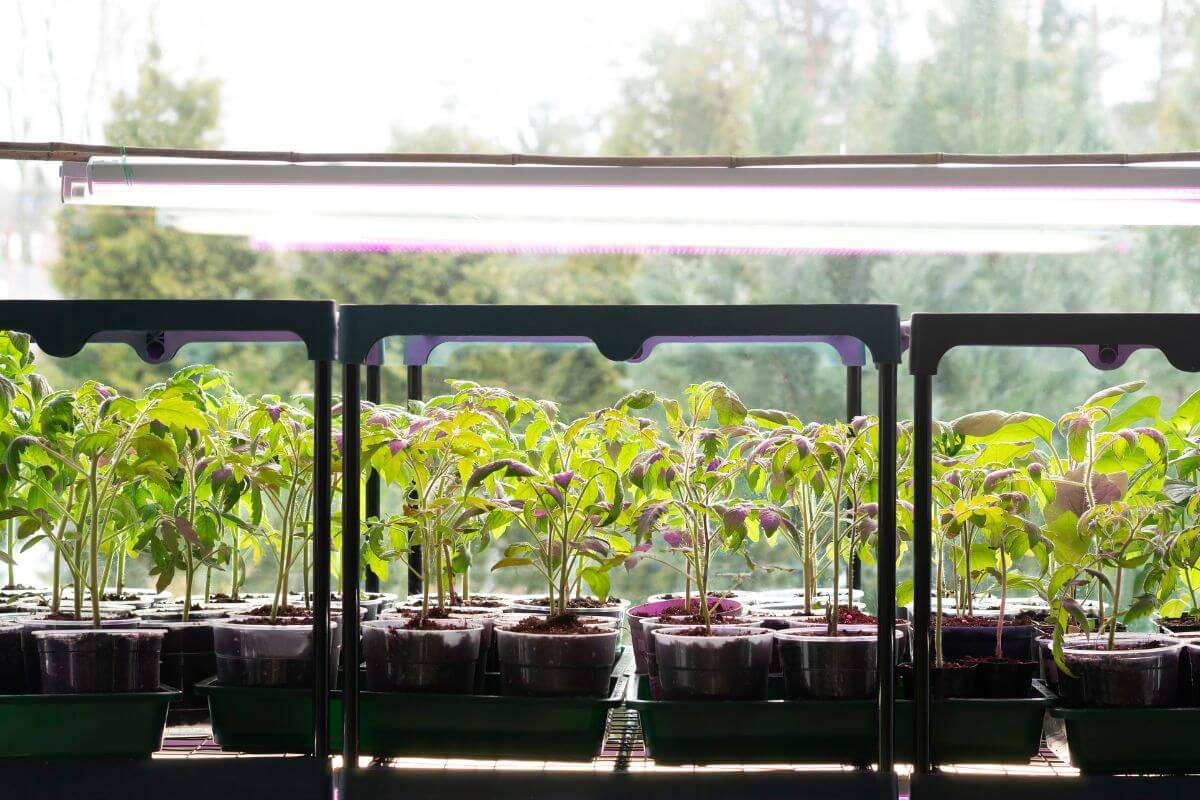
Program the lighting with a timer for 14 to 16 hours per day and place the lamps approximately 5 to 10 cm (2-4 inches) above the tops of the plants. In general, aim for an intensity of at least 150–200 µmol/m²/s, but 200–300 µmol/m²/s is ideal for early seedlings. Above this intensity, the light can become stressful and cause damage to the foliage.
Provide a system that allows you to easily adjust the height of the lamps (or plants) as they grow. Also, make sure that the plants are evenly distributed under the lamps: those in the center always receive more light than those on the sides. To compensate, move the containers regularly or rotate them a quarter turn each time you water them.
2. Keep cool nights
The temperature inside our homes is often too warm and too constant to produce good seedlings. Plants need real temperature variations, especially between day and night. These nighttime drops slow down height growth, limit etiolation, and promote the development of thicker, stronger stems. Cooler nights also slow plant respiration, allowing them to conserve the energy accumulated during the day and redirect it toward strengthening their tissues rather than growing too quickly.
For warm-climate vegetables such as tomatoes, peppers, chili peppers, and eggplants, daytime temperatures of about 22–24 °C (72–75 °F) and nighttime temperatures of about 16–18 °C (62–64 °F) are generally recommended. This difference is sufficient to keep plants compact without excessively slowing their development.
However, it is best to avoid nighttime temperatures below 12–13 °C (54–55 °F), as colder conditions can cause stress and lead to irregular or stunted growth.

Cool-weather vegetables, such as cabbage, broccoli, lettuce, onions, and leeks, tolerate low temperatures much better. They grow well at daytime temperatures of 16–20 °C (61–68 °F) and nighttime temperatures of 10–14 °C (50–57 °F). These conditions often produce very robust seedlings that are well adapted for transplanting outdoors.
To achieve these temperature differences, it is often easier to place seedlings in a separate, slightly cooler room, in a bright basement, or in a well-lit garage, where temperatures can naturally drop at night without any complex intervention.
3. Create air movement
When air is stagnant, plants develop thin, fragile stems. Air movement stimulates tissue strengthening and promotes the formation of shorter, stockier, and stronger plants.

A simple fan set to low speed is sufficient. The foliage should move slightly, without lying down or swaying heavily. A few hours of air circulation per day are more than enough to achieve this effect.
As an added bonus, the movement of air reduces stagnant moisture around the leaves, which reduces the incidence of fungal diseases, common in seedlings grown indoors for too long.
4. Control atmospheric humidity
Before germination, it is recommended to use a dome or plastic bag to maintain high humidity. However, as soon as the seedlings begin to sprout, it is important to remove this protection. Excessive humidity after sprouting promotes fungal diseases, including the dreaded damping-off.

Conversely, the air in our homes is often too dry, especially in winter. Atmospheric humidity of around 40 to 60% is generally ideal for growing seedlings. If the air is too dry, using a humidifier can be beneficial, especially in a room that is heated continuously.
Conversely, if the humidity becomes too high—as in a seedling room or small greenhouse—it is essential to ventilate regularly. Good air circulation and the right level of humidity will result in healthier plants that are less prone to disease.
A hygrometer is essential for measuring the atmospheric humidity in your seedling area.
5. Use a light, not overly rich, well-drained substrate.
Contrary to popular belief, it is neither necessary nor desirable to use very rich or heavily fertilized soil for seedlings. A substrate that is too nutritious stimulates rapid but weak growth, resulting in fragile plants that are more sensitive to stress.
Soils that are very rich in compost also tend to compact over time, reducing soil oxygenation and potentially suffocating the roots. In addition, compost introduces active soil biology: microorganisms that are beneficial in garden soil but can cause problems in a seedling substrate, where the roots are still immature. For this reason, garden compost should be avoided, as its maturity, composition, and microbial load are variable and difficult to control. It may contain pathogens, fungal spores, or concentrations of salts that are harmful to young seedlings.

That said, very mature, sifted, and stable compost from a controlled source can be used in very small quantities, solely as a soil amendment. In practice, the target is 5 to 10% of the total volume, no more.
For good seedlings, it is best to use a light, aerated, and well-drained substrate, such as sphagnum peat moss or coconut fiber, to which perlite or vermiculite is added to improve the structure. In these proportions, well-controlled compost provides light biological support without weighing down the substrate or hindering root development.
6. Fertilize sparingly
AInitially, fertilization is unnecessary, as seedlings mainly use the reserves contained in the seed. Adding fertilizer too early or in excessive quantities can cause osmotic stress and stimulate excessive and unbalanced growth, resulting in soft and fragile tissue.
Wait until the plants have 4 to 6 true leaves, a sign that the root system and photosynthesis are well established, before you start fertilizing. Use a very diluted solution, about a quarter of the recommended dose, to support growth without weakening the tissue or overloading the still-young root system.
7. Water accurately
A lack of water causes water stress, while too much water promotes root asphyxia, rot, and the development of fungal diseases. The goal is to keep the substrate evenly moist, without ever saturating it.
The simplest and most effective method is to water from below. Pour about 1 to 2 cm (1/2 inch) of water into the bottom of the seed tray where the pots are located. The substrate will then become moist through capillary action, often up to the surface. After 20 to 30 minutes, empty the excess water to prevent the roots from sitting in it for too long.

Watering from below helps prevent damping-off, as the base of the stem remains drier, where the fungi responsible for the disease most often attack.
Water again only when the surface of the substrate begins to dry out slightly.
8. Choose plants that are suitable for early sowing
Not all plants tolerate long periods indoors. This difference is mainly due to their growth rate, stress tolerance, and the type of root system they develop. Slow-growing plants with fine roots generally tolerate prolonged pot cultivation better, while fast-growing plants or those with taproots react poorly to confinement and repotting.

Peppers, chili peppers, eggplants, celery, onions, and leeks are among the plants best suited for early sowing, as their initial growth is slow and their roots tolerate transplanting well. Some slow-growing perennials and annuals also fall into this category.
Conversely, squash, cucumbers, melons, beans, corn, and sunflowers grow very quickly or develop roots that are sensitive to transplanting. These plants suffer quickly when left in pots for too long and rarely produce good results when sown too early indoors.
9. Managing containers and repotting
Early sowing necessarily involves a prolonged stay in pots, which increases the risk of roots twisting in the container or becoming compressed. When roots lack space, they curl up, lose some of their absorbent hairs, and become less effective at absorbing water and nutrients. This root constraint also triggers hormonal stress responses, which slow growth, even if light and temperature are adequate.
Over time, an imbalance develops: the foliage continues to grow, but the confined roots can no longer keep up. The plant then transpires more water than it can absorb, making it more vulnerable to wilting, stagnation, and transplant shock. Contrary to what one might think, a large potted plant is not necessarily healthy if its root system is constrained.

To limit these problems, choose containers that are deeper rather than wider, which encourage roots to grow downward rather than curl up. Repot as soon as the roots begin to fill the pot, without waiting for the plant to show visible signs of stress. In the case of seedlings started very early, it is normal—and often necessary—to repot several times before transplanting outdoors in order to maintain an active, functional root system capable of supporting future growth.
10. Using a greenhouse as a transition zone
In the final weeks before transplanting, seedlings grow rapidly: space becomes limited, temperature and lighting management become more difficult, and crowded plants can sometimes promote disease. In this context, a greenhouse can be very useful, because it serves as a bridge between indoors and outdoors.
In a greenhouse, plants receive much more intense natural light than indoors (and sometimes even too intense), as well as more dynamic air and naturally cooler nights. This combination helps seedlings stay more compact and speeds up hardening. Be careful, however: leaves grown indoors can burn if exposed to full sun too quickly; if necessary, acclimate them gradually or add light shade at the beginning.

Since a greenhouse can quickly overheat, ventilation is essential: doors, windows, automatic openings—whatever the method, you need to be able to remove heat. Ventilation also helps limit stagnant humidity and condensation, two factors that promote disease. Finally, in early spring, minimal heating or bringing seedlings back indoors may be necessary on very cold nights, especially for warm-climate vegetables. A greenhouse therefore requires a little monitoring, but it greatly improves the transition from seedlings to the garden.
Sow later to make life easier
I have to be honest with you. If I have detailed some of the methods used by professionals or advanced gardeners to successfully sow seeds early, it was not so much to encourage you to sow earlier, but rather to make you realize how complex this approach is, requiring time, attention, and equipment. My hope, in fact, was that you would come to the conclusion that it is often simpler and more effective to start your seedlings as late as possible, so that they spend as little time indoors as possible.
When to sow later?
My approach is quite simple. I start with the average date of the last frost, let’s say May 15. I add about two weeks to give myself a safety margin, knowing that this date is only an average and that a late frost can still occur every other year. These are then referred to as frost-free dates, even though, in gardening as in nature, nothing is ever completely guaranteed.

From that date onward, I follow the recommendations on seed packets or in gardening books. If they suggest sowing 6 to 8 weeks before the last frost, I usually choose the lower end of the range—that is, 6 weeks before my frost-free date. Why? Because for many plants, frost isn’t the only limiting factor.
Many crops also struggle with cool nighttime temperatures, even when conditions remain above freezing. Some plants slow their growth significantly below 15 °C (59 °F), others below 12 °C (54 °F) or even 10 °C (50 °F). Soil temperature and nighttime coolness therefore play just as important a role as the absence of frost when it comes to successful transplanting and early growth.
However, in this specific context, my seedlings sometimes remain indoors longer than the planned six weeks, sometimes up to eight weeks, simply because spring is slow to arrive or the nights remain too cold.
That said, all the advice presented in this article remains valid, regardless of when you sow your seeds. Adequate light, well-managed temperatures, controlled humidity, moderate fertilization, air circulation… the more you apply these principles, even without aiming for perfection, the more robust, balanced, and resilient your seedlings will be. They will then be much better prepared to face their transition to the outdoors. But that’s a story for another time.