


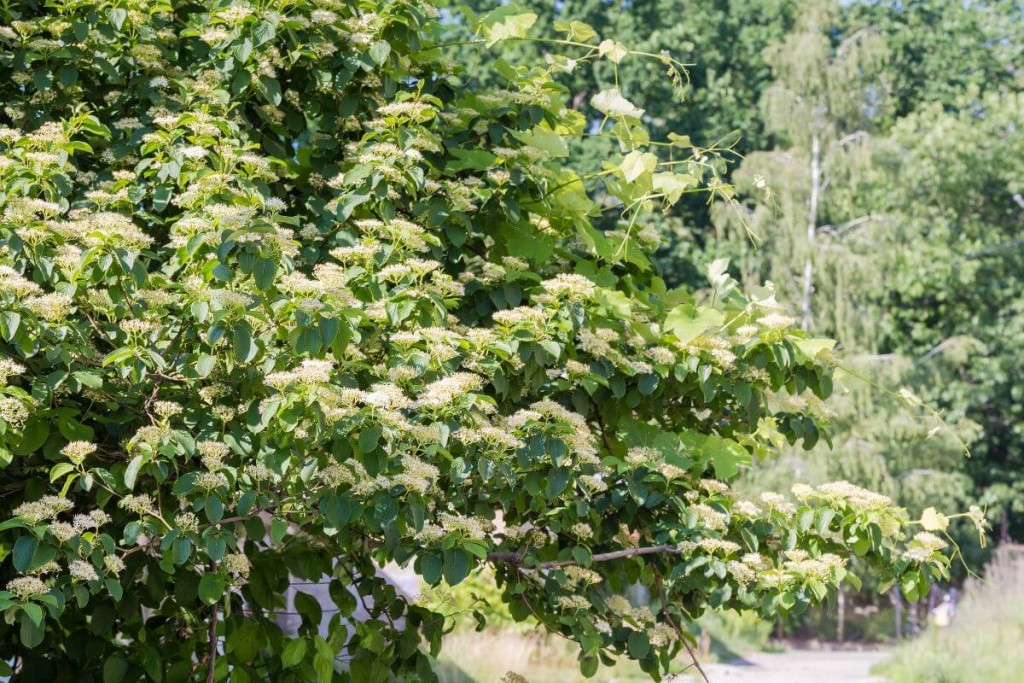
Last spring, I planted a small alternate-leaved dogwood, sold as a multi-stemmed shrub. In reality, I would have preferred the same plant, but trained as a single-stemmed tree; however, I was unable to find one. If I prune the secondary shoots every year to keep only one main trunk, will it eventually grow into an interesting tree?

Answer
There is an alternate-leaved dogwood or pagoda dogwood (Cornus alternifolia) in my father’s garden, and in my opinion, it is one of its main attractions. It is not the typical species, but rather a cultivar with variegated golden foliage, which explains its particularly bright colors. Having grown in partial shade, the tree is relatively slender and has few branches at the base, but its naturally tiered shape, formed by branches arranged in tiers, gives it an elegant and very distinctive look, making it a real focal point. In the fall, the foliage takes on subtle pink hues, further enhancing its visual appeal.
The pagoda dogwood is a species native to eastern North America, well suited to our climates. It prefers partial shade, although it tolerates sun if the soil remains cool, as well as soil rich in organic matter, cool and well-drained. It is an excellent choice for small gardens: it takes up little ground space, develops an architectural silhouette, and remains interesting throughout the seasons, even in winter when its structure is highlighted. Its blue-black fruits, produced in late summer, are very popular with birds, making it a valuable tree for local biodiversity.

Can it be trained as a single-trunk tree?
It is possible to train an alternate-leaved dogwood into a single-trunk tree, but it is important to understand that this is not its natural form. The species is programmed to develop multiple stems and a spreading silhouette; even when well trained, it will not form a long, straight trunk like a forest tree. The trunk will generally remain short, and branching will appear fairly close to the ground.

This growth pattern is directly linked to its growth habit. The alternate-leaved dogwood is a tree-like shrub, adapted to edge and open understory conditions. Rather than concentrating all its energy in a single dominant stem, it spreads its growth over several axes, allowing it to expand and capture light efficiently. It is this strategy, which is more horizontal than vertical, that explains both its tendency to produce several stems at the base and its naturally tiered habit, which is so characteristic.
How do producers manage to obtain a single trunk?
To successfully produce single-stem pagoda dogwoods, growers intervene very early in the plant’s life. From an early age, they select the straightest and most vigorous stem, called the “arrow,” and remove all other competing stems.
Subsequently, suckers at the base and unwanted shoots on the trunk are removed regularly.
This repeated pruning forces the plant to concentrate its growth on a single axis, allowing the trunk to gradually strengthen and thicken.
In some cases, especially for ornamental cultivars, grafting is used: the desired cultivar is grafted onto a rootstock from the typical species, which is more vigorous and stable. This technique makes it easier to obtain a straight, well-structured trunk from the outset.
All of this work requires several years of manual intervention, which explains why alternate-leaved dogwoods trained as single-trunk trees are rare and often more expensive on the market.
How to train a single-trunk dogwood
Start by choosing the straightest and strongest main stem, which will become your future trunk. Since dogwood wood is relatively flexible, installing a stake is highly recommended during the first few years to maintain good verticality while the trunk strengthens and thickens.
Basal shoots can be removed completely from the outset, without waiting, as they directly interfere with the formation of a single trunk by diverting the plant’s energy. You will need to remain vigilant and continue to remove them as soon as they appear, especially during the first few years.

Side branches, on the other hand, should be removed gradually. These branches, through their leaves, play an important role in photosynthesis and contribute to the thickening of the trunk. The lower branches should therefore be removed over several years, taking care never to remove more than 25% of the leaf mass in a single season.
Pruning period, health, and monitoring
Formative pruning is best done at the end of winter or very early spring, before the buds open. At this time, the tree’s structure is clearly visible, which makes pruning decisions easier and limits stress on the plant.
Alternate-leaved dogwood can be susceptible to golden canker (Cryptodiaporthe corni), particularly when under stress. It is therefore recommended that pruning tools be disinfected (with rubbing alcohol, for example) between cuts to reduce the risk of spreading disease.

Over time, once the trunk is well established, the bark has hardened, and the base of the tree is more shaded by its own canopy, suckers will generally decrease. However, you will still need to monitor them and remove them as necessary.
This will result in a small, elegant tree with a characteristic tiered shape that retains all the natural charm of the alternate-leaved dogwood.
Let’s face it, though: training a dogwood to a single trunk requires consistency and discipline that are not well suited to the lazy gardener, for whom the best pruning is often no pruning at all.