


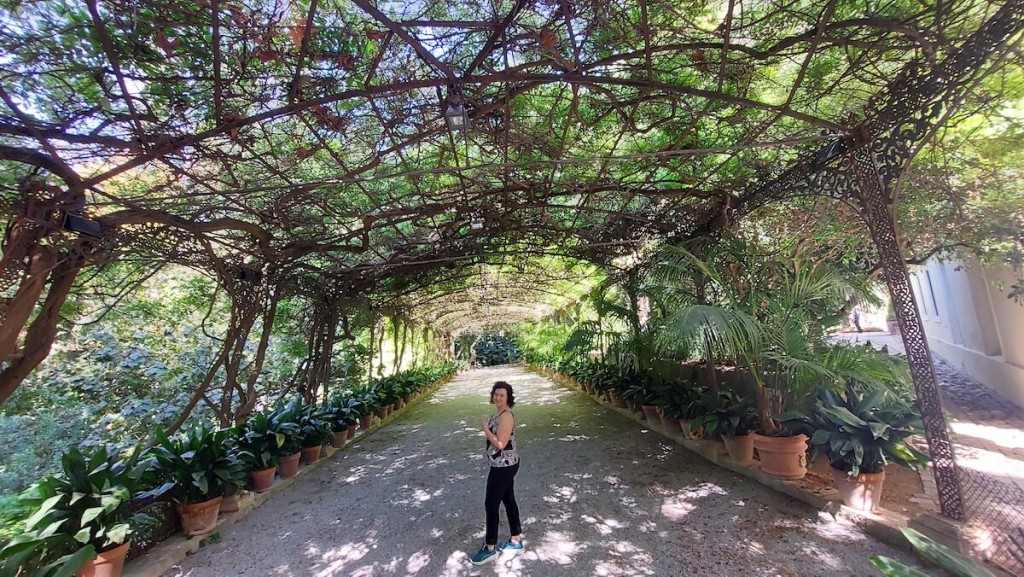
My partner and I have a well-documented problem: we can’t go on a trip without including at least one garden or natural setting in our itinerary. Our recent trip to Andalusia was no exception! According to guidebooks and tourist information, it was supposed to take two hours to tour the small historic botanical garden La Concepción (in Málaga).
It took us five. That pretty much sums up the wonderful visit we had!
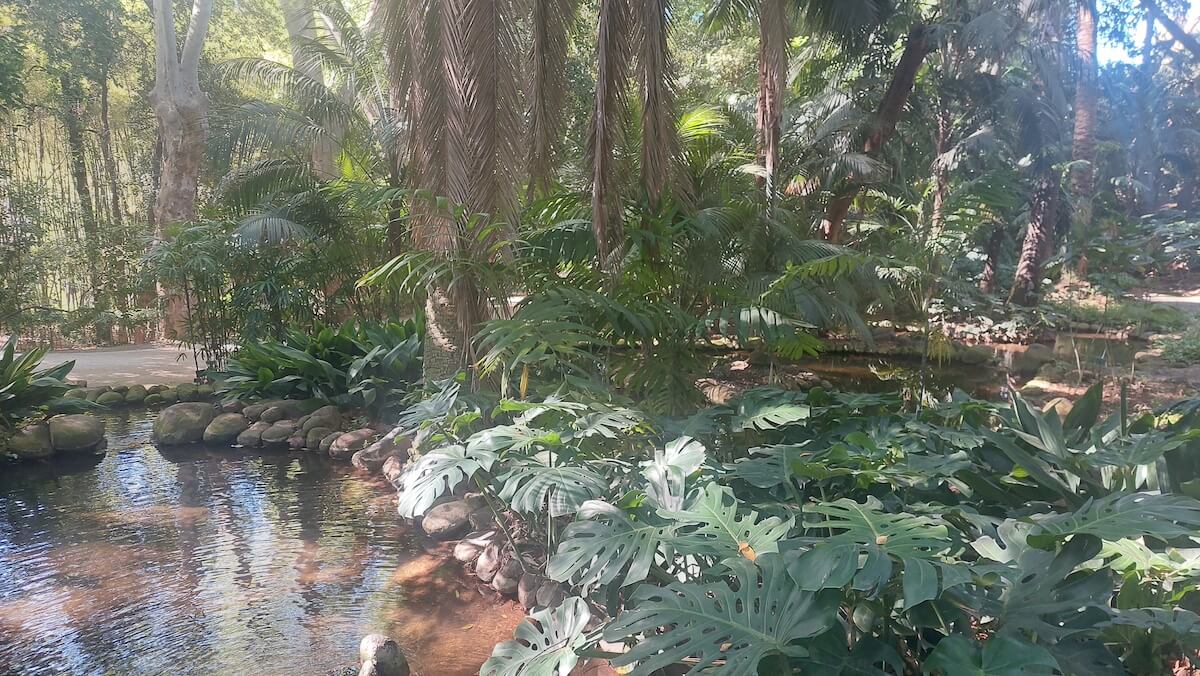
As promised in my last post: as soon as I got back, I sat down at my keyboard to tell you all about my discoveries (while massaging my sore calves and already missing the “sangria routine” that had become part of my daily life!)
A garden born from a honeymoon
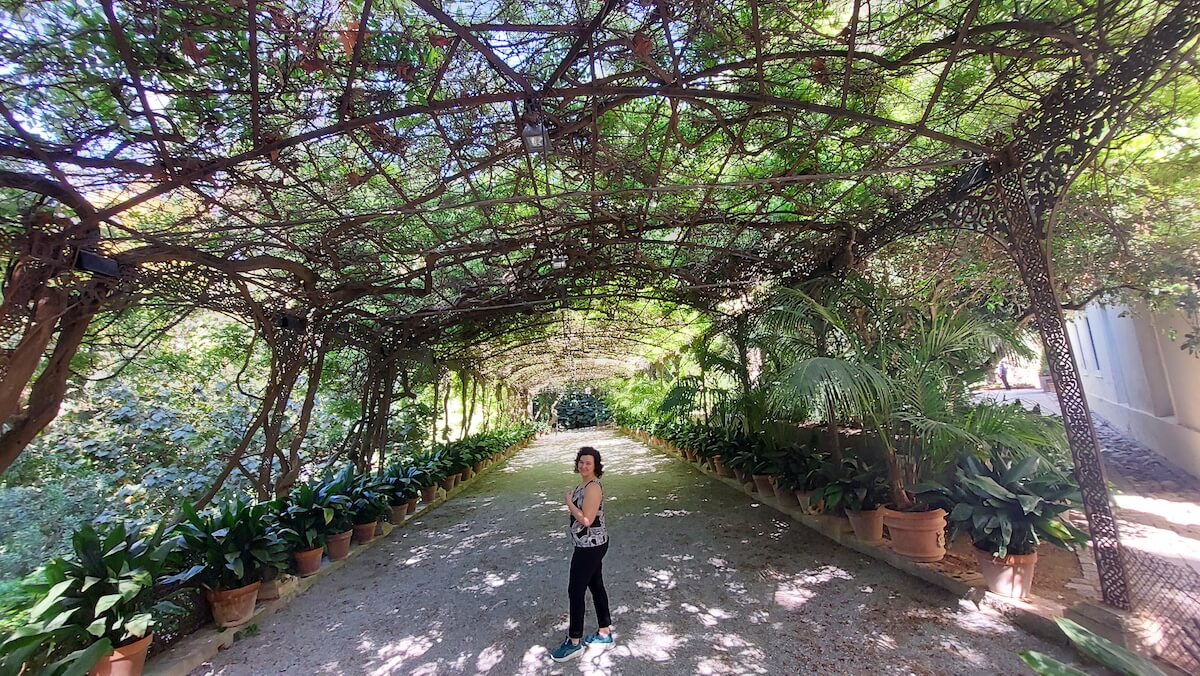
La Concepción is the story of love at first sight in the world of horticulture. In 1855, Marquis Jorge Loring and his wife Amalia Heredia returned from their honeymoon across Europe, their minds filled with the extraordinary gardens they had visited. Their new project? To build their own. They hired a French gardener, Jacint Chamoussant, who assembled for them a collection of plants from all corners of the world: Europe, the Americas, Asia, Africa, and Oceania. All set in a romantic English landscape style, complete with fountains, waterfalls, statues, and winding paths that disappear into the foliage.
Today, the historic central garden spans about 3 hectares of plant mazes, which one could theoretically walk through in an hour if one moves quickly—and if “moving quickly” is something one is capable of doing in a place like this. Surrounding this core, the City of Málaga, which purchased the site in 1990, has added themed gardens that bring the total area to 23 hectares: a forest trail (I’ll come back to this famous “forest trail”!), a cactus and succulent garden, one of Europe’s most diverse collections of palm trees, a sensory garden, a walk featuring eighty tree species from around the world, vineyards, olive groves… There’s something for everyone!
Another world
In my living room, I have a rubber plant (Ficus elastica) that’s about… let’s be generous: 20 cm (8 in) tall. It’s bravely fighting against the questionable care I give it. In La Concepción, I met its namesake: a creature whose roots form walls so tall and wide that I could have sat between two of them without being seen from the path. The photo doesn’t do justice to its immensity!
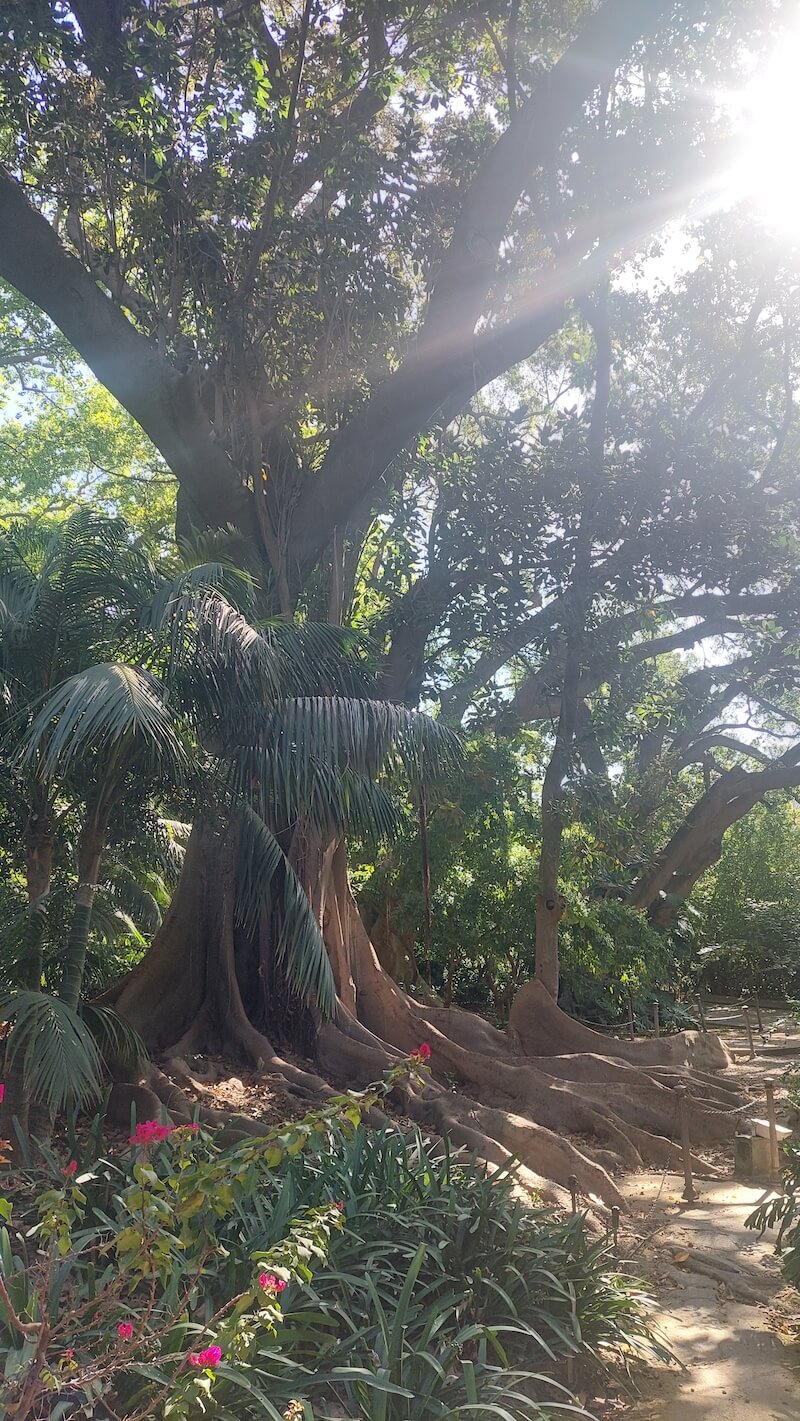
Same species, same name on the label (I had to search for it—poor thing, it was so tiny next to that tree with a trunk as wide as a house!). It was such a strange encounter—as if your house cat turned out to be, somewhere on another planet, Godzilla. And I’ve seen some huge rubber trees in my life: it’s a fairly common plant in cities with warm climates. But this one left me… speechless. The visit was off to a great start! A little further on, Norfolk pines (Araucaria heterophylla) so majestic, so ridiculously enormous, that I could never see the tops.

History and coexistence
That’s quite something. It’s worth noting that these enormous dragon trees (Dracaena sp.) and Canary Island pines (Pinus canariensis)—and all the others—have been standing there in the historic part of the garden for over 150 years. It feels special to come across them, not after a two-hour hike through a dense forest, but just sitting there, in a landscaped setting, covered in monstera and other climbing plants.
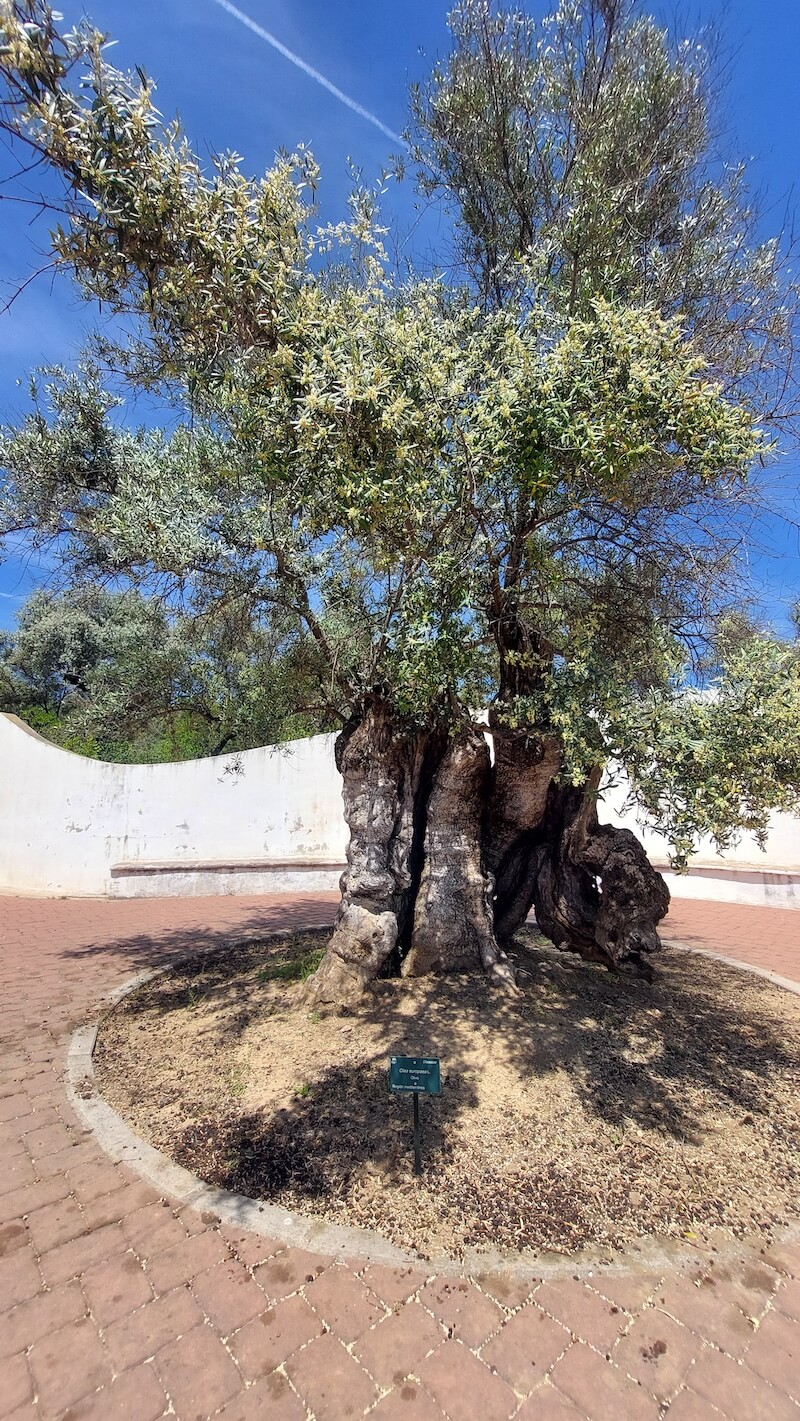
What struck me, even more than the size of the trees themselves, was how they coexist. Over a hundred species of palm trees, a bamboo forest, and conifers coexist harmoniously, as if they all shared the same origin and the same needs. Add to that the ponds, fountains, and waterfalls murmuring in every corner, the well-defined paths that blend seamlessly into the landscape… It’s a garden where you can sense the Andalusian touch, its global roots, and a long-standing love for nature. Honestly, Jorge and Amalia: good job!
The phantom scent
The real highlight of my visit wasn’t a tree or a fountain. It was a scent.
We had just stepped into the garden when it stopped us in our tracks. A fragrance somewhere between orange blossom and jasmine, but warmer and sweeter, more complex. We looked everywhere: no obvious flowers. A phantom scent, coming from nowhere. You should know that I’m very sensitive to smells, so as soon as I see a flower, I stick my nose right in… and I’m disappointed 90% of the time, because they rarely smell good unless they’re “florist favorites.” So I was VERY intrigued!
It took me a while to solve the mystery, but as I moved toward a sunnier spot, I finally spotted the elusive bloom: the Japanese (or Chinese) pittosporum (Pittosporum tobira). It’s a tall shrub, about 3–4 meters high, with dark green, glossy foliage and small white or yellow flowers clustered in bunches at the tips of the branches. In the shade of the undergrowth, the barely open flowers were already perfuming the entire area. In the sun, their scent wafted several meters in every direction. I finally realized that this was the plant that had been with me throughout my visit from the very beginning: it was everywhere! It was like a subtle olfactory thread, stretching from one end of the garden to the other.
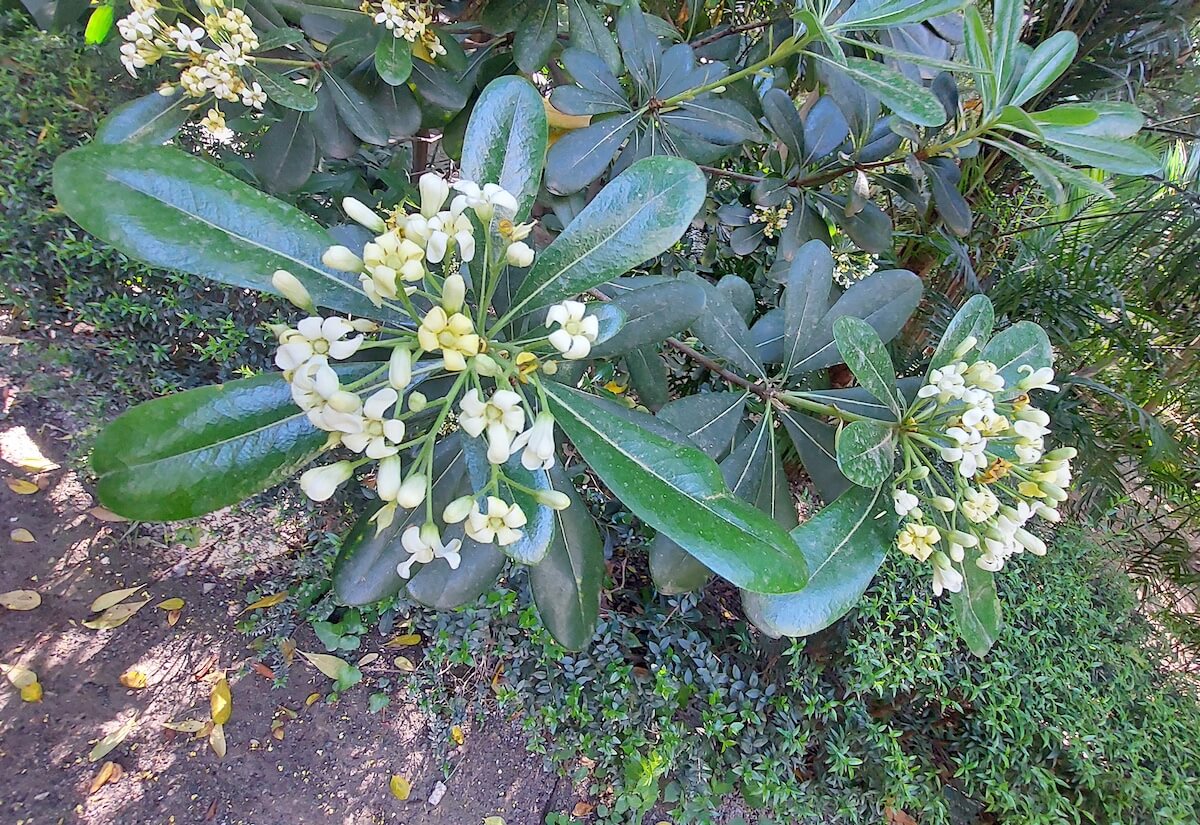
The Chinese pittosporum isn’t very well known here kin Canada—and that’s a shame, because it’s an absolutely charming plant. It’s available in pots, but it’s in the south of France and around the Mediterranean that it looks its best, forming fragrant hedges.
Coexisting biomes
While the historic garden impresses with its romantic elegance, the cactus garden is a completely different experience—and frankly surreal for someone from Quebec. Imagine: an elephant’s foot (Beaucarnea recurvata) standing outdoors next to a cypress hedge, with cacti from three continents and various desert roses as its neighbors. All of this together, under the blue Andalusian sky. Bonus: the cacti were in bloom, with half-open flower buds on every one!
After the cacti, we took the ruta forestal—which is “forest” in name only, at least in the sense we’d understand it in Canada. It’s an open, sunny path with a steep incline (I had to laugh as I wrote those words: it was such a steep hill that before we knew it, we were literally above the botanical garden!). To give you an idea of this trail, imagine a basket. The garden is inside the basket, and the forest trail is the handle sticking out on top—can you picture it? All along this path, you have a panoramic view of the mountains that make up the landscape and the gardens that look tiny down below, all accompanied by the sound of birdsong (and my heart racing from the exertion!).
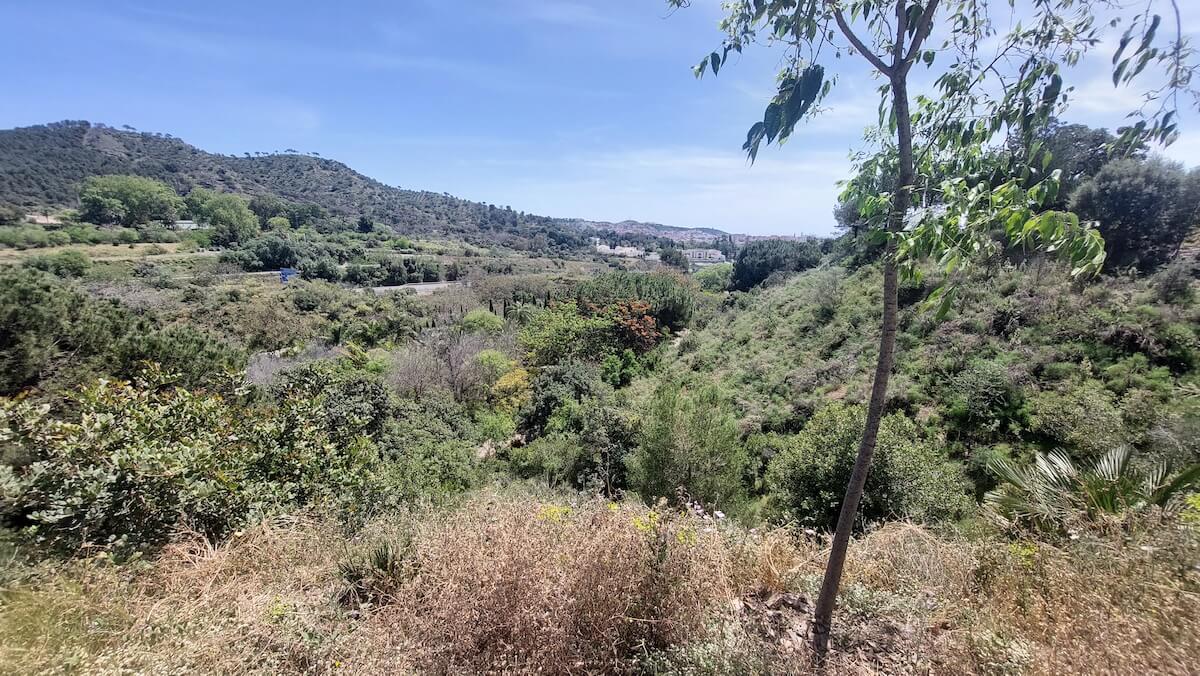
Our botanical gardens are usually flat; so seeing such varied terrain and views that change with elevation was a pleasant surprise. I’d still rename this forest road the “Forest HIKE,” just to be completely transparent with visitors!
The silence of the insects
One thing genuinely surprised me: the complete absence of insects. In April, in a garden in full bloom, near the water, with hundreds of plant species blossoming everywhere—not a single mosquito, not a single solitary bee, barely a white butterfly glimpsed out of the corner of my eye, and just a few domestic honeybees. Back home, in such a rich environment, you can’t open your mouth without swallowing something! In fact, even in April, when it freezes at night, there’s already a whole array of critters flitting about during the day!
I asked a local guide about it, who simply replied that they hadn’t “arrived yet.” Maybe it really is a matter of timing, but in any case, visiting a garden—or even a forest—under the sun with a dry 21°C (70°F), without any risk of choking on a fly… I won’t lie to you: I considered staying there!
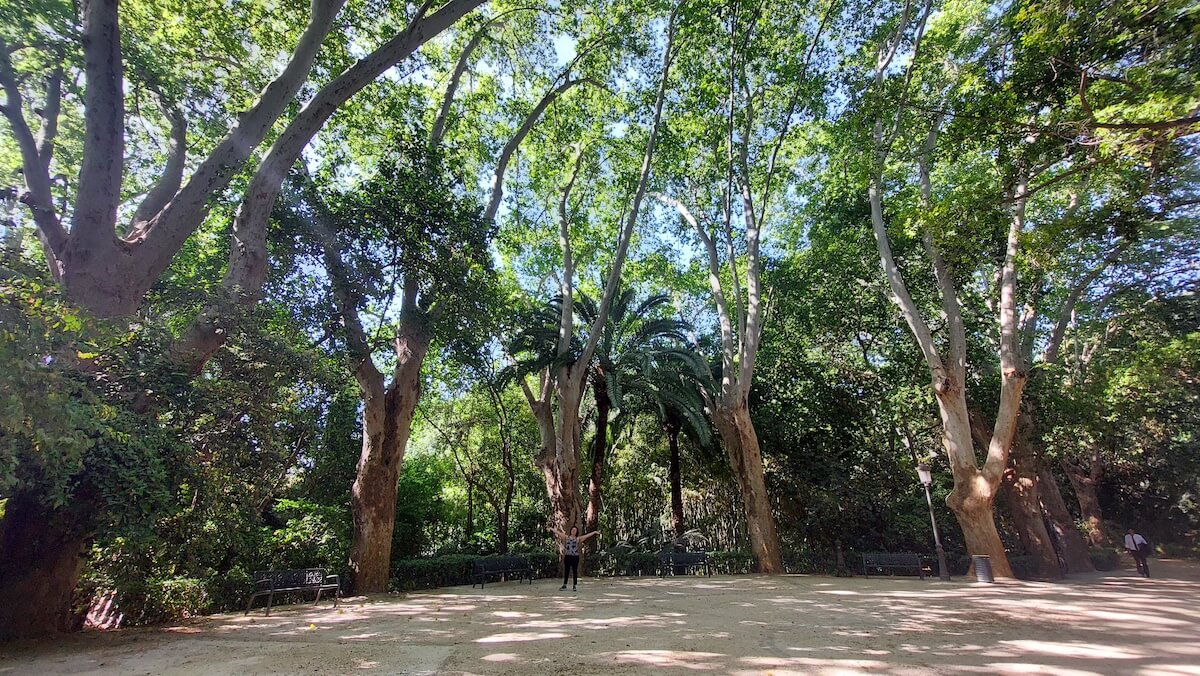
While we were resting in that “little” square, we saw lots of people in suits and ties walking by (look to the left!)… Strange attire for a Sunday morning in the park! But we figured it out later…
A bonus concert
Here’s what happened: as we rounded a corner in the garden, we heard music. The Malaga City Symphony Orchestra was warming up for an outdoor concert in the gardens. About twenty musicians, seated under the trees, all in formal attire: it was quite a serious affair. It was free, but you still needed a ticket… which we didn’t have. But one of the musicians, seeing us looking longingly at the program, handed us two tickets with a smile. We found ourselves sitting under century-old trees, surrounded by the scent of pittosporum, listening to classical music in a 170-year-old Spanish garden. Afternoons like that aren’t planned—they just happen.

For enthusiasts passing through
La Concepción is a garden that rewards those who take their time, the curious, those who touch the leaves and bury their noses in the flowers. It takes two to three hours to explore, but when you’re passionate about it, it’s easy to lose track of time and stay longer. Between the orange trees, the bamboo, the hibiscus path, and the world tour of trees, I could have gone on and on about this extraordinary place and its climate, which seems ideal for just about any plant! If you’re visiting southern Spain, fellow gardeners, don’t even think twice: add this place to your itinerary!