


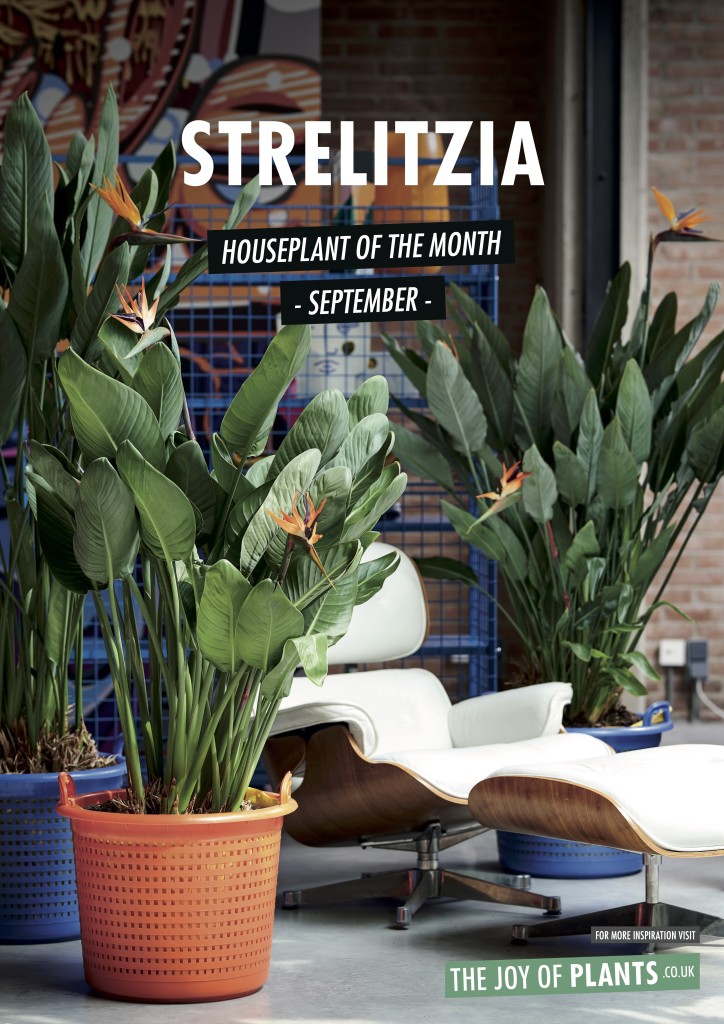
The strelitizia (Strelitizia reginae) is an eye-catching plant with a tropical appearance that certainly lives up to its most popular nickname: bird of paradise plant. This comes from the large flower that features a horizontal beak-like sheath topped by a crown of flowers, recalling the beak and head of one of the birds of paradise of New Guinea (family Paradisaeidae) or possibly an African crowned crane (it is also called crane flower).
The plant of about 3 to 4 feet in height and, eventually, 2.5 to 3 feet in diamètre (90 to1,20 cm by 75 to 90 cm) forms a fan of tough, thick, upright petioles each ending in a sturdy grayish paddle-shaped leaf. As the plant ages, it divides at the base, forming a clump of multiple plants. The bird of paradise is a striking enough in appearance to be grown strictly as a foliage plant, but its brilliantly colored bloom remains its main claim to fame.
Flowers can appear in any season, although mostly typically at the end of summer or in fall.


The blooms too are borne on a thick, sturdy stem. From the green, red-edged sheath arises a fan of vivid orange sepals and a pair of more horizontal purplish-blue petals joined together and forming a nectary. A series of flowers appears one after the other from the same sheath, so each flower head can remain in bloom a month or more.
Origin


In its native South Africa, the plant is pollinated by sunbirds. They land on a special perch formed at the tip of the petals. As they land, their weight opens the flower and reveals white pollen which the bird then picks up as it bends over to drink the flower’s nectar. Thus, as it moves from flower to flower, it pollinates the blooms. Since sunbirds of the proper species are absent outside southern Africa, bird of paradise flowers are not pollinated when it is grown elsewhere and therefore produce no seeds. If seeds are required, you have to pollinate them by hand.


The plant is a member of the tiny Strelitziaceae family, closely related to bananas and heliconias. There are five species, of which Strelitzia reginae is by far the best known. The plant is named after the wife of the King George III of England, Charlotte von Mecklenburg-Strelitz, who loved plants. The second name reginae means ‘of the Queen’. Birds of paradise were first cultivated outside of South Africa at the start of the 18th century and are now grown worldwide in tropical or Mediterranean climates as well as indoors.
Streltizias are also grown for the cut flower industry and flowers are shipped all over the world.
Strelitzia Range


There are various Strelitzia species, all upright with sturdy grayish leaves. As mentioned, S. reginae, with bright orange and blue flowers, is the most common species. A rarer cultivar, ‘Mandela’s Gold’, has yellow and blue flowers.


Narrow-leaved bird of paradise (S. juncea) is similar in size and color, but, curiously, when grown in full sun, produces no leaf blade, but rather just a long, pointed petiole, like a reed (that’s what juncea means).


A less well-known species is the giant or white bird of paradise (S. nicolai), a much bigger plant with larger, greener leaves that tear long the veins like a banana leaf, eventually forming a thick trunk-like stem. This species has white and deep purple flowers, but is much trickier to bring into flower. It’s therefore mostly used strictly as a decorative foliage plant when grown indoors. Outdoors, grown in the ground in tropical climates, it does bloom and can become a tree 20 feet (6 m) high!


Birds of paradise (Strelitzia) are sometimes confused with heliconias (Heliconia spp.). The flowers come in a similar color range, but are arranged quite differently, and the leaves are inevitably less leathery and are pure green, not grayish.
What to Look for When Buying a Bird of Paradise
- Check that the plant has fully developed flowers showing color or at least a flower bud clearly in view. Plants sold without flowers may take years before they produce their first bloom.
- The price usually reflects the maturity of the plant. Young plants, years from blooming, are often sold quite cheaply. Mature plants with bloom, probably at least 6 years old, will be much more expensive, but are worth the price.
- Plants with multiple flowers and plenty of foliage are the most expensive, as they can take a decade or more to grow, but also the most desirable, as once they reach this stage, they’ll likely bloom annually.
- Give the flower stem of plants on sale a bit of a tug. Some merchants try to rip off consumers by inserting an artificial flower into the pot to push sales. If its stem comes off in your hand, you are being misled.
- You can grow bird of paradise plants from seed, but expect to wait 6 to 10 years before they bloom.
- Make sure the plant is free of pests and diseases. The hard leaves and the plant’s structure lend themselves to pests such as aphids, scale insects and mealybugs that are hard to get rid of. Red spider mites can develop if conditions are too dry, which causes a gray discoloration of the leaves.
Did you know that the bird of paradise is the official flower of Los Angeles, California?
Care Tips
- The bird of paradise is a real sun worshipper: full sun will encourage flowering.
- Water your bird of paradise generously, particularly in summer, letting it dry out more in winter, and maintain good atmospheric humidity in order to prevent red spider mites.
- If the plant develops brown leaf tips, they can be trimmed off. Old withered leaves and flowers can be removed.
- Supply the fertilizer of your choice at one quarter the recommended frequency during the spring-through-fall growing season.
- In the summer, you can acclimatize your bird of paradise to outdoor conditions and put it on the patio or balcony.
- A cool period during the winter, with nights from 55 to 65 °F (13 to 18 °C), combined with reduced watering at that season, will help encourage your bird of paradise to flower again, but this is not strictly necessary. The real secret to repeat bloom is patience. After a first bloom, the plant will likely not bloom again for two or three years, but as plants grow older, flowering becomes an annual occurrence.
- Repot as needed using the potting mix of your choice when the plant’s roots threaten to split its container.
- You can divide plants with multiple stems, but the shock of the division can cause the plants to delay blooming for several years.
- You can plant bird of paradise plants outdoors as garden plants, but only where there is little to no danger of frost, as in USDA hardiness zones 10 to 12 and milder parts of zone 9. Even light frost can damage the leaves, buds and flowers, but, if cold temperatures don’t last more than 24 hours, it will often regrow from the base.
Display Tips


Incorporate industrial materials, bright colors such as yellow and blue and powerful patterns into your display. Line markings and graffiti designs suit bird of paradise well and fit with the interior deco trend that rejects perfection. In this style, real and artificial mix: you decide what you find beautiful.
The overall look can have a seventies vibe to really show off the bird of paradise’s on-trend credentials.
Text adapted from a press release by Thejoyofplants.co.uk.
Unless otherwise mention, photos also by Thejoyofplants.co.uk.
Styling by Elize Eveleens, Klimprodukties