


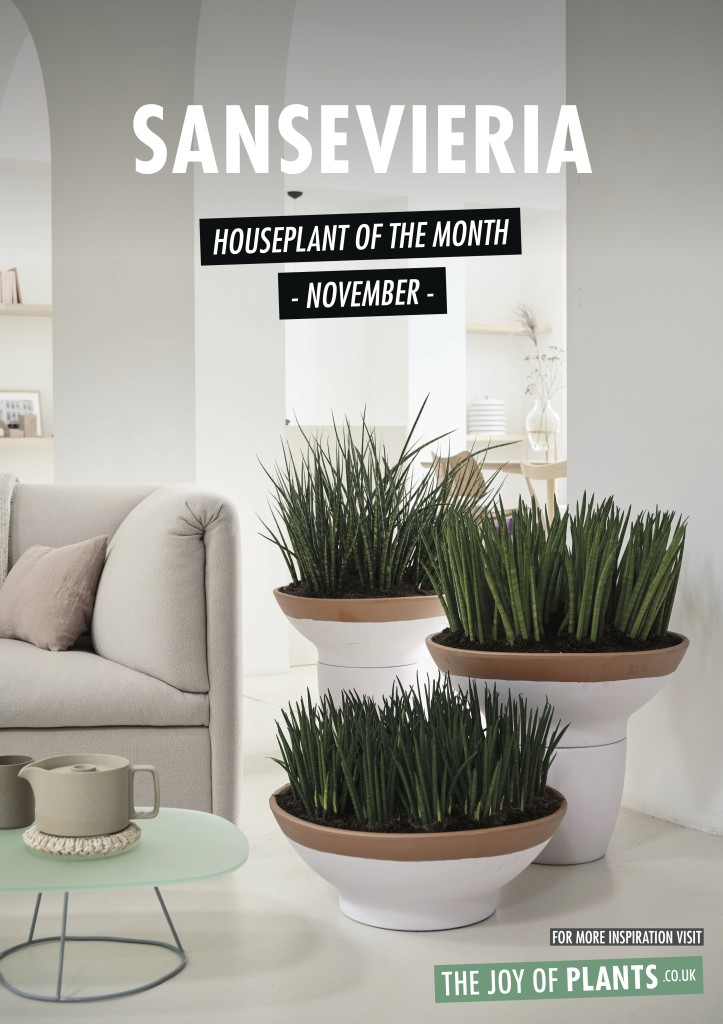
Photo: Thejoyofplants.co.uk, Styling by Elize Eveleens, Klimprodukties
The Story of the Sansevieria
The snake plant or sansevieria (Sansevieria trifasciata) is one of the world’s easiest and most widely grown houseplants and is also a common garden plant in tropical climates. The stemless plant produces thick upward-pointing, sword-shaped leaves with succulent properties.

The plant is called the snake plant because of its snakelike shape and markings and also mother-in-law’s tongue, because of its sharp tip, theoretically like sharp tongue of a critical mother-in-law. You may also hear the name bowstring hemp, because the tough leaves contain a fiber used in bowstrings, cordage, ropes, mats and nets.
Description
The coarse, fibrous leaves of the snake plant usually measure 28–35 in (70–90 cm) in height and 2 to 2 1/3 in (5–6 cm) wide, although under exceptional circumstances, they can reach over 6 ft (2 m) in height. Although flat towards the tip, at the base they are semicircular, fitting together in a tight rosette of usually 6 leaves. The leaves are dark green with distinctive light gray-green cross-banding.
The plant spreads by producing new rosettes at the tip of thick rhizomes. Indoors, it fills its pot; outdoors in the tropics, it forms an ever-expanding mass of spiky greenery.

Flower are rare indoors and only appear on plants that receive abundant light. They appear on upright stalks and are whitish or greenish. They’re also highly perfumed, but only at night. The flowers are sometimes followed by small orange berries. Each rosette will only bloom once, but doesn’t die afterwards, but rather produces offsets that will flower in their turn.
Did You Know?

That the genus Sansevieria has been transferred to a new genus, Dracaena? This surprising change doesn’t make any sense to the average gardener, as the upright-growing, treelike or shrubby dracenas with their soft leaves (many people will know the corn plant, D. fragrans, for example) and the hard-leaved, rhizome-producing sansevierias, most with no visible above-ground stem, look nothing alike. But they share very similar flowers, both in appearance and in delicious nighttime perfume. And it goes to say that both are in the Asparagaceae family.
For the purpose of this article, I’m sticking to the name Sansevieria, as on the market, they are only sold under that name, and hope that taxonomists will revise their reckoning. However, if you’re a hybridizer, maybe the two types could cross: imagine the possibilities!
Origin of the Snake Plant
The common sansevieria (S. trifasciata) is native to tropical Africa, from Nigeria to the Congo. The name Sansevieria honors the 18th-century scientist and inventor, Raimondo di Sangro, Prince of San Severo in Italy. It has been grown as a greenhouse plant for over 250 years, but only caught on as a houseplant in the 1920s when the famous department store chain, Woolworth’s, began offering it at only 5¢ per plant. Since it’s incredibly easy to grow and will put up with conditions that would kill most other plants, the snake plant has remained popular ever since.
Sansevieria Range

The snake plant has given a wide range of cultivars over the years, most starting as mutations from the original plant. The best known is Sansevieria trifasciata ‘Laurentii’, with long green leaves with a golden-yellow edge. ‘Bantel’s Sensation’, abundantly striped with white is fairly popular, as are ‘Moonshine’, with broader, shorter, silvery-green leaves, ‘Nelsonii’, with solid dark green leaves and no markings and ‘Black Gold’ with dark green leaves and transversal markings. Plus, there are many, many more of these “tall” sansevierias.

However, there is also another very different category: the bird’s-nest sansevierias. These derive from a mutation found in 1939 in New Orleans. Rather than tall, spearlike leaves that mostly grow straight up, these produce short, squat ones that arch a bit outwards, like a bird’s nest.
This first clone was called S. trifasciata ‘Hahni’ and has the same mottled coloration as the normal S. trifasciata, but many others followed, including ‘Golden Hahni’ with yellow bands along the leaf edges, ‘Silver Hahni’, with leaves heavily marbled in gray-green and ‘Black Dragon’, entirely dark green with no mottling whatsoever.

Then came the intermediate varieties, with broad leaves (up to 4 in/10 cm) half as long as the species, but still forming a sort of elongated, spreading bird’s nest. This includes the original, ‘Futura’, with gray-green marbling and a thin yellow edge, and a whole host of others, often mutations of ‘Futura’, such as ‘Futura Simplex’ with a broader yellow edge, or of ‘Robusta’, which is similar to ‘Futura’, but shorter.
You can usually find at least a few choices of all three groups (tall, intermediate and bird’s-nest) in most garden centers that sell houseplants.
Other Species to Try
Some 70 different species of Sansevieria are found throughout Africa, Madagascar and southern Asia. Many are grown as houseplants, but only a few have achieved any real popularity.

Since around 2004, a different species, the cylindrical snake plant (Sansevieria cylindrica, now more correctly Dracaena angolensis), and also called African spear, has also become very popular. Its pointed leaves are tubular rather than flat. They are green with lighter transverse bands and set in a fan-shaped rosette. It’s generally a more compact plant that S. trifasciata, but still, some specimens have been known to reach 6 feet (2 m) in height. I find it easier to bloom than S. trifasciata.

The cylindrical snake plant is often sold in the form of leaf cuttings either placed symmetrically or braided. These curious forms are produced on an industrial scale in Thailand and other Asian countries. Of course, the cuttings eventually produce normal plants and the abnormal shape, whatever it was, will be lost.

There are other species of sansevieria with cylindrical leaves, usually much thinner than those of S. cylindrica, including S. bacularis (sold as S. ‘Fernwood Mikado’).

And it doesn’t stop there! Some species are short and squat, others tall, some with broad leaves, others cylindrical, even more distinctly keeled. All seem easy to grow. Among those currently seen are S. ehrenbergii ‘Samurai Dwarf’ (‘Banana’) with a rosette of thick, short, boat-shaped leaves, the star sansevieria (S. kirkii), forming a flattened rosette of heavily marbled leaves, the whale fin or Mason Congo snake plant (S. masoniana) with often only one giant leaf flat leaf and one commonly called baseball bat (S. hallii) for its huge, thick, blue-green leaves that look like… you guessed it.
A Little Bit Poisonous
Sansevierias contain saponins which are mildly toxic to humans and pets (about as toxic as kitchen soap) and can lead to gastrointestinal upset if consumed, so keep them out of reach of pets or train them not to nibble on them. Serious poisonings are unlikely: the leaves are just too tough to ingest!
What to Look for When Buying Sansevierias

- Size: Look carefully at the pot size and the thickness and length of the leaves. On some plants the pot may be somewhat distorted by the enormous strength of the underground rhizomes. This can sometimes even cause the pots to tear open. In that case repotting is an urgent necessity.
- Leaves: On some varieties the way in which the leaves are trained or braided may be important to you.
- Health: Check that the plants are free of scale insects and mealybugs, corkiness or damaged leaf tips and that the roots are healthy.
- Rot: If sansevierias have been kept too wet for a long time they can suffer from rot. So, check that they are stable in the pot
Care Tips
Sansevierias are definitely low-care plants, ideal for beginning indoor gardeners.

- You’ll hear all sorts of things about the light needs of sansevierias, but the truth is that they prefer very bright light and are not afraid of full sun. Bright light will always give the healthiest, happiest plants. And only in bright light will they bloom. That said, they are incredibly tolerant of negligence, including poor light, and will grow for years in spots so dark few other plants can survive. Growth will be slow and the leaves may be weak and need staking, but hey! At least they survive low light and that has to count for something!
- Let the soil dry out between waterings, especially in the winter. Sansevierias definitely prefer to be too dry than too wet! Watering frequencies will necessarily vary according to conditions, from once every two weeks in bright light in summer to as little as once every 3 or 4 months under low light and cold conditions. When the soil is dry, do water, but do so thoroughly, moistening the entire root ball.
- Sansevierias with thick leaves, like S. cylindrica and S. ehrenbergii, need even less water than those with fairly thin leaves, like S. trifasicata.
- Do not pour water into the rosette of bird’s-nest sanseverias: they’re not bromeliads!
- Their succulent leaves mean that sansevierias cope well with dry air.
- The plant does not require a dormant period in winter, but can take temperatures down to 40?F (4ºC) if kept very dry, although a minimum of 55ºF (13ºC) is safer.
- The underground rhizome is incredibly strong and can distort and even crack the pot. Ideally, you’d repot it before it gets to that stage.
- Little to no fertilizer is required.
- Repot as needed into a well-drained potting mix. Standard potting mix or cactus mixes are fine.
Multiplication

- Sanseverias are best multiplied by division of plants with multiple rosettes, usually done spring through fall. Sections of rhizomes will also produce more offsets. Only these two methods will allow most cultivars, especially variegated ones, to be true to type.

- Almost all will grow from leaf cuttings (even sections of leaves will do!) set into fairly dry soil, although the traits of many cultivars (especially variegation) will be lost, as many are chimeras and only come true from division. Cuttings may take months before showing any signs of life, but as long as the leaf remains green, offsets are likely to appear.
- Sanseverias can readily be grown from seed, but this method is rarely used, because most will not be true to type (most cultivars will revert to the wild species). Also, it’s also a very slow method, taking years to produce a sizeable plant.
Did You Know?
That sanseverias are useful at filtering the air. The NASA Clean Air Study found S. trifasciata to be efficient in removing 4 of the 5 main toxins involved in the effects of sick building syndrome.
Display Tips for Sansevierias

People are increasingly seeking out nature and tranquility. Sansevieria fits perfectly with this with its simple clear shape. This can be emphasized by placing the plant in a mat cache-pot of a white or pale natural shade. Surprisingly enough, the effect is actually reinforced if the sansevieria is displayed as a “family” in the same style of pot.
Feng Shui ( ??)
According to Feng Shui principles, sansevierias bring good fortune into the home and ward off evil spirits. I find that to be only partly true. I’ve grown sansevierias for over 40 years and I still haven’t found fortune. However, I have not noticed any evil spirits hanging around either.
But do you really need Feng Shui as an excuse for growing sansevierias? I say just grow them because you like them!
Text partly based on a press release by Thejoyofplants.co.uk.