


By Larry Hodgson
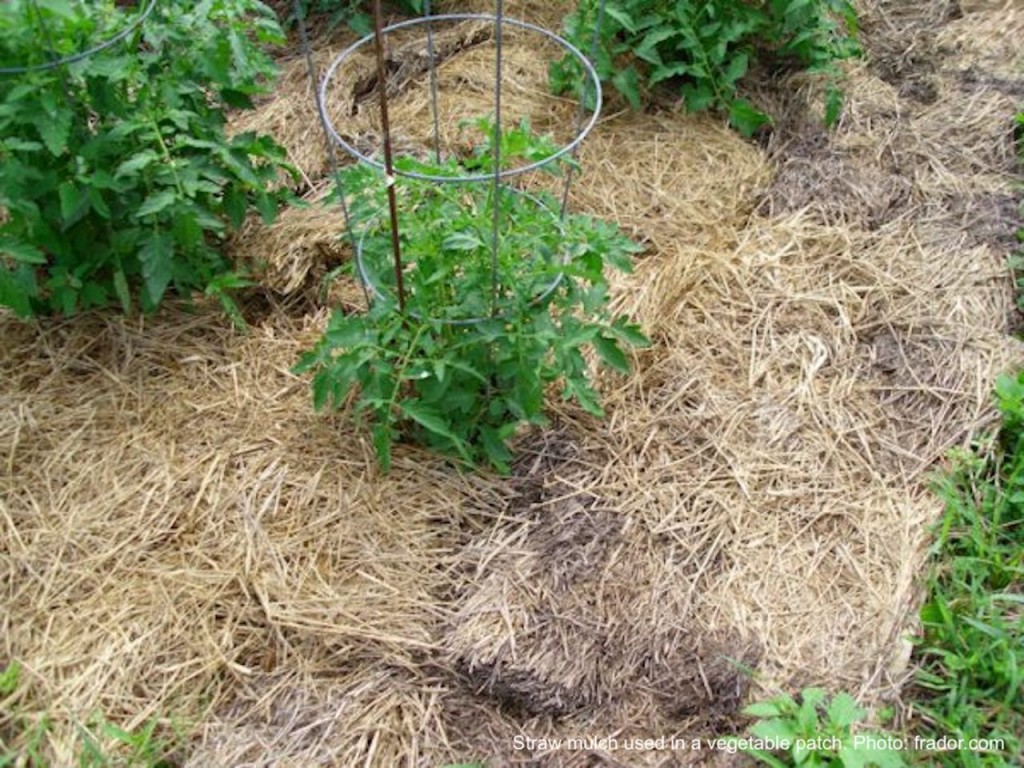
Mulching is one of the basic elements of “laidback gardening”. Mulch consists of a layer of usually organic matter about 3 to 4 inches (7–10 cm) thick covering the soil of a garden and thus creating a barrier between the air and its drying effect—and also against the seeds of the weeds being blown in—and the soil where the roots of your plants grow.
If you’ve never gardened with mulch, you will be amazed to discover how mulches—and especially the decomposable kinds—can make it easier to grow plants. Here are the main advantages of decomposable mulches:
- They keep most weed seeds from germinating;
- They help keep the soil moister in summer which greatly reduces the need for watering;
- They absorb excessive moisture at snow melt or after a heavy rain, helping to prevent root rot;
- Mulches keep the soil cooler in the summer. Even during a heat wave, the soil temperature can be many degrees lower than the air temperature, much to the delight of the plants;
- They protect the plants’ roots and crown against the extreme cold in winter;
- The soil warms up more slowly in the spring, which can prevent plants from budding out too early and thus from being damaged in a late frost;

- Mulches enrich the soil by decomposing, indeed, to such an extent that fertilizers often become almost superfluous;
- They keep the stems and leaves clean. Compare that to exposed soil which tends to coat plants in dust and dirt after a rainfall;
- They greatly reduce leaf diseases, largely because disease spores remain trapped under the mulch and can’t reach the leaves;
- Beneficial microbial flora and fauna flourish under organic mulch… and earthworms are on Cloud 9;
- There is a marked reduction in insects and other pests when mulch is used. This is largely because, under a mulch, the soil is no longer tilled, an action that tends to upset the habitat of the pests’ predators. As the numbers of predators increases, pest populations decrease—even the number of slugs drops! —, although this effect takes a few years to set in;
- Mulches completely eliminate the need for weeding or hoeing… and it’s the task most gardeners find the most tedious;
- Mulches protect plants against frost heave, that is, their crown and roots being lifted out of the ground by alternating freezing and thawing during the winter. Under mulch, crowns and roots tend to remain firmly in place, even when the plant is not yet well rooted;
- Mulches help prevent soil erosion, because they easily let rain penetrate;
- The soil remains friable, even after many years. That’s because it’s largely the force of rain falling on bare soil that makes it compact and impenetrable. When rain falls on mulch, it’s the spongy mulch that takes the hit, not the soil.
But There are Also Disadvantages

Nothing is perfect in this world and so it is with mulches. Their greatest sin is… they decompose over time and thus disappear, forcing the gardener to “top them up” regularly. But there are also other flaws, including:
- The soil under a mulch warms up more slowly in spring (note that this can also a plus: see above!) and some plants then come up or bloom a little later than usual. This delay usually clears up with the arrival of summer;
- Mulches enrich the soil by decomposing, which is detrimental to plants which prefer poor soil; you should normally avoid mulching such plants or else use a mulch that is poor in minerals like conifer needles;
- They keep the soil moister, to the chagrin of the minority of plants that prefer dry soil. Use only the best aerated mulches with these… again, such as conifer needles;
- Organic mulches can temporarily use up more nitrogen than they give off, yet plants need nitrogen for healthy growth and may therefore run out. This problem can be solved by applying a slow-release organic fertilizer rich in nitrogen before or after applying the mulch;
- Plants are unable to self-sow when there is a mulch in place. If this is something you want certain of your plants to do, you’ll have to leave a few spaces free of mulch.
The Best Mulches for Gardening

The best mulches for use in an active garden (one where you do a lot of planting and harvesting) are organic mulches that break down fairly quickly, because if a mulch remains intact for several years, it ends up filling in with dust and is then no longer very effective. When the layer of mulch thins decreases to less than 2 inches (4 cm), at which point light starts to sneak through the mulch and reach the soil which can allow weed seeds to germinate, the solution is fortunately simple: just add more mulch to bring it back into the 3 to 4-inch (7 to 10 cm) range!
But that does mean that mulches that last for a long time, even those of organic origin, such as bark mulch, cedar mulch and wood mulch in general, including all those tinted mulches that come in various colors, are not very good choices for a flower bed or vegetable garden.
Also, inorganic mulches (river pebbles, decorative stones, marble shards, lava stones, recycled glass mulch, rubber mulch, etc.), essentially permanent, are more decorative than anything else. You certainly do not want to mix them into the soil when you’re gardening!

Helpful Hint: Use readily decomposable mulches in flower beds and vegetable gardens, places where you’ll be frequently digging, planting and harvesting, while long-lasting mulches could be used outside of intensely gardened areas, such as in paths, at the foot of trees, in shrub borders, at the base of hedges, in foundation plantings, etc.
Here are some of the most interesting “decomposable mulches” for active gardening:
- Compost;
- Conifer needles* (needles are not rich, so it may help to also apply a slow-release fertilizer when you use them);
- First cut hay (later cuttings will likely include too many weed seeds);
- Fragmented rameal wood (BRF, deciduous branches shredded with their leaves);
- Grass clippings (they should be mixed with another product to lighten them, such as shredded leaves or peat moss; otherwise they can form an impenetrable crust);
- Plant hulls (peanut, cocoa, buckwheat, coconut, etc.);
- Sawdust (add nitrogen fertilizer initially, as this product is not very rich).

- Shredded fall leaves (my favorite mulch: free and very rich in minerals!);
- Shredded paper or cardboard;
- Straw (cereal, flax, hemp, etc.);
Mulches: when you learn how to use them, they can make gardening so much easier!