


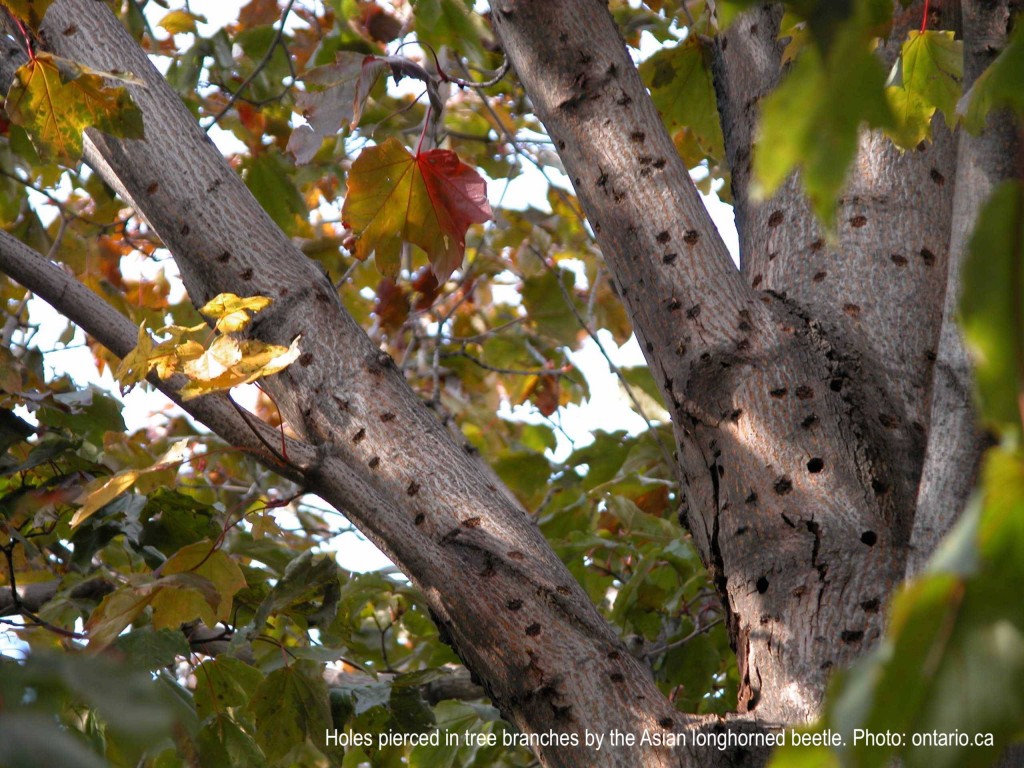
The following article was derived from a press release by the Canadian Food Inspection Agency and specifically concerns tree pest concerns in Canada. However, while specifics may vary, I find it could also be useful to gardeners and homeowners in the United States or Europe, as inspecting your trees for insect damage in August is an excellent idea throughout the Northern Hemisphere.
It is peak season for adult wood-boring insects to be spotted outside of trees, and their impacts are most obvious in the summer. Invasive pests like the emerald ash borer, gypsy moth (Lymantria dispar dispar) and hemlock woolly adelgid are serious threats to Canada’s economy, environment and society. This August, the Canadian Food Inspection Agency (CFIA) encourages everyone in Canada to take an active role in protecting Canada’s plants by joining plant health enthusiasts from coast to coast to coast who will be participating in Tree Check Month.
It only takes a few minutes to check, so please take a quick trip outside to inspect the trees in your yard or in and around your community. Start by looking at the whole tree, then focus on specific areas. Look for unusual or sudden changes in tree health, including leaf discolouration, bark cracks, insect holes and tunnels under bark that has come off. Start your inspection at the roots, move up the trunk and along the branches, looking for noticeable insect populations and evidence of feeding activity on the leaves.
Everyone in Canada is encouraged to share photos of invasive species on social media using the hashtag #TreeCheckMonth. Contact the CFIA with any suspicious finds for your area, especially if you see the spotted lanternfly for example—an insect that we want to keep out of Canada. The sooner the CFIA receives a report that a new pest has been found or a known pest is in a new area, the quicker CFIA scientists can investigate the source and prevent further spread.
By becoming familiar with pests in your community and by participating in Canada’s Plant Health Hero Challenge, you can help spread the word about Tree Check Month and the importance of plant protection. Use the hashtag #TreeCheckMonth when reporting your actions and in your conversations on social media. Although the International Year of Plant Health has just ended, vigilance is still key, and everyone in Canada can play an important role in keeping our plants and trees healthy to lay the foundation for a better future.
Quotes
“By taking action this Tree Check Month, you’ll help keep our beautiful landscapes free from invasive species. Together, we can protect Canada’s plant resource base while supporting continued economic growth.”
—The Honourable Marie-Claude Bibeau, Minister of Agriculture and Agri-Food
“Let’s all get involved in Tree Check Month this August. When we make discoveries in our own backyards and report them, we are contributing to community science. The early detection and reporting of pests in Canada allows the CFIA to act fast to protect our health and well-being.”
—Dr. Bill Anderson, Chief Plant Health Officer for Canada and Executive Director, Plant Health and Biosecurity, CFIA
Quick facts
The Canadian Food Inspection Agency (CFIA) dubbed August as Tree Check Month to mobilize community scientists and help keep Canada’s trees healthy and free from invasive species and pests.
Canada’s Plant Health Hero Challenge is a social media campaign aimed at increasing awareness about the importance of plant health in Canada, by inspiring people to participate in certain plant health activities and report their actions via social media using the hashtag #CDNPlantHero.
Some of the CFIA’s pests of concern include the following:

- The emerald ash borer (EAB) has spread to parts of five provinces (New Brunswick, Nova Scotia, Quebec, Ontario and Manitoba) and has killed millions of ash trees across North America. If you see it outside of these provinces, report it to your local CFIA office.

- The hemlock woolly adelgid (HWA) is threatening hemlock trees in British Columbia, Nova Scotia, and parts of Ontario. Survey activities for this pest are ongoing and measures are in place to contain it. Report all sightings outside of British Columbia to the CFIA.

- Oak wilt is established in the United States and is a risk to oak trees across Canada. Report all sightings.

- Spotted lanternfly is not known to exist in Canada but was added to the regulated pest list in 2018 in an effort to prevent its introduction from infested areas in the United States and elsewhere. Report all sightings.

- Japanese beetle has established in most parts of the country where it can survive – but not British Columbia. The CFIA, the City of Vancouver and the Province of British Columbia are actively working to eradicate it from Vancouver so it doesn’t become established in that province. Alert your local CFIA office to suspected sightings in British Columbia.

- Box tree moth was detected in Toronto in August 2018 by a citizen scientist. The CFIA is working with the Province of Ontario, the City of Toronto and other organizations to stop its spread. Report all sightings or any feeding damage on boxwood outside of the Greater Toronto Area.

- The Asian longhorned beetle (ALHB) was eradicated from the cities of Mississauga and Toronto in Ontario after five years of surveys with no detection of this plant pest. Verification surveys are ongoing, so report all sightings to your local CFIA office.

- Gypsy moth or LDD (Lymantria dispar dispar) is established in many areas east of the Manitoba–Ontario border. If you find it outside the regulated area, including in Newfoundland and Labrador or western Canada, report it to the CFIA.


Don’t Move Firewood. One of the most common ways pests travel to new locations is by hitching a ride in firewood. A best practice is to always buy firewood where you’ll burn it or purchase heat-treated or kiln-dried firewood to be sure that no invasive insects are hiding inside.
The CFIA (Canadian Food Inspection Agency) is the National Plant Protection Organization for Canada and is responsible for setting and implementing plant-health regulations, policies and programs that are consistent with international standards and trade rules.