


By Larry Hodgson
It’s your first experience with houseplants. So, you choose a flowering plant of extraordinary beauty and bring it home, proud of your choice … and it immediately begins to go downhill. It’s a double disappointment: loss of the plant and loss of your illusions, as your hope that you might have a green thumb are dashed.
But this disaster doesn’t conclusively prove that you’re not good with plants, as most flowering plants are difficult to keep alive and healthy, even for experts. So, why not get started with truly easy houseplants?
Here are 7 practically unkillable houseplants, all foliage plants, that are much better suited to your first plunge into art of growing plants indoors.
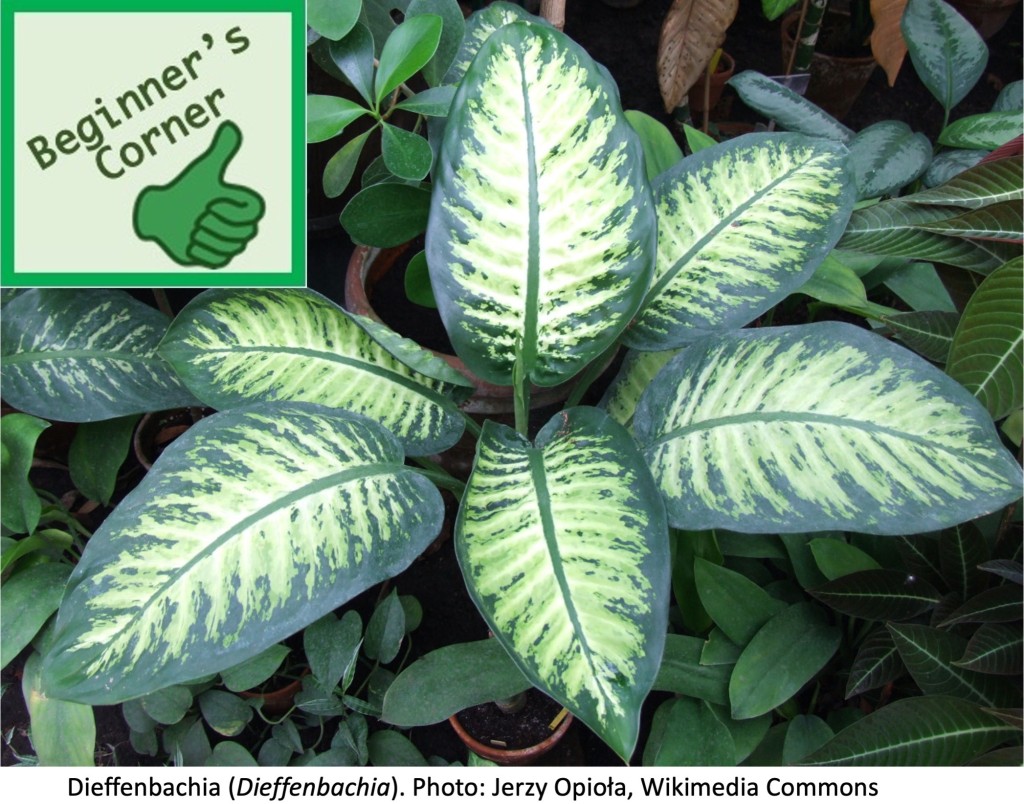
Dieffenbachia (Dieffenbachia): usually a very large plant with a thick stem that rises ever so slowly towards the ceiling. The long, broad leaves are mottled white or yellow. Any location protected from full sun is suitable. Water when the soil is dry. When the plant reaches the ceiling, cut off its top and try your first experience at taking cuttings.

Corn Plant (Dracaena fragrans): Sometimes called dragon tree, this thick-stemmed plant produces long, lance-shaped leaves that first arch upwards and then downwards. And it does look like a corn plant (Zea mays), although there is no true relation between the two. It’s grown as a foliage plant, but mature specimens occasionally produce fragrant flowers. Any light situation—as long as there is some light!—is suitable. Just water it when it’s dry!

ZZ plant (Zamioculcas zamiifolia): with its pinnate leaves of shiny dark green leaflets forming a flared rosette, it looks like a fern or a palm with thick petioles, even though it is more closely related to the philodendron. Give it at least a little light and water it only when the soil is dry to the touch.

Fiddle-Leaf Fig (Ficus lyrata): This plant hides an often gnarled woody stem that produces huge, glossy, violin-shaped leaves. Don’t be afraid to cut back this indoor tree before it hits the ceiling! Any lighting from intense to low is suitable. Water it when the soil is almost dry.

Heart Leaf Philodendron (Philodendron hederaceum oxycardium, syn. P. scandens oxycardium): it produces dark green, heart-shaped leaves on wandering stems. This philodendron adapts to all types of light except full sun and only needs an occasional but thorough watering when its soil is dry to the touch. The stems can be trained onto a trellis or obelisk or allowed to drip down from a hanging basket.

Jade plant or crassula (Crassula ovata): a bonsai-like succulent plant with swollen brown stems and thick, spoon-shaped leaves. It prefers full sun, but tolerates much less. Wait until the soil is completely dry before watering it.

Snake Plant (Sansevieria trifasciata, now Dracaena trifasciata): also called mother-in-law’s tongue, it produces long, very upright, pointed leaves marbled in gray. They rise straight out of the ground, without a stem. It tolerates both full sun and deep shade. Water only when the soil is quite dry, as it’s a succulent (a plant adapted to arid conditions).
And there you go! Practice your budding horticultural talents on these tough plants until you’ve gotten the hang of growing plants indoors. Then you can try flowering plants, always much more delicate.