


It can no longer be denied: fall has arrived. The leaves are falling off the trees, some plats are getting frostbite, the nights are getting cooler: summer is far away. So, it’s time to think about protecting our plants for the winter.

Winter protection is popular in my region, Eastern Quebec. Conifers are wrapped up like mummies and hedges covered with neon orange snow fences are numerous here all winter long. .
However, such protections are seldom necessary and can even seriously damage the shrubs they are meant to protect. If you have chosen plants that are well adapted to your climate and placed them in suitable locations, they should not need any protection.

Discreet Winter Protection
The most important thing for all plants is, of course, to protect their roots. Roots are the most delicate part of the plant, much more than the branches, the leaves or the needles. People who protect the branches and other aerial parts of their plants, but leave the roots exposed to the cold, risk seeing them damaged anyway.
The best winter protection is to cover the roots with 3-4 inches (7 to 10 cm) of mulch. You can buy mulch or use your own shredded fall leaves. Shredded leaves do not blow away and give excellent winter protection. I also suggest leaving the fall leaves in your flowerbeds on the ground. By falling at the base of the plants you want to keep, they help insulate the roots.

For plants which are a little more prone to winter blight, such as conifers and rhododendrons, it is doubly important to ensure that their root system is well protected. They lose moisture in winter due to their leaves. Plants transpire and lose moisture through their leaves. But, since the ground is frozen in winter, they cannot absorb as much water through their roots. It is therefore necessary not only to apply a mulch, but also to water them in autumn if rain is lacking. Do so until the ground freezes.
Extra Protection
For shrubs or conifers that are at risk of bending under the weight of snow (especially pyramidal cedars), the first line of defense is to avoid locations subject to rapid snowfall, such as under a roof overhang. If necessary, push a sturdy, neutral-coloured stake into the ground, on the less visible side of the plant, and tie the plant to the stake with a sturdy, discreetly colored wire or a transparent net. Do not overtighten! (You see a lot of people damaging their shrubs by wanting to straighten them too much). Just wrap them gently, that’s all. When this work is well done, you should not even see the difference.

Roses: A Special Case?
In the past, it was customary to mound roses in the fall and cover them with a rose cone… but that was at the time of the hybrid tea and grandiflora roses , which were not very hardy. Nowadays, these roses are less and less cultivated, having given way to rustic roses. And the name says it all: a hardy rose bush is hardy! So cold-hardy, it doesn’t need winter protection.

Freshly Planted Evergreens and Shrubs
The only time visible winter protection can be useful is on newly installed plants.
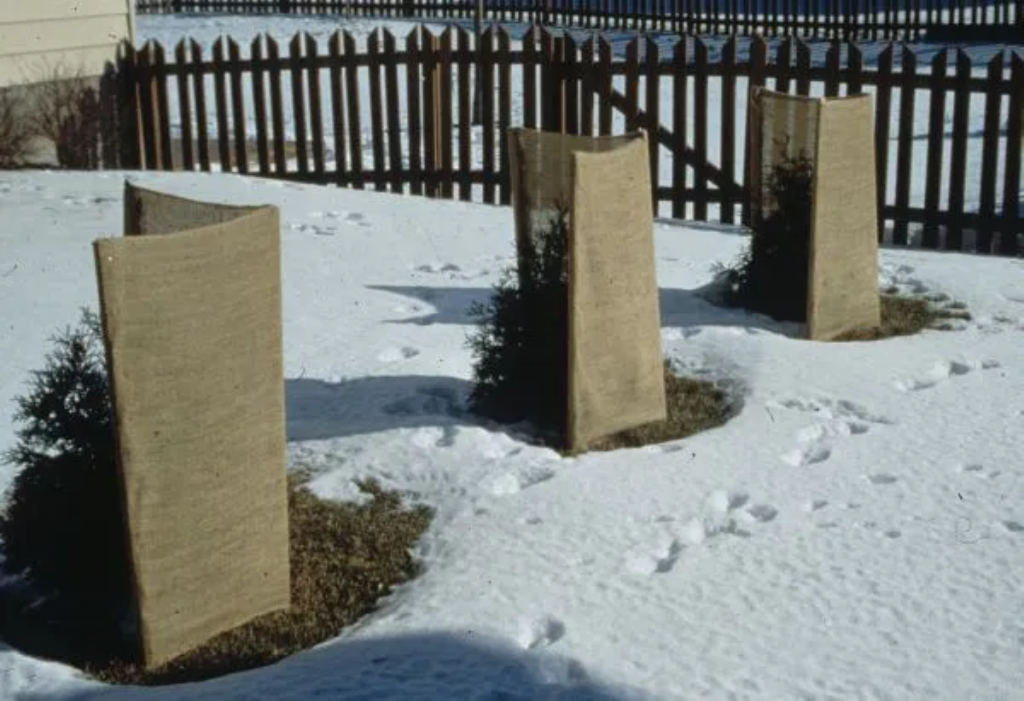
Trees, shrubs and conifers planted in the fall did not necessarily have time to take root properly before the onset of cold weather. Mulch is useful to help them survive the winter, but is not always enough. It is therefore useful to protect them from the prevailing wind by placing two stakes on the northwest side of the shrub and attaching a piece of burlap or agrotextile (geotextile) to them. However, the fabric must not touch the plant, otherwise there is a danger of burning.
Some people prefer to set four stakes and surround the entire shrub , forming a sort of open tube. Leave the top open. It is essential that the plant can breathe at all times and that the heat can be evacuated. At the end of winter especially, there can be sudden rises in temperature. And that’s when plants tend to overheat. To this end, never close the top of your protection.
Good winter protection is essentially invisible. It can be easy and discreet and at the same time effective. It is a question of using common sense rather than embarking on heavy protection which will make your whole landscape ugly.