


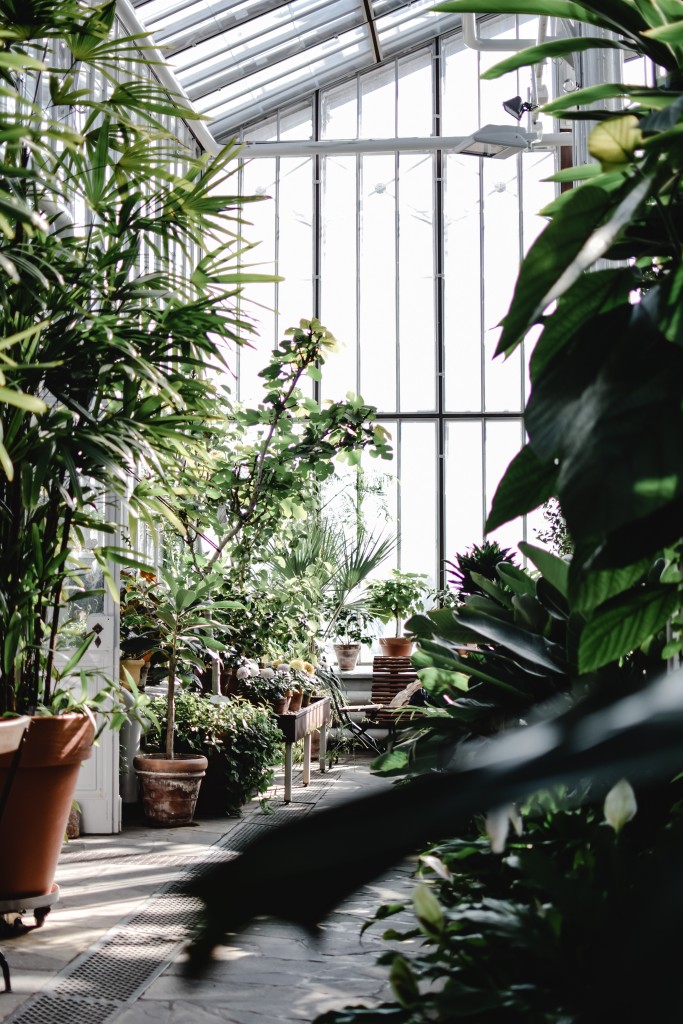
Last summer, I wanted to add some houseplants to my (small) collection. But as is often the case, I ran out of time. Work, family responsibilities, gardening! All good reasons not to carry out our projects. On top of that, I’m a landscaper, so I work a lot from spring to winter.
Never mind, you say, winter is coming, the gardens will soon be closed. Then, after all, you have time to buy new houseplants. The catch is that winter is the worst time to do it.
I can hear you all booing!
Yes, I know you’re disappointed, just like me. Now that I’ve ruined your lives, let me explain why. It comes down to three things: low light, dry air and cold.

The Great Darkness
On the summer solstice in Quebec, we get about 15 hours and 30 minutes of sunshine. I imagine that the situation is similar in Canada, the United States and Europe, where many of our readers live. On the winter solstice, there are only 8.5 hours left! That’s a huge difference! That’s almost half as much. Your houseplants find it very difficult to adapt, but at least they can get used to the situation gradually. This is not the case for plants adopted in winter, which cannot help but be traumatized by the contrast.
If you buy a plant that has grown in a greenhouse, with artificial lighting that works 12 to 18 hours a day to accelerate its growth, and it suddenly finds itself near a north-facing window with 8 hours of sunlight, it’ll definitely take a hit! It’s a bit like going from a vacation on the beach in a tropical country to a Canadian half-basement in the middle of January: it’s depressing!
I’m exaggerating just a little for dramatic effect. Sure, you can add artificial lighting and put your plants in front of the sunniest window. And you should do all of these things… but for the plants you already have. As for plants you adopt in winter, in the best-case scenario, they would leave the ideal environment of a greenhouse and go into the adequate environment of your home. They’ll still have a tough go at it.

Northern Desert
Depending on the temperature, the air may contain more or less moisture. Cold air contains less moisture, warm air more. As cold air enters your home and warms, the relative humidity drops. Let’s say you start with a 1-liter (30 oz) bottle filled with 500 ml (15 oz) of water. As the air warms, its capacity to hold water vapor increases. In this case, our 1-liter bottle has become a 2-liter (60 oz) bottle, but still only has 500 ml (15 oz) of water. The relative humidity started out at 50% and is now 25%. I know this is a simplistic explanation, but it quickly illustrates why the humidity in our homes is so low in the winter. So the greater the difference between the outside and inside temperatures, the lower the relative humidity.

It goes without saying that when a plant leaves a rainforest-like greenhouse and finds itself in our desertic homes, it might get a case of cotton mouth! You can use a humidifier, but is it enough? I have three humidifiers in my house to try to keep the humidity at 50%. In the middle of winter, during the coldest months, I sometimes have to refill them every day. Inevitably, I forget to fill them occasionally, or I leave for a few days and they run dry.
I make do with a humidity level of between 30 and 50%, which, by the way, is very comfortable for humans. It’s also quite tolerable, in general, for your houseplants. The problem is, again, the sudden change. If you buy a houseplant in the summer, when the humidity is higher in your home, and the humidity drops, it will have a chance to gradually adapt.

Cold Wave
No, our houseplants that are used to their environment do not suffer from the cold in our homes; in general, they like the same temperatures as we do. The problem is transportation. As soon as the temperature drops below 50°F (10°C), there is a risk that a tropical plant will catch cold. That’s why it’s best to bring your houseplants in before it starts to get cold, late summer or early autumn, depending on where you live.
But what happens when it’s below zero (-18°C)? After all, you come out of the garden center, walk a few steps to find yourself in a heated car, that’s not so bad. Not so bad for you, but it can kill your plant, murderer! If you buy plants in winter, make sure you wrap your latest arrival very well. Specialty stores will know how. But if you buy them from a big-box store, they probably won’t have what it takes to properly protect your plants. Online plant stores, on the other hand, have gotten much better over the years and offer packaging designed for winter transport, even going so far as to use heat packs.

Do as I Say, Not as I Do
Imaginez maintenant l’effet combiné d’air sec, de faible humidité et de choc thermique. Ça peut très bien sonner le glas de votre plante. Ma suggestion est donc de remettre l’achat de plantes d’intérieur au printemps, à l’été ou au début de l’automne.
I have to be honest with you, though: I’ll probably buy a few houseplants this winter, anyway. They’ll contribute to my mental health, that’s my excuse. It’s not ideal, I know, but I’ll take every precaution, I swear! No tropical jungle, just a few new ones to liven up our frigid winter!
I had thought of starting a collection of succulents and cacti. These are plants that live very well in arid environments as long as they have very good lighting. They’re not unhappy in a temperate climate like our homes provide them either.
In winter, plants rest, both indoors and outdoors. Let them. They reduce their growth in response to their environment. This is perfectly normal. Perhaps we gardeners (especially the laidback ones!) should follow their example and take a well-deserved break this winter.