


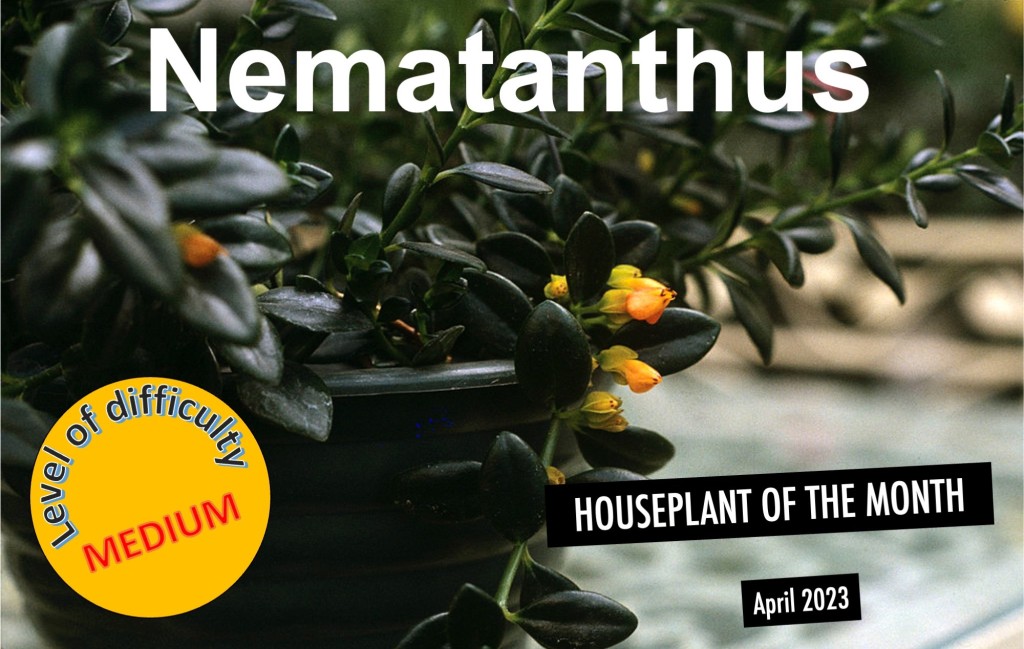

Also called Goldfish Plant, the Nematanthus is a houseplant that is less commonly found in our homes and nurseries than some of the other more popular plants, but it does appear in stores once in a while, most often in a hanging basket. Although it is a little more temperamental than beginner plants, it’s still quite easy to grow and fulfills one of the lesser known needs of Maslow’s pyramid: to have flowers in your home!
Origin of the Nematanthus

In the wild, the Nematanthus is endemic to Brazil. It was discovered in 1821 by Heinrich Schrader, a German botanist and mycologist. The name comes from nema, which means thread, and anthos, which means flower, in reference to its narrow thread-like flowers. It is still sometimes called Hypocyrta, its former name, or Goldfish Plant.
There are about 30 different species of the genus Nematanthus, of which N. australis, N. gregarius and N. wettsteinii are mainly cultivated. Nematanthus belongs to the large family Gesneriaceae, which has produced several flowering plants that are adopted in our homes, such as African violets (Saintpaulia) or the Red Lips Plant (Aeschynanthus), the latter being very similar to Nematanthus.
Description

The nematanthus is a generally epiphytic shrub, which means that it doesn’t grow on the ground, but on the bark of a tree or in the axil of one of its branches. Its root system is thus limited, but slightly tuberous, conserving water for periods of drought. The stems are semi-erect at the beginning of their growth, then drooping. They branch generously with adequate care. The leaves, rigid and succulent, generally remain dark green. In some species, they have a reddish tinge on their underside.
In addition to the glossy foliage, Nematanthus is grown for its symmetrical flowers (fused petals), whose crown forms a small swelling. The reduced mouth of the flowers allows only the beak of the hummingbirds to come to pollinate them in nature.

Varieties

There are various cultivars of nematanthus, adapted to indoor conditions, most of them being complex hybrids. They are difficult to distinguish because, apart from a few exceptions, they all have roughly the same habit and green color. Some will stand out from the crowd, for example with a constant and non-cyclic flowering, a better tolerance to difficult growing conditions, the size of their leaves or the reduced internodal space (i.e. the leaves are closer together, showing less stem length and offering a more compact, often more attractive habit).
Some Striking Differences
I will not try to present all the various cultivars, the differences being too subtle, but some of them offer striking differences that should be presented here:I will not try to present all the various cultivars, the differences being too subtle, but some of them offer striking differences that should be presented here:
- The cultivars ‘Rio’ and ‘Après’, for example, produce red flowers, the cultivar ‘Lemon and Lime’ produces yellow flowers, and the cultivar ‘Shady Ladies Mae’ produces two-tone red and yellow flowers;
- The cultivars ‘Castanet’ and ‘Stoplight’ have reddish undersides;
- Nematanthus ‘Tropicana’ has the same dark green leaves, but it is larger than its companions. It is also distinguished by its abundant flowering which, under good conditions, occurs all year long: the buds are of a charming red color and then emerge the flowers of a dark yellow striped;
- Nematanthus ‘Dibley’s Gold’ and ‘Golden West’ is the variegated version of the plant. Pale green in color, the variation is in the heart of the leaf for the former and in the margin for the latter. They flower like the other nematanthus;
- The hybrid Nematanthus x codonatanthus ‘Fiesta’ offers pink flowers with more prominent petals.

Growing tips

Light
This is the main obstacle to indoor growing: nematanthus needs at least bright light and would probably prefer some direct sun. Indoors, it can easily get used to full sun and will bloom more abundantly. Outdoors, it prefers morning or late afternoon sun or it will dry out too quickly.


Watering
Sources differ on when to water nematanthus. The Laidback Gardener suggests letting the soil dry out, but other sources advise keeping the soil constantly moist, especially during the growing season.
Considering that the plant is epiphytic by nature, one might think that it offers some tolerance to drought. Personally, I avoid keeping the soil constantly wet, but I don’t let it dry out deeply either. During the flowering period, it is advisable to water more frequently to prevent the buds from drying out and falling off.

Atmospheric Humidity
As a tropical plant, Nematanthus prefers high humidity, but can cope with the levels usually found in our homes. Too little humidity can cause the foliage to fall off, partially or completely.

Soil and repotting
Like other epiphytes, nematanthus prefers an aerated soil, with a lot of draining elements. Commercial potting soil, based on coconut fibers, keeps water perhaps a little too long for its restricted root system: one can add potting soil for cacti and succulents or other draining elements (perlite, bark, pumice) to avoid asphyxiation of the roots kept in a potting soil that is too humid for a long time.
The plant tolerates a narrow space for several years. Rumor has it that it blooms better in such conditions, but I can’t tell if this is a horticultural myth or the truth. Still, it’s better to wait until it’s absolutely necessary before repotting (which is a good thing, because repotting plants with a drooping habit, as is often the case with Nemantanthus, is not an easy task…)

Fertilizers
Nematanthus can be fertilized while growing at the recommended rate.
For more information, read this fertilizer primer again.

Temperature
Although Nematanthus can withstand colder temperatures, it should not be subjected to temperatures lower than 10 °C. It remains more compact at a temperature around 16 °C, suitable for a relatively cool room (but with bright light, this aspect being non-negotiable for the plant).

Maintenance
Flowers should be removed frequently when they are faded (or dropped on the ground and swept up!). Occasionally, you can water the plant in the shower to clean its leaves, it will thank you for it. Although it’s not absolutely necessary, it’s a plant that will benefit from spending the summer outdoors and will thank you by waking up its secondary nodes and blooming more beautifully!

A small haircut will please the aging nematanthus and encourage it to branch out. It is best to prune when the plant is growing, so most often in spring and summer.

Multiplication
Nematanthus is propagated by cuttings. Since the root system takes time to appear, it’s recommended to cover the cutting with a mini greenhouse.

Toxicity
No stress for cats, dogs and children! Nematanthus is not toxic.

Problems
- Leaf drop: partial or total leaf drop occurs when humidity is too low, drafts or excessive watering;
- Curled, drooping and limp leaves: the plant lacks water. Since hanging baskets are often underwatered, it may be necessary to soak the plant;
- Ravageurs: cochenilles, mites du cyclamen, pucerons et tétranyques surviennent à l’occasion;
- Powdery mildew: a whitish powdery film covers the leaves or stems. It is a fungal disease that is a sign of a lack of aeration. Cut the most affected stems, increase aeration and avoid wetting the foliage when watering;
- Long, leafless stems: in older (or less well treated) plants, stems can sometimes lose their basal leaves. A pruning of the growth tips can stimulate the lateral buds and the branching. A little summer treatment in bright light will also do it a lot of good!
Tips for Purchasing

Nematanthus is often composed of several larger or smaller cuttings, potted together so that it quickly takes on a dense, shrubby form. As it does not need much space, the different cuttings won’t suffer, if they’re well established (which should be the case in a serious nursery!). Choose the pot with the largest number of cuttings and the least amount of damaged foliage. Hanging plants can be difficult to transport: be careful not to expose them to the cold in fall, winter and spring, as well as to damage during packing and unpacking. Be gentle with them!
Tips for Presentation
With its beautiful shiny green leaves, nematanthus goes well with pots or planters made of natural materials: wood, terracotta, wicker, fabrics… However, for practical reasons, terracotta pots are particularly suitable: they allow the potting soil to breathe better and are heavy enough to avoid toppling over with larger plants. Use a pot that is wider than it is deep, if possible.
With a traditional but still appreciated foliage, lovely and frequent flowers, reasonable growing conditions… nematanthus is a nice plant to hang in front of a bright window. The cultivar ‘Tropicana’, in particular, is an opportunity not to be missed!
