
Normally, I only accept plants in my home that can tolerate low light. You see, I only have one rather medium-sized window at the front of my building, which faces west, and in summer it’s in the shade of a tree. At the rear, I have two north-facing windows. Nothing to get worked up about! With this little light, I manage to keep hoyas, pothos, dracenas and a peace lily alive… and I have to admit that, despite their tolerance to shade, they don’t always look their best in winter.
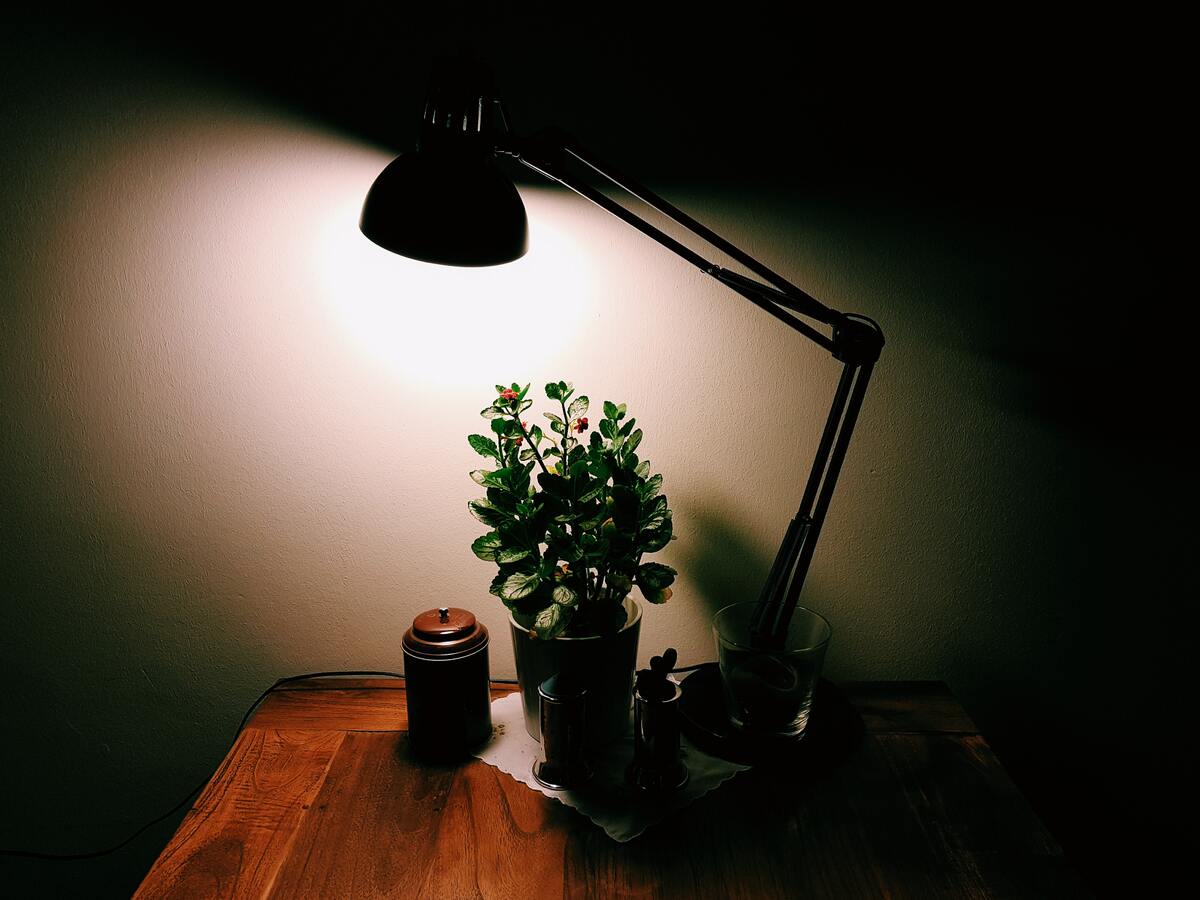
However, I made an exception to the rule when I inherited a few plants from my father, including a magnificent crown of thorns (Euphorbia milii) and an Achmea that has been in bloom since it arrived in our home this summer. There’s no way I’m going to leave these heirlooms in a dark corner where they’ll succumb to the darkness of my apartment. So, how do I get these plants to survive until I take them outside for the summer, given that I don’t have enough natural light? Artificial lighting, of course!
Types of Lighting
So where do we begin?
I’ll be dealing mainly with full-spectrum LED lighting, since it produces all the light plants need, produces little heat, has an acceptable color and is, by far, more energy-efficient than the other options. I prefer full-spectrum LEDs to the red and blue ones that are also sold. It’s true that plants need mostly blue and red light, but they still need green light too. Full-spectrum lamps, as the name implies, have the full light spectrum that plants need and are very easy on the eyes… unless you like purple lighting!
If you already have fluorescent lighting, this is also a good option, especially the 120 cm (4 feet) tubes that are widely available at a reasonable price. They use little electricity, but still consume twice as much as LED lamps. LED lighting is more expensive to buy initially, but you may save pennies in the long run.

Tip: if you already have a 120 cm (4 foot) fluorescent lamp installation, LED tubes of the same size are also available.
Incandescent and halogen bulbs are utterly useless, using much more electricity to produce a light spectrum that is not suitable for plants. As for metal halide or sodium vapor lamps, they are not suitable for residential use, as they use far too much current and are ridiculouly bright.
How Much Lighting Do I Need?
The answer may be simple… or it may not be at all! First of all, you should know that houseplants will adapt to lower light levels for a while. If you think you need more, you don’t need ideal lighting, just the minimum to get you through the darkest months of the year. So there’s no need to rack your brains and make calculations. Just about any lamp will do. Or simply move your plants to a brighter window and you’re done!
Otherwise, here’s how I proceed: I find out my plant’s light requirements and subtract what it receives in natural light. I then make up the deficit with artificial lighting. Easier said than done! Bear with me. Although a little complex, I think this type of calculation will teach you a lot, whether you decide to use artificial lighting or not.
A Few Notions
Plants use light with wavelengths between 400 and 700 nanometers, from blue to red, in the process of photosynthesis. This spectrum is known as photosynthetically active radiation (PAR).
PAR is calculated by measuring the number of photons (elementary particles of light) striking a surface over a given period of time, or photosynthetically active photon flux density (PPFD). Typically, PPFD is measured in micromoles per square meter per second (umol/m2/s). A micromole is one millionth of a mole. One mole is equivalent to 6.023 × 10²³ photons.

In short, many lighting manufacturers use the term PPFD to describe the amount of light emitted by their product that can be used by plants. For example, you might find a bulb with a PPFD of 100 umol/m2/s, at a distance of 30 cm (12 inches). Often, different PPFDs are added depending on the distance. So this same bulb will produce 25 umol/m2/s at a distance of 60 cm (24 inches), 11 at 90 cm (36 inches) and 6 at 120 cm (48 inches). So, keep your lamps close to your plants.
Don’t worry, there won’t be an exam at the end of the text!
To measure light, we often use expressions like lux, footcandles, lumen, etc. Although these terms are not useless, they refer to the spectrum visible to the human eye, not that used by plants. Although these terms are not useless, they refer to the spectrum visible to the human eye, not that used by plants.
Plant Light Requirements
Plant needs are calculated in DLI (Daily Light Integral), the amount of light a plant needs over the course of a day. DLI is measured in moles per square meter per day (mol/m2/d).
Roughly speaking, plants with low light requirements need a DLI between 2 and 6, medium from 6 to 12 and intense from 12 and up. A greenhouse rarely receives more than 30 mol/m2/d, to put it in perspective.
My crown of thorns needs intense light. I should therefore have a DLI of 12, in theory. However, I’m comfortable going down to 8 for a few months since it will spend the summer outdoors in full sun. It’s likely to stop flowering though, which doesn’t matter to me, the important thing is to survive the winter!
I’ve compiled a list of some houseplants with their light requirements. The data I found varied widely, so take them with a grain of salt. Also, some plants may tolerate less light than indicated for short periods and others much more, such as direct sunlight outdoors.
The lower figure represents requirements for survival and the higher is to aim for high performance and flowering.
Table of Light Requirements for House Plants
| Botanical name | Common name | DLI (mol/m2/j) | PPFD minimum (12 hours) |
| Aglaonema | Chinese Evergreen | 2 – 14 | 45 |
| Aloe | Aloe | 4 – 25 | 90 |
| Anthurium | Painter’s Palette | 4 – 14 | 90 |
| Cacti | 10 – 30 | 230 | |
| Caladium | Caladium | 4 – 14 | 90 |
| Chlorophytum | Spider Plant | 4 – 14 | 90 |
| Citrus | Citrus | 10 – 30 | 230 |
| Codiaeum variegatum | Croton | 4 – 30 | 90 |
| Cyclamen | Florist Cyclamen | 4 – 18 | 90 |
| Dieffenbachia | Dumb Cane | 4 – 14 | 90 |
| Dracenas | 4 – 14 | 90 | |
| Epipremnum | Pothos | 4 – 14 | 90 |
| Ficus benjamina | Weeping Fig | 6 – 30 | 140 |
| Fuchsia | Fuchsia | 10 – 30 | 230 |
| Hedera | English Ivy | 4 – 18 | 90 |
| Hoya | Wax Plant | 2 – 12 | 45 |
| Kalanchoes | 4 – 22 | 90 | |
| Monstera deliciosa | Swiss Cheese Plant | 4 – 22 | 90 |
| Nephrolepsis | Boston Fern | 4 – 14 | 90 |
| Oxalis | False Shamrock | 2 – 12 | 45 |
| Philodendron | Philodendron | 4 – 14 | 90 |
| Schefflera | Umbrella Tree | 6 – 30 | 140 |
| Schlumbergera | Christmas, Thanksgiving or Easter Cactus | 4 – 16 | 90 |
| Spathiphyllum | Peace Lily | 2 – 10 | 45 |
| Streptocarpus | Cape primrose | 4 – 14 | 90 |
| Syngonium | Syngonium | 2 – 14 | 45 |
| Succulents | 10 – 30 | 230 | |
| Zamioculcas | ZZ plant | 2 – 10 | 45 |
Measuring Light
The most accurate way to measure light levels is to use a light meter (spectroradiometer), which will give you PPFD data. There are also applications for smartphones that will act as a spectroradiometer. That’s what I’ve chosen to do. It’s a good idea to use a diffuser to ensure that the light falls evenly on the sensor. Light sensors have one built in; for smartphones, a simple sheet of white paper over the lens will do the trick.
Measuring the light in your home is something I suggest every houseplant enthusiast does at least once. It’s amazing how much variation there can be in light levels in a single room. In front of my west-facing window, for example, I measured 60 umol/m2/s, while immediately next to the window it went down to 20 and on the opposite wall, high up, where there’s never any direct light, it was only 1! The lesson: I put all my plants in front of the window, and hanging a plant in a corner doesn’t work for me!

Of course, to calculate the amount of light in a day, you need to average it over the course of the day and know the hours of sunshine. Here’s how to calculate the DLI from your measurements:
DLI = PPFD × Hours of light × 3600 / 1000000. Or use an online calculator like I do.
In front of my window, I have an average PPFD of 60 and, on this December 3, the day will last 9 hours. I therefore obtain a DLI below 2 mol/m2/d. This is a minimum for low-light plants!
Measuring Without a Light Meter
You don’t necessarily want to buy a spectro-magiger or download an app on your phone? I understand, I’ve got other things to do too. If I hadn’t decided to write this text, I probably wouldn’t have done it. The other option is to determine the average amount of light per day according to our location via this website. You can find the average DLI per day, month by month. I tried this with Quebec City.
These figures represent the average DLI (mol/m2/d) per day by month, and take into account both the length of the day and the weather. Typically, a window reflects between 30% and 70% of the light that hits it (think of the sun’s blinding reflection in a window pane – that’s lost light!). On average, therefore, only 50% of light passes through a window. Depending on the location of a window, there will be more or less light, so we reduce it even more for those facing east, west and north.
| Outdoors | South | East or West | North | |
| January | 10 | 5 | 3 | 1 |
| February | 17 | 9 | 4 | 2 |
| March | 25 | 13 | 6 | 3 |
| April | 34 | 17 | 9 | 4 |
| May | 38 | 19 | 10 | 5 |
| June | 39 | 20 | 10 | 5 |
| July | 39 | 20 | 10 | 5 |
| August | 32 | 16 | 8 | 4 |
| Septembre | 26 | 13 | 7 | 3 |
| Octobre | 15 | 8 | 4 | 2 |
| Novembre | 9 | 5 | 2 | 1 |
| Decembre | 7 | 4 | 2 | 1 |
| Average | 24 | 12 | 6 | 3 |

My Example
According to this table, my west-facing window has a DLI of about 2 mol/m2/d. Doesn’t that sound like my calculation?
These are just estimates, but they’re still very revealing! Comparing this with the list of plant needs, we can see that a south-facing window has, on average, just enough light for plants with intense light requirements. A north-facing window, however, struggles to provide enough light for even plants with low light requirements, especially in winter. And the further you move away from a window, the less light there is.
Calculate Lighting Requirements
Let’s get back to my crown of thorns, to which I want to give a DLI of 8 and which only receives 2. So I’ll need to provide it with 6 mol/m2/d in additional lighting to achieve this.
To simplify things, I’ve produced a table showing the lighting required (PPFD) to obtain the amount of light we want (DLI) for a 12-hour period. (My girlfriend won’t tolerate my lights being on more than that, and I understand. I don’t feel like wearing my sunglasses at night either).
| PPFD | 25 | 50 | 100 | 150 | 200 | 300 | 400 | 500 | 600 | 700 |
| DLI | 1 | 2 | 4 | 6 | 9 | 13 | 17 | 22 | 26 | 30 |
In my case, I’m looking for a lamp with a PPFD of 150. Remember the bulb with a PPFD of 100, mentioned earlier. I’d need two! Fortunately, I already have a lamp that I use for my seedlings, hidden under my desk, and I place my demanding plants under it for the winter.

Conclusion
Well done to those who made it this far! Phew, that was a lot of information. To sum up, estimate the lighting you have, find out what your plants need and, if necessary, add a little artificial lighting. Don’t hesitate to move your houseplants to a sunnier spot or group them together under a lamp. Full-spectrum LED lighting is preferable. It may be best to avoid plants that are very demanding in terms of light, if you can, unless you have nice big windows.
For those of you who say you don’t have a green thumb, don’t worry. It’s probably not your fault. Our homes are much darker than we imagine. You’re probably just missing some light!
Hi, What an impressive post! Your blog brilliantly illuminates the artistry and functionality of outdoor lighting, inspiring us to create captivating outdoor spaces Outdoor lighting can truly transform a space, creating a magical ambiance that enhances both aesthetics and safety!
Hi, This is a very Impressive and also very informative post. Transforming spaces with expert outdoor lighting installation. Enhance ambiance, boost security, and elevate curb appeal effortlessly. Illuminate your outdoor world with precision and style.
Hi, This is a very Impressive and also very informative post. Transforming spaces with expert outdoor lighting installation. Enhance ambiance, boost security, and elevate curb appeal effortlessly. Illuminate your outdoor world with precision and style.
Thank you!
Very informative. Thank you
A million thanks Mathieu, for all the effort you put in to writing an excellent article which really helped turn my lights on!