


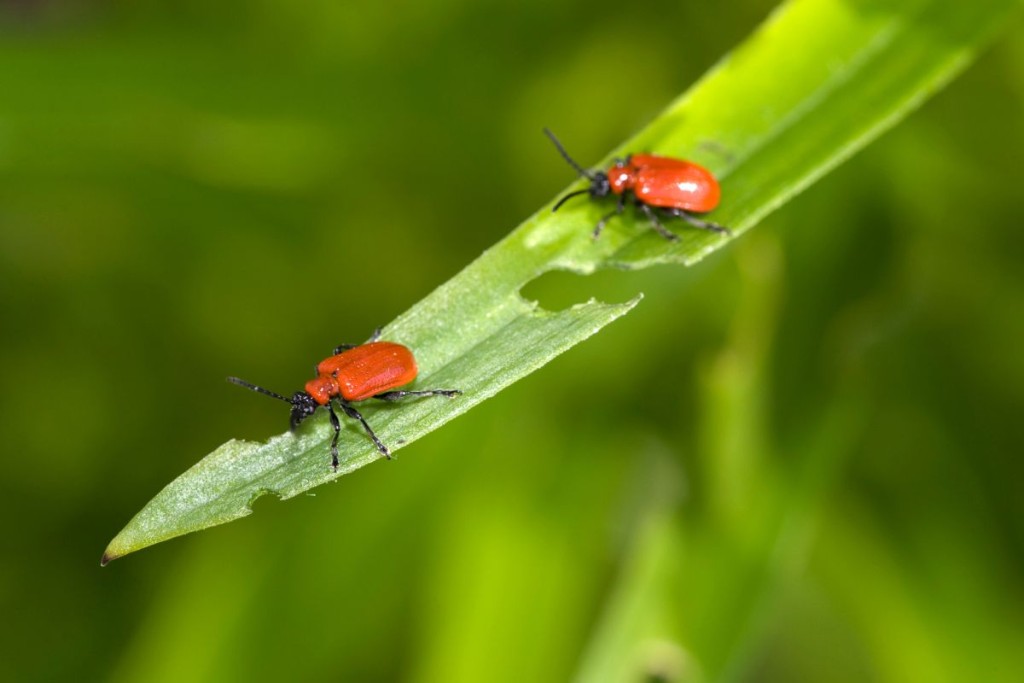
In 2015, my father, Larry Hodgson, announced that he had won the war against the lily leaf beetle, a small bright orange beetle with an elongated body, feared by gardeners for the damage it causes to lilies and fritillaries. Active from spring onwards, it lays its eggs under leaves, giving birth to voracious larvae that cover themselves with their excrement to camouflage themselves. These larvae, like the adults, devour leaves, buds and flowers, severely weakening the plants. The adult is very clever, dropping to the ground and turning onto its back to hide when threatened. Native to Eurasia, it spread to North America during the 20th century, becoming a feared pest in many gardens.


How did he defeat this invasive pest? After years of ineffective measures—including manual harvesting, biological sprays, repellent plants, and home remedies—he finally got rid of it… by pulling up all his lilies and fritillaries!
A Glimmer of Hope
In 2019, Larry Hodgson observed a dramatic decline in lily leaf beetle populations, to the point where none were seen that year, whereas they had previously been ubiquitous. Other gardeners in Montreal and Ottawa reported similar observations, although a few individuals persisted here and there. Two explanations were put forward: on the one hand, harsh winters could have decimated the populations; on the other hand, parasitoids introduced to control the insect, notably Tetrastichus setifer and Lemophagus errabundus, may finally have begun to play their role. It remains to be seen whether these natural allies are now well established in Canada.


The Impact of Biological Control
Since this observation, the hypothesis of a real impact of biological control has been strengthened. Researcher Naomi Cappuccino, from Carleton University, coordinated the release of the parasitoid wasp Tetrastichus setifer in Canada for several years, including at the Montreal Botanical Garden. This tiny wasp lays its eggs inside the larvae of the leaf beetle. The young wasps develop by eating them from the inside, killing them before they reach adulthood.
In some places, such as Ottawa, the leaf beetle population has declined so much that it is becoming difficult to find them for study. A citizen science project has been launched to map the pest’s spread across the continent and see if there is a correlation between areas of dispersal and population declines. With the help of gardeners, it is hoped that we will not only gain a better understanding of the phenomenon, but also consolidate the gains made in this promising biological control effort.
Between 2014 and 2016, T. setifer was released at several sites in central Alberta, including the Olds College campus, Calgary, and Airdrie. Follow-up studies until 2020 showed parasitism rates of up to 90% on campus and confirmed that the wasp had become well established in Olds and Calgary. Its ability to overwinter in this region has been confirmed, and reports of leaf beetles have dropped significantly. However, colonization of the city of Calgary is expected to take another decade or so, as the parasitoid disperses slowly.
Protecting Native Lilies

The lily leaf beetle poses a serious threat to several species of lilies native to Canada, particularly the Canada lily (Lilium canadense), which is already in decline in many regions. This beetle, accidentally introduced in 1943, feeds not only on ornamental lilies, but also on wild species, which it can completely defoliate. After several years of repeated defoliation, the plants stop flowering and often die. This pressure adds to other threats to native lilies—habitat loss, ecological fragmentation, climate change—and could hasten the local disappearance of some populations. It is particularly to protect these endangered species that parasitoid wasps have been released near natural habitats, such as in Granby, in a wild population of L. canadense.
Did It Work?
The question now is: has the introduction of parasitoid wasps been successful, and what is the status of the lily leaf beetle in Canada?
The available data are very encouraging. Release sites for Tetrastichus setifer, particularly in Ottawa, Montreal, and Granby, show marked declines in leaf beetle populations, down to “almost zero” in the areas concerned. Initial data from the citizen science survey launched in 2021 by Naomi Cappuccino reveal that, in release areas, lily cultivation has become viable again without intensive treatment—although the decline in leaf beetles could also be influenced by other factors such as climate or the abandonment of this crop by several gardeners.
A Study Confirming the Success of Biological Control
The results of this citizen survey are included in a USDA report published in 2022 by Casagrande, Tewksbury, and Cappuccino. This study confirms that the introduction of European parasitoid wasps has significantly reduced lily leaf beetle populations in several regions of North America. It documents more than 140 releases of three species of parasitoids—T. setifer, L. errabundus, and Diaparsis jucunda—between 1999 and 2019 in residential gardens and public sites in Canada (notably in Quebec, Ontario, Alberta, and Manitoba) and the United States.

Follow-up studies show parasitism rates of up to 100% at some sites, reduced damage to lilies, and slow but steady natural recolonization around release sites. In Ottawa, for example, T. setifer spread over 3.5 km in six years, and leaf beetles have almost disappeared. The results are similar in Montreal, where gardeners report being able to grow lilies again without intensive intervention.
The study also confirms that these parasitoids are specific to the lily leaf beetle and do not threaten other native insects. The cumulative effect is such that researchers are now struggling to find beetle larvae for their research, which is in itself proof of the strategy’s success.
What’s next
To my knowledge, no official scientific monitoring has been published since 2022. It is therefore difficult to know how the situation with the lily leaf beetle is actually evolving. According to the Manitoba Regional Lily Society, seven years after its introduction in Manitoba, T. setifer appears to have contributed to the local disappearance of the pest, although residual populations are too low to sustain the parasitoid in the long term.

The supply of wasps remains a challenge, particularly since Naomi Cappuccino’s retirement and the end of projects related to T. setifer at the University of Rhode Island. Despite this, field observations show that when this parasitoid becomes established, it can effectively reduce leaf beetle populations, often to undetectable levels. Its dispersal remains slow, but the benefits are long-lasting where releases have taken place.
What About You?
Have you noticed a decline in lily leaf beetle populations in your area? Have you observed the presence of these parasitoid wasps? Personally, I wouldn’t start growing lilies again right away. But if any of you feel the spirit of a scientist and are willing to sacrifice a few lilies to advance knowledge, let us know how it goes!