
A while ago, I was harvesting my garlic flowers—you know, that little moment of happiness when you try to get the longest flower stalk?—when I noticed a smooth movement at the base of my plants. Looking at my phone screen (because, of course, I was filming my harvest), I saw a small snake slithering between my stems.
I got two types of reactions when I shared this online: “I WOULD HAVE DIED ON THE SPOT, I’m so scared of snakes!” and “WOW, what a beautiful encounter, what a useful animal for the garden!” It made me realize that there was a real interest in these animals that leave no one indifferent, so I decided to tell you about them!
A Fear That Dates Back
Before introducing you to Quebec’s snakes, let’s talk a little about this famous fear of snakes. Because, let’s be honest, even if you’re one of those people who think they’re “cool,” you probably still get that little instinctive jump when you see a snake pop up between two begonias, right?
Ophiophobia—the fear of snakes—affects nearly one in three people. It’s the most common animal phobia in the world, ahead of even spiders. It’s a fear that’s been ingrained in our brains and culture since… well, before humans even existed. Our animal ancestors also feared snakes, as they can be a deadly threat in some parts of the world.
(An Anecdote That Proves My Point)
I’m straying a bit from gardening here, but I love this story…
My boss back when I was a young adult had a kinkajou as a pet (an animal from the raccoon family, but it looks a lot like a monkey with its prehensile tail).

(I tried to find an archive photo, but phones 15 years ago didn’t take very clear pictures!)
I know, he’s cute, but keep in mind that this is not an animal to have at home. I used to work at an exotic animal shelter!
Sami was free to roam around the house and had a penchant for… let’s say mischief. That’s normal, he’s a very curious animal! That week, his explorations led him irrevocably to the intriguing spice drawer. To discourage him, we put a large reticulated python skin in the drawer. (OK, they were special items related to my job at the time, don’t ask me why we had them!)
Well, as soon as Sami opened the drawer and saw the python’s scales, he was so scared that he ran off to hide in the living room and NEVER opened that drawer again! This little animal, raised in captivity, had never seen a snake in his life. The pattern of the scales triggered a fear and flight response in him, probably without him even realizing what a snake was. That’s how deep and innate this fear is!

Is fear of snakes encoded in our DNA? Scientists are still researching this topic today. The hypothesis is that among our ancestors who encountered dangerous snakes, those who were afraid of them survived longer than the others. This trait could have been genetic and passed down to subsequent generations.
However, more recent research (2023) calls this theory into question. Studies have shown that macaques do not spot snakes any faster than other predators. But there is a world of difference between spotting something and feeling fear. So, is fear innate or learned? The debate continues among scientists (it’s their favorite pastime to argue!).
What is certain is that this startle response is normal. Luckily, in Quebec, we only have small, completely harmless snakes.
Family portrait
Where I live in Quebec, there are between 8 and 9 species of snakes, depending on who’s counting. They are all called garter snakes (grass snake) and none of them are poisonous. These snakes are small creatures that generally don’t grow longer than a meter, with teeth so small that even if they bite you (which is rare), it’s more insulting than anything else!
Red-Bellied Snake
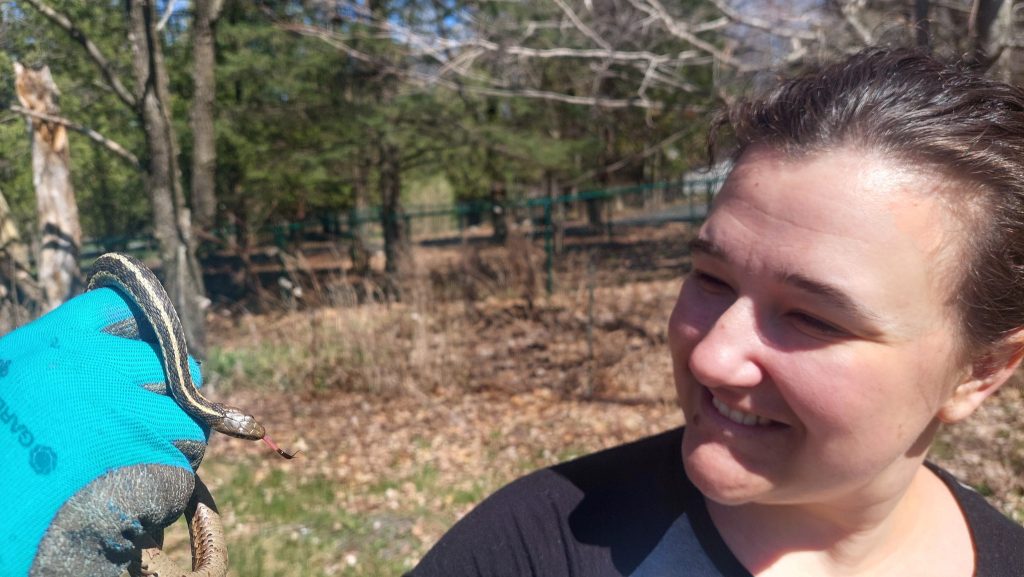
The red-bellied snake (Storeria occipitomaculata) that I encountered in my garlic patch is one of the most common snakes found in gardens, as it likes open areas and fields. It grows to a maximum length of 40 cm, has a brown-gray back with subtle stripes and, as its name suggests, a bright orange to red belly. How can you recognize it? It is very thin (about the size of a pencil), often with a more or less subtle pattern of three spots on its neck that sometimes extend to form a collar. This discreet little snake feeds on slugs and snails—so it clearly keeps my garden tidy.

Ring-Necked Snake
If you live at high altitude in a forest environment, you may encounter one of my favorites: the ring-necked snake (Diadophis punctatus). It is dark gray-black, almost bluish, but has a colorful band around its neck that is anything but discreet. Yellow, orange, or red, this collar is the same color as its belly. It is also thin and no longer than 40 cm (16 inches). It is rarer, but beautiful!

Common Garter Snake
The common garter snake (Thamnophis sirtalis) is its big sister. It can grow up to one meter long and has three pretty yellow, orange, or red stripes running down its black back. With its bright colors, it’s impossible to miss! You’re most likely to encounter it while walking in the forest. Since it’s quite large and flees very quickly in a large S-shaped pattern when disturbed, it often startles distracted hikers when it passes close to their feet!
Common Water Snake
There is also the common water snake (Nerodia sipedon), which is our largest species and, as its name suggests, likes to swim. It has wide black stripes on its body and can be frightening due to its size, but if you see a snake in the water while you are paddling, don’t panic, it’s not an anaconda! It’s just Mrs. Water Snake minding her own business.

Unfortunately, all of these species are in decline. Six of our eight species are likely to be designated as endangered or vulnerable. So if you see one, or better yet, if one of them takes up residence in your garden, consider yourself lucky!
Our Little Snakes, Friends of the Laidback Gardener
Now let’s talk about the practical side: why should you be happy to have a snake in your garden? Because it’s a discreet and versatile exterminator.
Our snakes eat everything that can bother your garden: slugs, snails, white worms, voles (the famous field mice that nibble on your roots), mice, grasshoppers, crickets, etc. They can consume an impressive amount of these little pests every day.
They have developed a whole arsenal for hunting. Their forked tongue, which they constantly stick out, is not to taunt you: it is their sense of smell. They “taste” the air to detect their prey. They can dislocate their jaws to swallow prey larger than their heads (like a field mouse, not a deer!), and they swallow whole.

Aussi, c’est important de mentionner que ce sont des animaux très craintifs. Si vous en voyez une, il y a de bonnes chances qu’elle vous ait déjà repéré et qu’elle se dirige vers la cachette la plus proche à toute vitesse. Elles ne sont pas du tout agressives et préfèrent toujours la fuite.
When Are You Most Likely to Encounter Them?
It’s no coincidence that I came across my snake in June. Spring and early summer are the season for encounters. After their long winter sleep, our snakes emerge from hibernation hungry and in need of warming up in the sun, feeding, and even finding a mate. They live quietly during the summer until September, when the temperatures start to drop and they begin to look for a place to hibernate. In winter, they sleep deeply underground, so there’s no risk of any winter surprises in your shed!
The best times to spot them are on warm mornings after dew, when they come out to warm themselves on rocks, or in the late afternoon. They don’t like the hot afternoon sun and often stay hidden in the shade during this time.
How to Live With Our Scaly Neighbors
If the idea of having a snake in your garden still makes you shudder a little, I understand. But rest assured, it is entirely possible to coexist in harmony!

First, don’t panic. If you come across one, stop, look at it (it’s probably beautiful!), and give it time to leave. Nine times out of ten, it will disappear before you have time to say “snake.” They would much rather flee than confront you.
If you want to encourage them to stay, create habitats for them: a small pile of stones at the bottom of the garden, a few planks or logs where they can hide, and, above all, leave part of your land a little wild, with taller grass. They like wasteland and the edges of forests: a neatly mowed lawn is pretty, but it offers no hiding places (or food) for our friends.
If, on the other hand, you prefer them to stay away, eliminate their food sources: control slug and rodent populations and keep your land clear.
SOS: I Have a Snake in My House/Garage/Shed!
Okay, now it’s getting less romantic, I’ll give you that! Stay calm (easier said than done, I know!). She’s just looking for a way out.
The gentle approach:
- Put on gardening gloves if it makes you feel safer.
- Approach SLOWLY—if you move quickly, it will move quickly!
- Gently pick it up behind its head and support its body. Their spine is very fragile, so be very careful.
- Carry it outside and release it in a quiet place.
If you really don’t feel comfortable:
- Use a shovel or broom to gently slide it into a bin or box
- Cover with a cloth and take it outside
- Release it at a safe distance from the house
Who to call as a last resort: An exterminator can come and capture it and release it elsewhere. No need to kill it!
Some Myths to Debunk
While we’re on the subject of snakes, let’s dispel a few misconceptions:
NO, they don’t sting. They don’t have stingers, and their tongues are just tongues, even if they are forked. They may bite if they feel cornered, but this is a defensive reflex, not aggression. And their little teeth can’t do much harm: they’re thinner than needles and sometimes they don’t even draw blood because they’re so small!
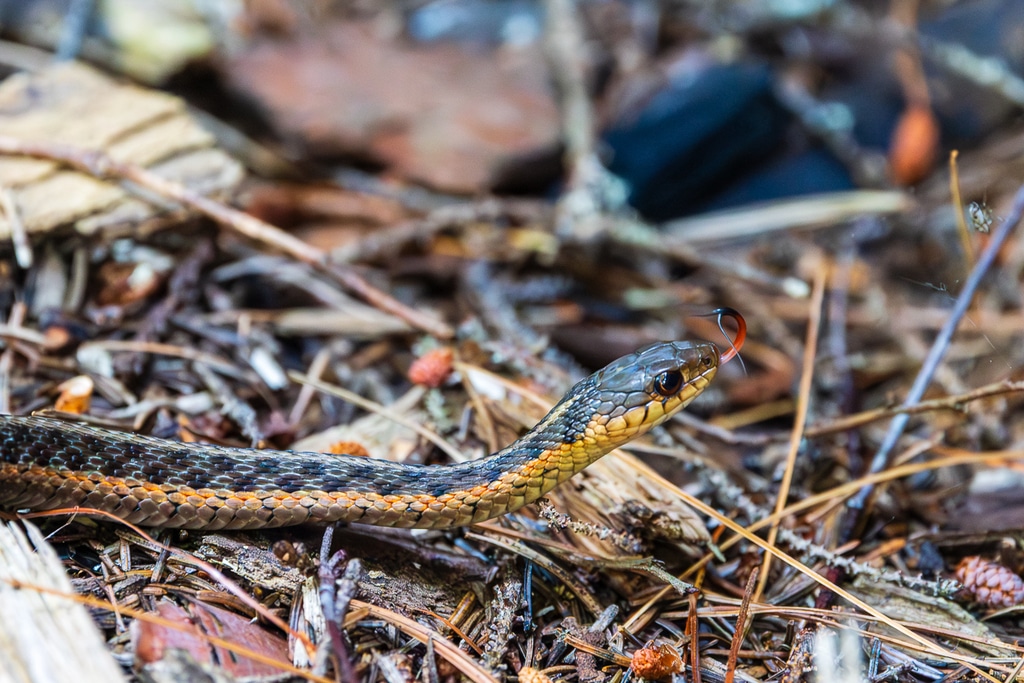
NO, when they stick out their tongues, it’s not because they’re scared or threatening you. Their tongue is their nose! They stick it out constantly to “taste” the air and detect the smells of their prey or their environment. It’s just like when your dog sniffs around—it’s curiosity and gathering information, not aggression.
NO, seeing one snake doesn’t mean you have a lot of them. They are rather solitary and territorial.
NO, there are no effective repellents. Mothballs, sulfur, coyote urine… it’s all marketing! The only thing that really works is changing the habitat.
NO, it’s not slimy. Can you imagine it crawling around covered in dirt and dead leaves? Its skin is as dry as ours—even drier, in fact! What gives it that shiny appearance is simply the fact that its scales are very smooth. Touch your fingernails: that’s EXACTLY what a snake feels like: smooth, soft, and dry.

My Little Snake in the Garlic
Getting back to my encounter in the garlic garden, I was extremely happy to see her! My red-bellied snake was probably hunting slugs and snails attracted by the moisture in the soil around my plants. She was doing her job as a natural exterminator, and I was quietly harvesting my garlic flowers.
Our snakes are valuable allies in the garden. They are harmless (at least here in Quebec), discreet, and they work for us 24 hours a day to eliminate the real pests in our gardens. In a world where biodiversity is declining, having a snake in your garden is a privilege and a sign that your little ecosystem is healthy.
I understand that not everyone is ready to shout with joy when they see a snake. This fear, whether innate or learned, is very real for many people. But I hope I’ve given you a few reasons to view these little creatures with a little more kindness, and taught you to let them go hide on their own when you come across one that makes you feel uncomfortable.
I look forward to hearing your stories in the comments!
I grew up in Australia, and so have SO many snake stories…..but my response is simply to congratulate you on the tone of this article. I’ve been trying to convince people of how beautiful and useful snakes are all my life, mostly to no avail. Nice to read an appreciative article like this. You are doing a great job of maintaining Laidback Gardener as a in informative and interesting read!
I really enjoyed reading it, thank you for bringing up this interesting topic.
Thank you for sharing.
It sure changed my attitude towards snakes.
Thanks for sharing this most interesting article. And thanks for sharing.