
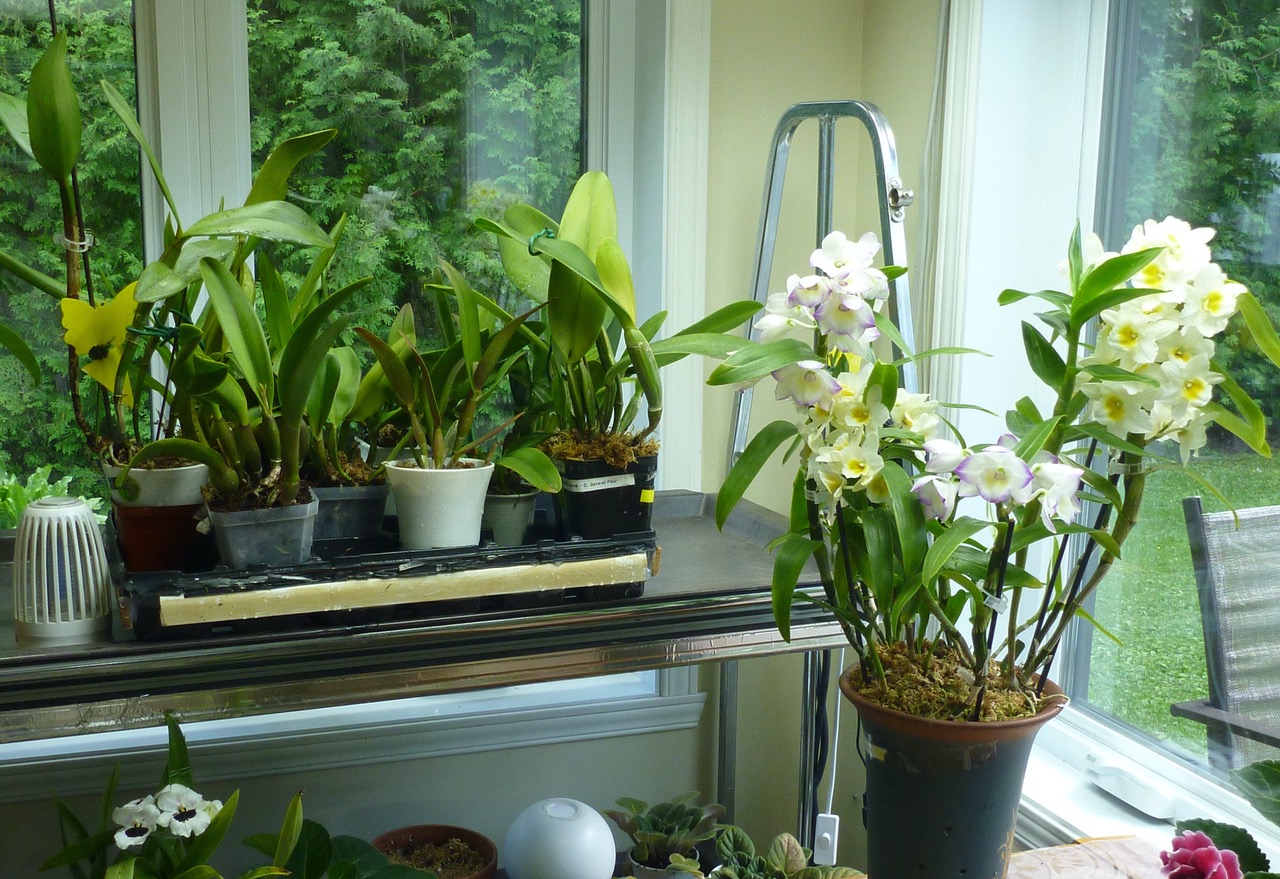
Once children have returned to school, it’s time to bring orchids back inside. This important task requires vigilance and certain precautions.
Autumn Is Ripening Season for Many Orchids.
During the summer months, the orchids experience strong growth, producing new roots and leaves. This promotes intense photosynthesis during the summer months. In autumn, the days shorten and the sugar production slows down, but it still allows reserves to be built for inflorescence production. This is the first necessary condition for our orchids to flower; the formation of sufficient reserves to supply the demanding flowering period.
At the same time, the temperature differences become more pronounced as does the humidity. These are the main factors that trigger the flowering process, as we explained in a previous article.
However, it should be remembered that most orchids are tropical and do not tolerate low temperatures, especially those in Canada. Therefore, it will be necessary to start bringing the orchids in as soon as night-time temperatures regularly drop below 13°C-15°C (55 °F – 59 °F). Start with the mildest ones (such as the Phalaenopsis and the Vandas), followed by the intermediate ones (such as the Cattleyas and the Oncidiums , which tolerate temperature down to 10°C-12°C/50 °F – 54 °F). Finally, bring in the most resistant ones(such as the Cymbidiums and some Dendrobiums before temperature drop below 5°C-10°C/41 °F – 50 °F.
An Inflorescence? Bring Them Inside Quickly!
If any of your plants have started to form an inflorescence, bring them in immediately, as the young flowering stems are fragile and they should not be exposed to temperatures below 15°C (59 °F). The flower buds could fall after a cold night. Young (immature) plants are also very sensitive to cold snaps and should not be exposed to temperatures below 15°C (59 °F).
Stimulating the Flowering of Mature Orchids
If some of your “mature” orchids have refused to bloom for several years, you can try leaving them outside a little longer to encourage them flowering. This method sometimes works with plants that have become lazy due to overly comfortable growing conditions. In fact, it seems that several Cymbidiums even need this type of «thermal stimulus» to bloom well.
No matter when you bring them back inside, you must always examine and clean them meticulously first.
Step 1: A Meticulous Inspection Is Required for All Plants Returning Inside.
If you follow our orchid chronicles, you will already be aware that monthly inspections are essential for properly managing a plant collection. This is even more important when the plants return indoors than at any other time of year.
While we won’t repeat all the advice given last July, it’s important to summarise the main recommendations:
- Inspect the top and bottom of the leaves and clean if necessary.
- Check the condition of the substrate (it should not smell of fungus or rot).
- Ensure that the container is always adequate and in good condition.
Look for signs of maturation, such as plump pseudobulbs, thick, solid leaves and, of course, inflorescences forming. Normally, you should see a clear increase in growth after a few weeks outdoors.
At the same time, it is recommended that you inspect and clean the indoor cultivation spaces to ensure they are clean and fully functional when the orchids return. This includes checking the artificial lighting systems, humidifiers, fans and thermostats, if applicable.
Adjusting Indoor Lighting
To avoid disturbing plants whose annual cycle is synchronised with the length of the day, it is strongly recommended that the duration of artificial lighting is adjusted to be comparable to the length of the day outdoors. This is particularly important for several species of Cattleya. Providing similar conditions to those outdoors in an indoor growing space will generally be less stressful for your transitioning plants.

Step 2: Cleaning Plants, Pots, and Trays
When examining plants, we often find small defects that need correcting, such as stains on the foliage or debris in the pots and trays (i.e. compartmented trays designed to hold culture pots). There are many spiders where I live so there are almost always webs to clean off my plants. I start with a deep clean using a hose with a nozzle that can be adjusted to different settings. I also take this opportunity to empty and clean my cabarets. Then I spray rubbing alcohol (70% or more) into the trays to disinfect them.
If necessary, I clean leaves with a disinfectant wipe (e.g. Lysol or Clorox). This process is a bit tedious, but I find it very useful, and I greatly appreciate how clean my foliage is afterwards. I also remove any diseased leaves or damaged roots, as these will be of little use and could cause contamination.
If the pot is stained, soiled or damaged, I replace it without hesitation. This is inexpensive and makes the collection much more hygienic.


Step 3: Apply an Insect Repellent to Foliage
If there are any hidden insects when you move your plants indoors, it is recommended that you spray an insect repellent solution onto their foliage. There are many ready-to-use products available to buy in garden centres. As our readers are spread across several countries in America and Europe, you may need to consult a local expert regarding the regulations in force in your region.
However, I will offer you a homemade mixture consisting of ‘Murphy’ soap, neem oil and hydrogen peroxide. This solution is a universal insect repellent with very little toxicity. The recommended doses are indicated in the caption under the photograph below. There are several other possible formulations, but I prefer this recipe because it is effective yet low in toxicity.
Ingredients for My Homemade Insect Repellent
Murphy Oil Soap Original Concentrated Wood Floor Cleaner
Murphy’s concentrated wood cleaner is a vegetable oil-based soap with natural lemongrass. It is an effective insect control product that is also non-toxic to children and pets. It is also more economical than specialised products sold in garden centres.
Neem Oil
Neem oil is sold in the beauty products section of pharmacies. Although it is a beauty product, it is still effective in repelling insects and is very low in toxicity. This vegetable oil adheres to the surface of leaves, repelling insects for a few weeks. It also contains enzymes (or hormones) that poison insects trying to eat the foliage of plants. For immediate and longer-term effectiveness, mix the two oils in the same spray bottle (thanks to Murphy soap and neem oil, respectively). Spray and leave to dry. The majority of plants tolerate this mixture of natural oils very well. If in doubt, select one or two leaves to treat and observe for a few days. The plant will ‘tell’ you if it does not like it.
Hydrogen Peroxide
Finally, add 3% hydrogen peroxide, which is available from pharmacies, to the insecticidal solution to give it anti-bacterial and anti-fungal properties. Once you have completed these steps, your foliage should be very clean and pose minimal risk of further contamination.

Step 4: Treat the Substrate With Insect Repellent
To maintain hygiene, sprinkle diatomaceous earth on the surface of the substrate and around the base of the plant to prevent crawling insects from taking refuge in the pot. Diatomaceous earth is a microscopic abrasive that cuts insects as they move across it, causing deadly haemorrhaging. This product is available from hardware stores or garden centres. I recommend choosing food-grade diatomaceous earth (from freshwater sources) as it is very low in toxicity to humans and domestic animals (as it is edible). However, you should avoid inhaling the fine dust released during vaporisation.
Diatomaceous Earth
Diatomaceous earth is often more effective in bark-based substrates (such as those used for orchid cultivation) than in traditional potting soils. This is because diatomaceous earth remains on the surface of the substrate particles, even when watered regularly. In soil, diatomaceous earth mixes with fine particles, leading to a significant loss of abrasive efficiency. Reapply if there is no visible abrasive powder on the surface of your pots after a few weeks.
Hydrogen Peroxide
If you detect a fungal (or bacterial) smell, you can pour a 1% hydrogen peroxide solution to stop pathogens proliferating. This concentration of peroxide is safe for roots. To prevent re-infestation, many orchid enthusiasts will sprinkle ground cinnamon on the surface of their pots. Cinnamon is the dried and crushed inner bark of certain laurel trees. It is non-toxic and offers good protection against fungi and bacteria for several weeks.

Once Inside, Stay Attentive!
The key to successful orchid collection hygiene is rigour. It is important to remain attentive and disciplined during the first few weeks after bringing them indoors. To detect the reappearance of insects in indoor growing spaces, it is useful to install small yellow sticky traps and check them periodically.
Don’t hesitate to examine plants from all angles by taking them in your hands. If you suspect a recurrence, repeat the insecticide treatment once a week for one month to ensure complete eradication. To prevent insects from developing resistance to your insecticidal solution, it may be necessary to vary the type of treatment. If in doubt, consult a specialist at a garden centre or orchid association in your area. Regulation varies greatly from one country to another.
If your plant is badly affected despite your attempts at cleaning and preventive treatment, it is better to get rid of it than to keep it in your collection. It is difficult to save orchids when they are heavily infested, and visible damage to the foliage does not heal well. They pose a high risk of contaminating your collection.
I think these suggestions are good for a lot of plants we may bring in in the fall. Thank you.
Goodness! I might not grow orchids if they were this much work. Cymbidiums live outside here all year, so I need not worry about insects getting too bad for them. Cattleyas are, . . . well, a bit more work.
Dear Tony,
” Life is a fight !”
😉