
We continue our Halloween series with a fall classic: apples! Have you made your applesauce after your green ketchup? Are you SURE it’s safe? If you’ve read the rest of the series, you probably already know the answer!
I have to tell you a little story before handing over to our Halloween narrator: there was… (many years ago, in fact)… when I was in college, I had a friend who had traveled to the poorest parts of Africa. He was eating an apple while telling me about his adventures, and he ate it… ENTIRELY. The core, the stem, everything! He told me that over there, when you’re given a bowl of rice and two chicken bones for a meal, you eat EVERYTHING, and the same goes for apples… Not sure he would have eaten his apple if he had known…!
Come closer, come closer, my dear hungry gardeners! It’s me, Dreadbak Gardnoir, back with a new revelation that will make you look at your apple trees in a whole new light…

Remember the evil queen in Snow White? The one who poisons the princess with an apple? Well, guess what? She didn’t even need to add poison! Apples ALREADY contain toxins! Krrrh-hihi-HIK! You don’t know it, but EVERY TIME you bite into a nice, juicy Cortland apple, you’re BRUSHING UP AGAINST POISONING!
Well… if you chew the seeds, which no one does… normally… Let me scare you properly before I reassure you, it’s more fun that way, isn’t it? Krrrh-hihi-HIK!
When Cyanide Suffocates You From Within
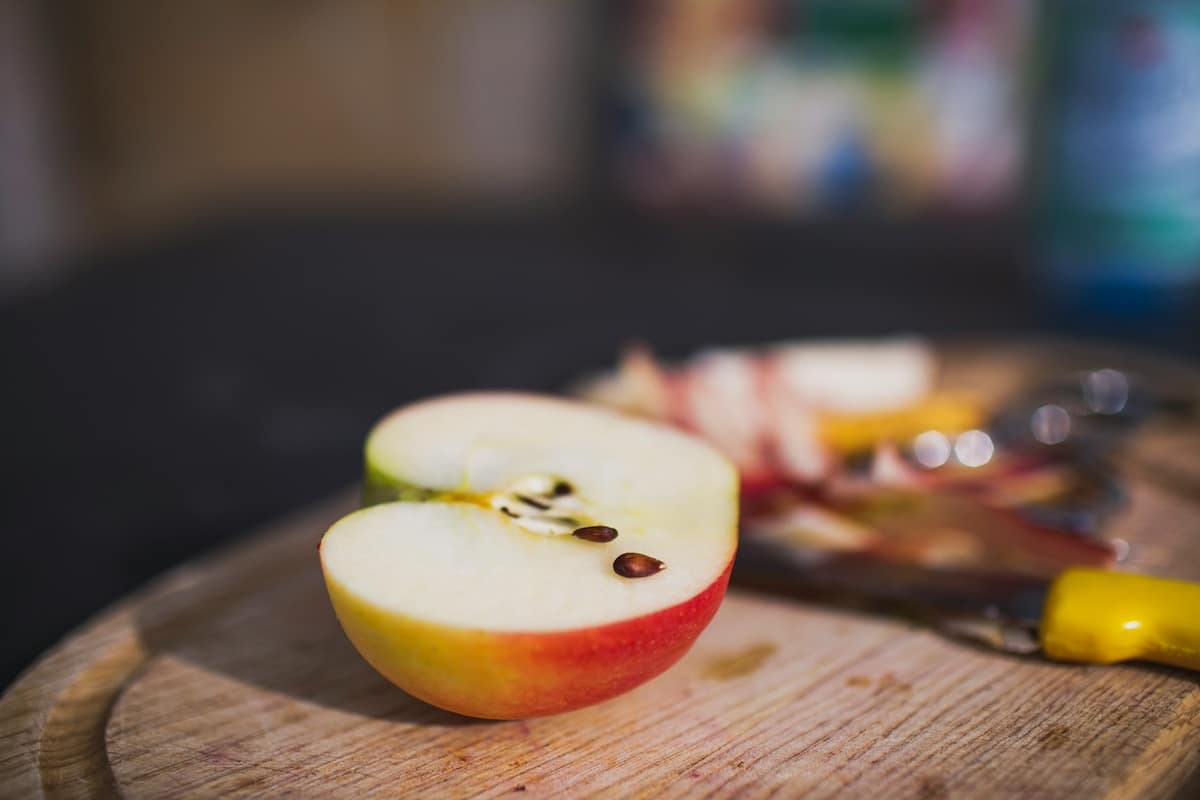
You know those little brown seeds you leave on the core of your apple? They contain amygdalin—a molecule that, when you chew it, turns into HYDROGEN CYANIDE and attacks your cells!

And how does this little cellular massacre work? Oh, it’s fascinating! When you bite into a seed—and I mean BITE, you don’t even need to swallow it—you release enzymes that convert amygdalin into cyanide. Amygdalin and enzymes are both found in seeds, but separately. It’s a real time bomb. When they meet, it’s like opening a cage… The poison is released and goes straight to your cells, blocking them and preventing them from breathing. Krrrh-hihi-HIK!
Want to know what happens when cyanide enters your body? Oh my, it’s quite a show, with little cells gasping for air!
Cyanide prevents your cells from using oxygen. They can no longer breathe, even if you are breathing normally! This is beautifully referred to as “histotoxic hypoxia.” Not a great fate, but it can help you win at Scrabble Krrrh-hihi-HIK!
The actual symptoms? Oh, they’re HORRIBLE: severe headaches, dizziness, confusion, convulsions, loss of consciousness… And in severe cases—brace yourselves—cardiac arrest, respiratory arrest, and… death!
And you know what? The classic signs we see in movies—cherry-red skin, the smell of bitter almonds—almost never appear! You could die of poisoning without even looking poisoned! Damn Hollywood for lying to us so brazenly!
Agatha Christie and Her Cyanide Killers
Speaking of murder, do you know who LOVED cyanide? The Queen of Crime herself: Agatha Christie! Not that she loved it like you love apples, mind! I don’t mean she consumed it! No, no, this dear lady graduated as a pharmacist in 1917. Having been an apothecary’s assistant (the drugstores of the time) during World War I, she saw her fair share of cases of care and poisoning! She used cyanide in at least 28 of her 66 detective novels! And no, I didn’t count them myself.

In Sparkling Cyanide, Agatha Christie kills her victims outright with cyanide-laced champagne. Romantic, isn’t it? You have to know a lot about this toxin to make such “recipes” believable, ones that don’t taste bad and can be hidden in drinks and food, and you know what? Her scientific accuracy was so impressive that a 1920 review in the Pharmaceutical Journal speculated that the author must have had a background in pharmacy! Krrrh-hihi-HIK! Of course she did!
The Chemistry of the Toxin
But you’re probably wondering: where do murderers get their cyanide from? Apple seeds? Well, NO, my curious friends! That would be far too time-consuming and complicated! In fact, cyanide can be made in a laboratory.
In Agatha Christie’s day, cyanide was surprisingly EASY to obtain! It was commonly used in photography (as a fixer), gold and silver mining, insect fumigation, and even in certain medical treatments! A pharmacist or photographer could order it without too many questions…!

Today, it is more controlled, but cyanide is still used in industry: electroplating (metal plating), plastics manufacturing, ore processing, etc. Laboratories also use it for certain chemical analyses. That’s why stories of poisoning often involve chemists, photographers, or people working in these industries.
And no, no one bothers to extract cyanide from apple seeds! It would take hundreds of pounds of seeds, specialized equipment, and a lot of patience! It’s much easier to get access to a laboratory: a little methane and ammonia and you’re done. Krrrh-hihi-HIK!
Combien faut-il de pommes pour vous tuer?
Okay, my anxious little gardeners, you want to know how many seeds you need to chew to die? We’re almost there in today’s issue!
The lethal dose of cyanide is between 0.5 and 3.5 mg per kilogram of body weight. An average apple seed, when chewed completely, releases about 0.1 mg of cyanide.
So, let’s do the math together! For a 70 kg adult, you would need to… drum roll, please… chew the seeds from… 147 APPLES, all at once!
The Truth Hidden in Your Orchards
Want to know a secret? There are essentially NO documented modern cases of fatal poisoning from apple seed cyanide!
There was ONE woman in 2014 who ate ENTIRE BAGS of seeds for MONTHS to “treat” her cancer… And guess what? She made a full recovery after being hospitalized! Just goes to show that an apple a day keeps the doctor away… But just one, because otherwise they’ll come running in droves! Krrrh-hihi-HIK!

Sometimes I hear warnings like: remove apple seeds when making juice/jelly, etc. It’s SUPER dangerous… And yet, companies have made cider, juice, compotes, pies… And I’ve never seen a job offer for an apple seed remover! The seeds are crushed, pressed, cooked with the rest… and no one has died! Do you know why? Firstly, because the ratio of seeds is tiny, but also because when you make juice or cider, even if the seeds are included in the production, the heat treatment and fermentation eliminate the cyanide. It has a very low boiling point—around 26°C (79°F)—so as soon as you heat it, the cyanide evaporates! Poof!
Studies on commercial apple juice show negligible cyanide concentrations – between 0.001 and 0.007 mg/mL. In other words, nothing at all! Ultimately, it is undoubtedly the most dangerous toxin discussed in this series, but also the least likely to be consumed in large quantities by a careless gardener. Krrrh-hihi-HIK!

Conclusion on the REAL Poison
So there you have it, dear viewers! Everything I’ve told you about cyanide is TRUE. The chemistry is real. The toxic mechanisms are real. Agatha Christie wasn’t lying in her novels.
But the dose needed to kill you? It’s so absurdly, comically, mathematically IMPOSSIBLE to achieve by eating apples that it turns a real chemical threat into the perfect urban legend: just enough truth to scare you, not enough danger to justify the fear!
You bite into a beautiful, freshly picked Gala apple and accidentally swallow a whole seed? It will pass through your digestive system intact and come out as good as new! Chew one by accident? Your body will eliminate that tiny 0.1 mg of cyanide without even batting an eye!
The real poison, my friends? It’s misinformation and unfounded fear! STOP believing the alarmists on the web! It’s completely absurd to throw away a pie because you find a pit in it! Give your pie to a clown, and they’ll eat it without even removing the little rascal!
See you next week for our very last toxin in this series! Get ready for something cabbage-tastic, Krrrh-hihi-HIK!

Great info. Thank you. My dog seems to “know the danger”. She will eat a whole entire apple and leave only the seeds. Funny
A good story ! Love facts ! Very apt in ourfear driven media world ….
Interesting article Audrey. had no idea apple seeds also contained cyanide. Thought it was just the stone fruits.