
Now that we have set up a good growing environment, we will look at some additional adjustments that will ensure optimal growing conditions for our collection. For orchids, this includes carefully controlling the amount of light they get, keeping the air humid (especially in winter, when indoor air gets way too dry), making sure there’s constant air circulation (24 hours a day), lowering the temperature at night, and making sure it’s really dark at night. These improvements are not difficult to implement, but they will be crucial to the success of our business.
Install a Timer to Vary the Lighting Duration Throughout the Seasons
Orchids need an appropriate amount of light. As we explained in a previous article, several species of orchids need seasonal variations in daylight hours to synchronize their flowering with the time of year when their pollinating insects are most abundant in nature.
To best control this cycle, you can use a programmable timer to simulate natural conditions and promote flowering. For example, give them 12 hours of light in November, December, and January, then 14 hours in May, June, and July. In the other months, make a gradual transition in the duration, increasing the lighting by half an hour per month in February, March, and April, then decrease the duration in August, September, and October.
Orchids will synchronize with these lighting variations and will thus be able to perceive the seasonal variations that stimulate their flowering. Even orchids that are not very sensitive to seasonal variations will tolerate this modulation of lighting and will adapt to it without difficulty.
For safety reasons, it is strongly recommended to use electrical components designed for outdoor use (e.g., a waterproof timer to withstand humidity, outdoor lighting fixtures, triple-connector wiring including reliable grounding, etc.). This is because the temperature and humidity cycles required for growing orchids often exceed the design limits of traditional household components. In addition, handling watering containers can cause spills for which “indoor electrical components” are not designed, as they are not waterproof.
Increase Indoor Humidity for Tropical Orchids
Dans nos maisons, l’air est peu humide, surtout en hiver, lorsque le chauffage domestique maintient une température confortable pour les humains malgré le froid extérieur. Pour pallier ce manque, vous pouvez avoir recours à l’une des stratégies suivantes :
- Place your plants on a bed of clay pellets (or gravel), which will release a little moisture locally, much to the delight of your orchids. This is often the preferred solution for growing plants on a windowsill. Unfortunately, humidifying trays require regular maintenance, as bacteria often proliferate in stagnant water. To simplify maintenance, you can use a synthetic fiber mat that is kept moist at all times. A simple machine wash will remove any unwanted odors. These types of mats can be found in pet stores, as they are also highly recommended for captive reptiles.

- For large orchid collections, a home humidifier is often the best solution. The best manufacturers offer models specially designed for growing spaces, equipped with specialized features for home horticulture, such as automatic start and stop, to help maintain optimal growing conditions. Choose a cool mist model with a power rating proportional to the size of your room. Modern devices are often equipped with Wi-Fi and a temperature sensor, which is very convenient for automated remote monitoring.

Expect a Drop in Temperature at Night for Orchids
When the lights are turned off, the temperature in the growing areas inevitably drops, especially if the plants are close to the lights. This drop in temperature is entirely desirable, but it must be controlled to avoid any risk of condensation and to maintain the plant’s chemical activity during the night. A drop of 5 to 10°C (9 to 18°F) is recommended for most orchids. This corresponds to the temperature drop observed in most of the natural environments where they have evolved.
This parameter is easy to control with a simple electronic thermostat that can be programmed accordingly. As mentioned in a previous article, few tropical orchids appreciate nighttime temperatures below 15°C (59°F). This will therefore be our base temperature. During the day, however, an average temperature of 22°C (72°F) is preferable, as it is more comfortable for both tropical orchids and the inhabitants of the house. This temperature difference of 7°C (13°F) should suit most orchids. However, be aware that some exotic orchids may have special requirements and that it may be necessary to increase or decrease this temperature difference for certain specialized plants.
Keep the Air Moving in Growing Spaces
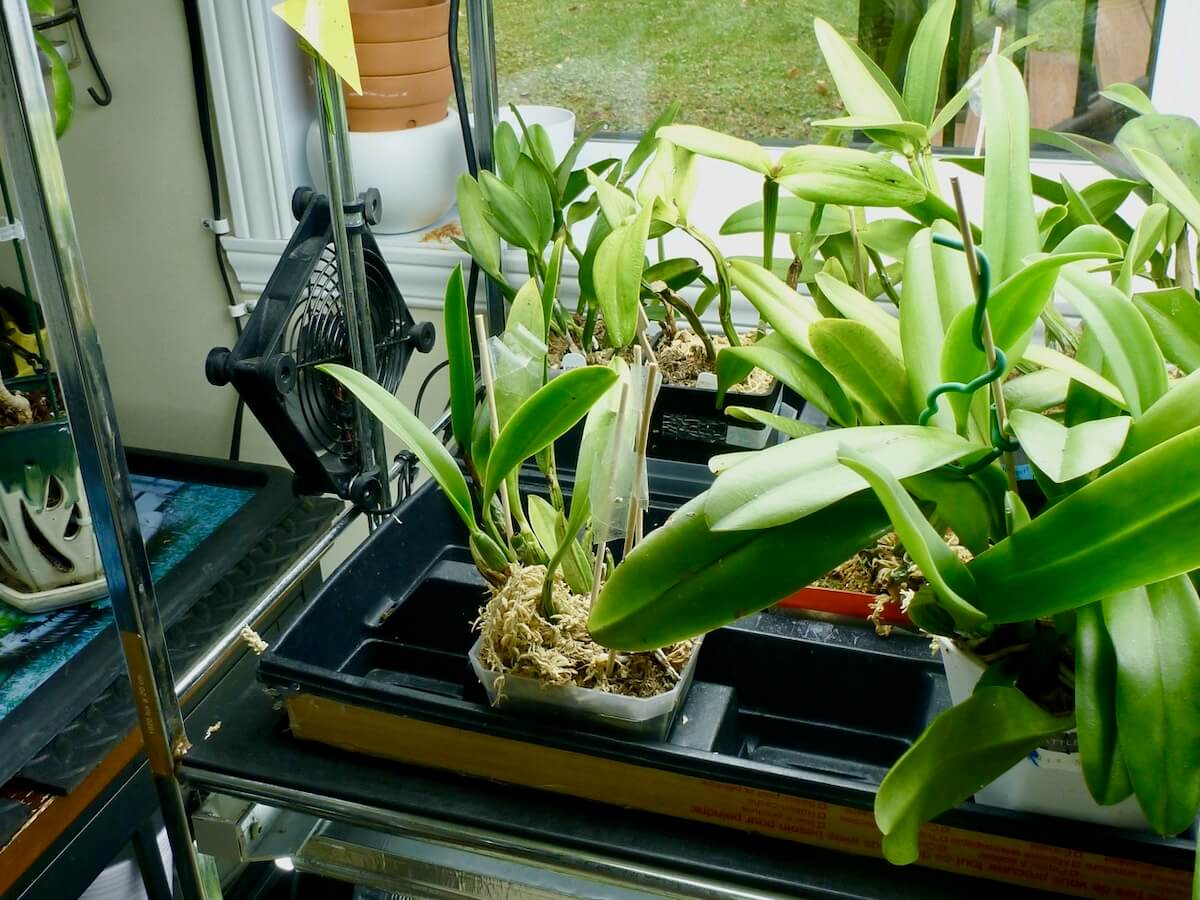
In our homes, there is little air movement, much less than in natural environments. This causes a few problems. The most obvious is the accumulation of heat on shelves, which can easily be avoided by circulating fresh air in the growing facilities. In the evening, when the lights are turned off, it is advisable to maintain air movement in order to reduce the risk of condensation. When the temperature drops in the evening, excess moisture in the air tends to settle on plants, promoting the development of fungal and bacterial activity. A simple, gentle but continuous movement of air will evaporate this moisture and prevent the proliferation of pathogens.
Another Advantage to Be Aware Of
The other “major advantage” of air circulation is a little more subtle to understand. Unlike all animal species, plant species do not have elastic lungs that allow them to inhale or exhale the gases essential for their growth. Plants can only open their respiratory stomata and wait for the gases produced to diffuse into the atmosphere, without the ability to expel these gases or draw in fresh air. This is where air circulation plays a vital role, facilitating gas diffusion and replenishing the stomata with fresh air. The scientific community has not yet been able to quantify this beneficial effect on gas exchange, but it is reasonable to assume that gentle, continuous air circulation can accelerate these exchanges by a very significant factor, especially if the air movement reaches the underside of the leaves, where most of the stomata are located.
Maintain Good Darkness at Night So as Not to Disrupt Nocturnal Chemical Reactions
Experienced orchid enthusiasts also ensure that their indoor plants enjoy total darkness at night, without any stray light. The internal chemistry of plants changes radically during this period, as photosynthesis is no longer possible. However, plants remain active and take advantage of the darkness of night to carry out certain chemical transformations that are not possible during the day, as they are disrupted by light. The technical details are relatively complex, as they involve highly sophisticated organic chemistry reactions. But remember that several internal chemical processes in plants require complete darkness to occur during the night.
In Practice
Artificial lighting should not be turned on during the night so as not to “wake up” photosynthesis. All lights that could reach the growing areas should also be turned off. If a night light is necessary to ensure safe movement around the room, choose one with very low intensity and install it close to the floor, below the level of the growing trays.

Several species of orchids are said to have CAM (Crassulacean Acid Metabolism), meaning that they capture CO? (essential for photosynthesis) only at night. In their natural habitat, these plants are exposed to very intense sunlight and cannot open their respiratory stomata during the day, as they would lose too much moisture. They have therefore adapted their functioning by carrying out their gas exchange at night, which requires almost total darkness. This is also the case for crassulaceae, hoyas, cacti, and most plants adapted to arid or semi-desert regions. For more information, see Larry’s excellent summary from January 2020.
Editor’s Note
Mr. Charpentier’s orchid articles are published on the Laidback Gardener website under a legal “Copyleft” format. As a result, republication of his columns is permitted provided that the following credit is added: This article was originally published in french on the jardinierparesseux.com website and in the English on laidbackgardener.blog.
I found this explanation of adapting horticultural practices with artificial lighting really insightful, especially the focus on observing orchids and adjusting light intensity over time. The reminder that orchids respond differently depending on species and environment feels very practical for home growers. I’ve noticed that consistency and spectrum quality make a huge difference in leaf color and flowering cycles. That’s one of the reasons I’ve been paying more attention to modern grow light solutions and setups you can explore when you Click Here. Thoughtful lighting choices paired with patience truly help orchids thrive indoors and make artificial lighting feel much more natural and effective.
Really appreciate how clearly you explained the lighting and humidity adjustments—this makes caring for orchids feel much more approachable. I’ve been experimenting with similar routines, and consistency really does make a difference. While reading, I ended up checking some unrelated info in the Lynchburg inmate database at http://lynchburg-inmate-search.arrests-org.com and came back to realize how thoughtfully you’ve laid everything out here. Looking forward to trying the gradual light changes you suggested.