


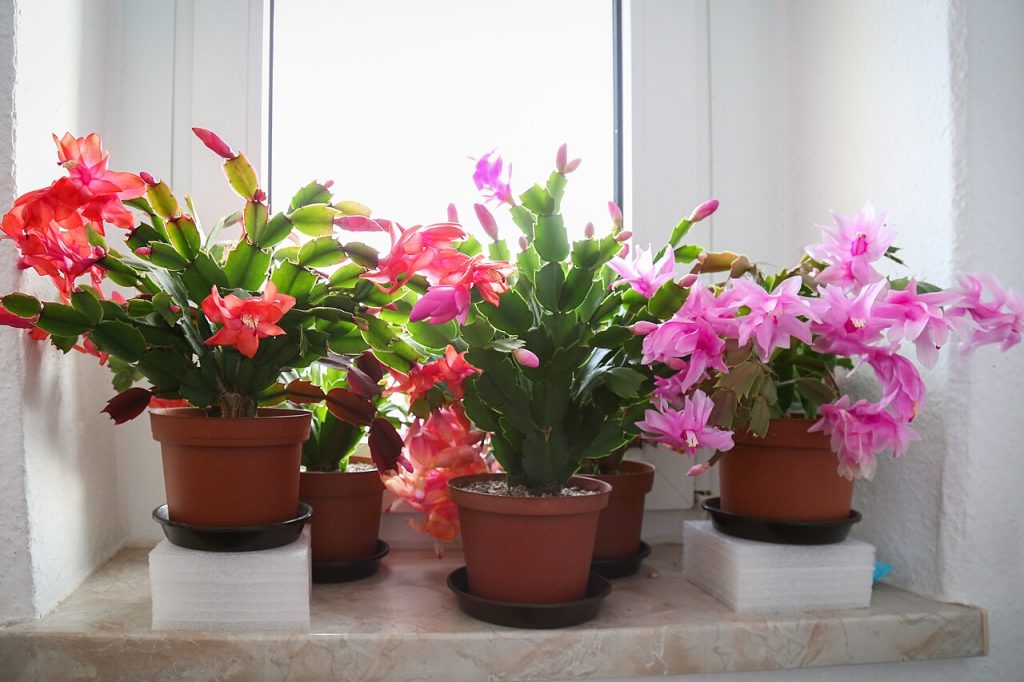
With the advent of artificial lighting, it is possible to produce flowering pots for all times of the year, including during the holiday season when our interiors need a touch of color to rival the gray outside. For many holiday plants, only the first bloom is spectacular: if the plant survives the dark months, many will not bloom again or will bloom only timidly in subsequent years. This is not the case with holiday cacti: in addition to being easy-to-care-for houseplants, it is entirely possible to make them bloom again year after year with minimal care, which we will discuss today.
Origin
When I refer to “holiday cacti,” I am actually referring to three types of plants commonly known as Thanksgiving cactus, Christmas cactus, and Easter cactus.
Thanksgiving Cactus
The Thanksgiving cactus, often confused with the Christmas cactus and then surprising people when it blooms well before the winter solstice, is a horticultural hybrid derived from Schlumbergera truncata and blooms around November.

Christmas Cactus
Its close cousin is the Christmas cactus, which blooms a month later, in December. In this case, these are hybrids derived from Schlumbergera russelliana, which are still often referred to as S. bridgesii, a name that is no longer recognized as valid in modern taxonomy.

These two Schlumbergera species belong to a small genus of the Cactaceae family. They are native to a specific Brazilian biome called the Atlantic Forest, which consists mainly of mountains and tropical rainforests. The fact that these cacti grow in a tropical forest is an important factor in understanding their needs.
Schlumbergera
The Schlumbergera genus consists of only six to nine species, depending on the nomenclature used. Due to its similarity in shape to other plants, particularly Rhipsalis, there has been some confusion regarding its taxonomy. As revisions have been made and science has progressed, various plants have been moved back and forth between groups, resulting in the current classification. Thus, the following terms are sometimes used as synonyms for Schlumbergera: Epiphyllanthus, Opuntiopsis, Zygocactus, Zygocereus, and Epiphyllum—but occasionally these terms also refer to other plants that have not been moved to the Schlumbergera genus—it is best to stick with Christmas cactus to be as accurate as possible.
Easter Cactus
The Easter cactus is a little different. Although it resembles the previous two, it is not a Schlumbergera, but a Rhipsalidopsis gaertneri. It flowers much later, from April to May. It is found in the Brazilian biome mentioned above. Sometimes referred to as Hatiora gaertneri, the plant was once grouped with other Hatiora species, but has now been reclassified into its own genus, Rhipsalidopsis, which consists of only two species (R. gaertneri and R. rosea). To reflect this difference, I will use the term “holiday cactus” to refer to the three plants discussed in this article, and not strictly to Schlumbergera.

Description
The three holiday cacti are epiphytic plants, whose limited root systems allow them to cling to trees or rocks in the rainforest. Like other cacti, they are leafless plants that produce photosynthesis by exposing their thick segmented stems to the sun.
Branches
These modified branches are called cladodes. They are flattened and make it easy to distinguish between different plants: the cladodes of S. truncata have serrated edges, while those of S. russelliana and R. gaertneri are rounded. The different segments, which correspond to the cactus’s growth spurts, are very clearly visible. In a growing plant, you can even see tiny, fully formed cladodes that will gradually grow to become similar to “adult cladodes.” With age, the cladodes become covered with bark and form a stronger stem, but this only occurs in plants that are several years old.
It is difficult to distinguish the Easter cactus from Schlumbergera, but the segments are sometimes slightly shorter and rounder, and the plant generally has a compact, upright habit, unlike Schlumbergera, which quickly becomes drooping.

Before the flowering period, the plants will be covered with buds at the tips of the most recent cladodes. Each segment may be covered with one or, less often, more than one bud. These buds usually take on the color of the emerging flower. Over time, the rounded buds will take on a more elongated shape, then unfold into a tubular flower.
Flowers
Schlumbergera flowers have a complex shape, somewhat reminiscent of large, brightly colored shrimp. This narrow shape was developed to attract the long beaks of hummingbirds, which pollinate them in nature. At the tips of the flowers are long stamens covered with pollen, protected by petals (actually tepals—a botanical term used when the petals and sepals of a flower are not differentiated). They can be different colors: white, pink, yellow, orange, red, and purple, as well as all shades between these colors and, sometimes, two-tone.
R. gaertneri flowers, on the other hand, look more like traditional flowers, with rows of colorful petals reminiscent of chrysanthemums or asters. They come in much the same colors as their Christmas and Thanksgiving cousins, but the selection is slightly more limited, and the colors are more saturated.

Why Is This Cactus Associated With Christmas?
The answer is that… it isn’t at all in its country of origin. In Brazil, Schlumbergeras are called Flor de Maio, “May flower,” since they do not bloom in November or December. It is only in the Northern Hemisphere that, in a burst of extraordinary creativity, we have nicknamed this plant, which blooms around December, the “Christmas cactus.”
In 2018, Larry Hodgson decided to add to the legend by writing his own Christmas story about Schlumbergera, a much more creative reason to call it a Christmas cactus.

Varieties
Although plants cultivated as holiday cacti resemble those found in nature (notably, S. truncata and S. russelliana), they are generally hybrids descended from these two specimens. For example, the hybrid between S. truncata and S. russelliana, the main parents, bears the sweet name of S. x buckleyi, and is sometimes still cultivated.

The rich history of this plant, whose hybridization began in England in the 19th century, has led to a long line of diverse hybrids, distinguished in particular by the color of their flowers or certain characteristics (such as ease of care, ability to flower profusely, or a more upright habit).
On the market, the specific species is rarely specified (if ever!). Several attempts have been made to bring some order to the hundreds of varieties and hybrids of this prolific plant, but this is difficult to do, especially since certain characteristics vary from one individual to another! In fact, particularly in plants with white and yellow flowers, low temperatures cause them to take on a pinkish hue, which of course confuses any classification based solely on flower color.
Complex Hybrids
Easter cacti are in much the same situation: the cultivated species are complex hybrids whose parentage is almost never indicated. The main recognized hybrid is Rhipsalidopsis x graeseri, a cross between the only two species of the genus, R. gaertneri and R. rosea. Flowering time, flower shape and color, and resistance to suboptimal growing conditions are the main selection criteria, with the difference that Easter cacti are generally a little more difficult to grow. For this reason, there are far fewer Easter cactus cultivars… but still enough to make it difficult to organize them!

Growing Tips
It may be tempting to see “cactus” and treat the plant the same way we treat our cacti: direct sunlight 28 hours a day, no water ever, freezing nights, soil straight from the vacuum cleaner tank… But remember that holiday cacti are not desert cacti, but tropical plants. In this sense, the care we give them is more similar to that we give to leafy plants from similar humid climates.


Light
Holiday cacti tolerate a wide variety of lighting conditions. As a general rule, they should be given bright light without too much direct sun, but they should be able to adapt to reasonable extremes.
When they get too much direct sun, they turn a pretty pink color, which isn’t necessarily harmful to them, but it does indicate that they are at the limit of their tolerance. It is therefore important to keep them well hydrated, as they are at risk of drying out. They can burn with the increase in light during the summer.
While they can survive under more modest lighting conditions, flowering will be more limited. Plants that lack light will show this by becoming spindly. The flowers require at least bright light.

Watering
Holiday cacti should be watered like tropical succulents, which means allowing the soil to dry out between waterings. However, they are quite resilient to mistreatment, even occasional overwatering—up to a point: repeated overwatering will lead to root rot.
If the plant inadvertently begins to wilt slightly, this is a sign that it should have been watered a little earlier. During the flowering period, it is best not to let it wilt, so that it does not lose its buds. During the dormant period, the plant tolerates forgotten watering much better than overwatering.

Atmospheric Humidity
These tropical cacti prefer moderate humidity, but they tolerate the atmospheric humidity levels in our homes without too much fuss (our homes tend to be generally drier than humid, except for those who, like me, are prone to frequent water damage—my secret to beautiful houseplants? Plumbing from the last century!).

Potting
As epiphytic plants, it is easiest to keep them in a light, airy potting mix, such as potting soil for indoor plants with added drainage elements, or potting soil for cacti and succulents.
Christmas cacti like to be cramped in their pots, which significantly reduces the risk of overwatering and inadvertently suffocating their underdeveloped root systems. Although they grow over time, their slow growth suggests repotting every 2 to 3 years, if necessary.

Fertilizer
They can be fertilized at the recommended dose during the growing season. They are not particularly greedy and monthly fertilization should be sufficient. Be careful not to fertilize during flowering (including bud formation) and during the dormant period after flowering: Christmas cacti do not need it. Fertilization during this period can actually disrupt flowering.

Temperature
As tropical plants, Christmas cacti should not be kept below 10°C (50°F). They prefer constant temperatures between 15°C (59°F) and 25°C (77°F). A slight drop in temperature in the fall can stimulate flowering (see box on this topic).
Main difference between Schlumbergera and Rhipsalidopsis
Both plants require exactly the same care, except that the Easter cactus is less tolerant of variations in all situations. It is more sensitive to overwatering and can rot more quickly, and it does not tolerate temperatures below 15°C (59°F) as well. In summary, Easter cacti can simply be considered similar, but more finicky.


Maintenance
Holiday cacti require little maintenance. They tend to grow segment by segment: if a stem is considered too long, the segment at the end can be removed once it has reached its final size and propagated (see next section). This sends a signal to the cladode to produce two segments from the cut branch, which can give the cactus a bushier appearance. This stem multiplication is not guaranteed, but Christmas cacti branch out easily anyway.
The plant should also not be rotated when it is budding: the quarter-turn technique is strictly prohibited at this delicate stage. This is because the buds try to turn towards the light source: if they are moved, they will try to turn excessively, which will cause them to fall off.
Similarly, make sure you maintain very stable conditions during flowering: be careful of drastic changes such as leaving a nearby window open for too long (drafts, drop in temperature on the windowsill) or when you turn on the heating (radical increase in atmospheric dryness).

Flowering: A Theoretical Explanation
The flowering of holiday cacti depends on several factors.
First, a little vocabulary. Most indoor plants are apophasic, meaning they are indifferent to variations in the length of the day. They can bloom in any season and tend to do so around summertime due to the abundance of light during this season (in the northern hemisphere, at least).
However, there are a few photoperiodic plants (or nyctoperiodic, a rarer term) that use the length of the nights to orient themselves throughout the year and trigger their flowering. They aim to flower in optimal conditions, which, in their country of origin, means a few months after the days start getting shorter.
For Schlumbergera, the best conditions are at the beginning of the dry season, just after the wet season. This is a period when conditions become more stable: slightly cooler temperatures, reduced rainfall, and hummingbird activity. Moreover, even though we talk about changes in conditions between the dry and wet seasons, these are nothing like the drastic changes between summer and winter in Canada! This is why small changes in our indoor conditions are enough to trigger flowering quite easily.

… and a Practical Application!
Thanks to this overview of the conditions that stimulate the flowering of Christmas cacti, we can isolate the important factors:
- The length of nights, corresponding to the shortening of periods of daylight
- A slight drop in temperature
These are obviously the conditions that need to be replicated. The most important factor is the shortening of daylight hours. Good news! Unless the plant is grown under a grow light 100% of the time, this shortening occurs naturally in Canada. Furthermore, unlike other photoperiodic plants such as poinsettias (Euphorbia pulcherrima), Christmas cacti are not overly sensitive to a little light in the room. This means that a plant grown on a windowsill will receive enough signals to start flowering even if you happen to read at night with a bedside lamp in the same room. (Of course, if a large neon light is shining directly overhead all night long, that may be a bit too much.)
Fairly Easy to Reproduce
Lower temperatures are not necessary to stimulate flowering, but they can support it. Another piece of good news: this happens naturally in Canadian homes, due to the slight cooling that occurs outside when temperatures drop from 30°C to -30°C. Be careful with heating, though: for those who wait until indoor temperatures are unbearable before turning on the heat, it’s a double shock for plants: not only can temperatures rise by several degrees, but atmospheric humidity also drops dramatically with heating. The best thing (for the plants) is to do it gradually: a little autumn cooling, then slowly turning on the heating over a few weeks and, who knows, maybe even using a humidifier for the first week?
Finally, temperatures below 15°C delay flowering, for those who want their Thanksgiving cactus to bloom at Christmas.
My technique for ensuring flowering year after year? It’s very complicated: I leave my plant on the windowsill where it stays all year round. I don’t do anything else. And it blooms naturally!


Propagation
Propagating Christmas cacti is particularly easy, as the plant itself divides into sections that are ready for propagation. Simply select a healthy cladode at the end of a branch, preferably one that is bright green and without buds or flowers. Twist it around and cut it off, then plant it in slightly moist (but not soggy) potting soil.
You can produce cuttings from a single segment or a few segments (two to three sections). For a denser pot, it is easier to join a few cuttings together: the final plant will be all the more lush.
Be careful to plant the cladode the right way up, i.e., the end where the flower buds will appear should be facing upwards. In addition, there is less risk of losing a cutting by covering it with a plastic bag or a transparent cover to create a small greenhouse for the plant. (Yes, even if it is a cactus, cover it! This is because, remember, these are tropical cacti.)
A pot containing a few cladodes should then be placed in bright light, out of direct sunlight (if the plant is in a greenhouse, direct sunlight would raise the temperature too much) or under a grow light. Roots should appear after a few weeks.


Problems
- When the leaves shrivel: this is a water problem, either too little if the soil is dry or too much if the soil remains moist. See the article on this subject to find out how to treat your holiday cactus.
- Flower buds fall off: basically, you should avoid moving the plant or changing its growing conditions when it starts to prepare for flowering. Drastic changes will cause it to stop flowering for the year.
- My cactus isn’t flowering: see the section on this topic in the article for tips on helping the plant to flower.
- Insects: Christmas cacti are not prone to infestations. The main infestations are mealybugs, tropical thrips, and impatiens thrips.

Toxicity
The sap of the plant can be slightly irritating, especially for people who are sensitive to latex. In general, apart from this specific characteristic, it is a non-toxic plant for humans and animals.
Presentation Tips
Since holiday cacti require the same care, why not mix two species with different colored flowers? In a very “Christmas” spirit, I propagated white-flowered and red-flowered species: with the green cladodes, my Thanksgiving cactus heralded the arrival of the holidays when it bloomed in Christmas colors.

Buying Tips
Several precautions are necessary when purchasing a holiday cactus.
First, there is less chance of losing a bud that is just beginning to bloom than one that is already in full bloom, so it is best to plan ahead. However, while the color of the buds often correlates with the color of the flowers, this is not always the case, so the plant may have some surprises in store for you.
Although it is tempting to purchase a huge holiday cactus covered with buds, keep in mind that larger plants are less adaptable to changes in conditions and are therefore more likely to lose their flowers. It is a risk worth taking, and since holiday cacti are easy to rebloom, losing one bloom in a lifetime of flowering may not be such a big deal…
Even though it’s a “Christmas” plant, it’s tropical: just five minutes outside in freezing winter temperatures can be damaging. Be sure to cover it well, like Santa Claus, because it will be so cold outside… and it’s really your fault.
Conclusion
Since holiday cacti don’t require too much specific care and can bloom year after year, they make a wonderful gift for the lazy gardener, who will forget about them on the windowsill until they burst into colorful bloom. On that note, I wish you all a happy holiday season!
