Ferns are wonderful houseplants. They are lush and relatively easy to care for once you know how. They bring a certain je ne sais quoi that other houseplants simply can’t match. The blue star fern is no exception.

Though slightly less well-known than the Boston fern, this beautiful fern deserves more attention. It can become quite imposing, with foliage reaching 2 to 4 feet (60 to 120 cm) in height. A large specimen can stretch its fronds nearly 90 cm (3 feet) wide. It’s the lush, full plant you’ve been looking for to “junglify” your sunny living room.
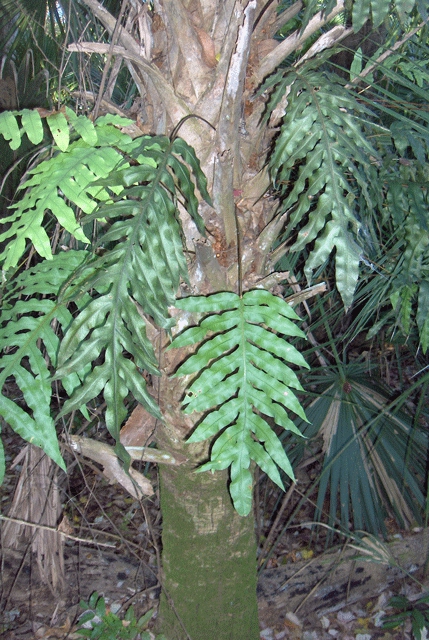
Despite the word “aureum” in its Latin name (Phlebodium aureum), the Blue Star Fern is not golden. Its nickname comes from the color of its rhizomes, which are yellowish or creamy white. The fronds (fern leaves) of this “golden” fern are a beautiful steely gray with a slight bluish tint. This distinctive foliage color sets it apart from other ferns, as do its roughly cut fronds. Few indoor ferns have that look!

A Thousand Names For One Plant!
Native to the tropical regions of South America, the blue star fern was first discovered under the name Polypodium aureum. That’s why it’s also called the golden fern. It then became Pleopteris aurea, and finally, Chrysopteris aurea, eventually leading to its currently accepted name, Phlebodium aureum. Along the way, however, it adopted no fewer than 17 different variants of its name!
In English, there are also many names for it. It is also called blue fern, gold-foot fern, golden polypody, harefoot fern, or rabbit-foot fern. The last name can be confusing because another fern, the Davallia (Davallia mariesii), is also called rabbit-foot fern. I think the rhizomes of the Davallia look more like tarantula legs than rabbit feet, but that’s another story.

The “Many” Needs of the Blue Star Fern
It’s easy to guess that, as a proud representative of the Canadian Indoor Fern Association (a fictitious name), the Blue Star Fern prefers bright rooms with high humidity. This isn’t entirely incorrect. However, this fern can adapt to a variety of growing conditions. For instance, it thrives in normal household humidity just as well as in the bathroom, typically the most humid room.
I’m not sure exactly how far away from direct sunlight it needs to be, but I can confirm that diffused light—that is, a spot that receives plenty of light but no direct sun—suits it perfectly. Even in low light, the plant offers a sparser version of itself without dying.
Regarding temperature, it thrives equally well in a warm room at 21°C (70°F) and in a cool location. As long as the temperature remains above 10 or 12°C (50 or 54°F), this fern will be fine. However, if the plant is grown in a warm room, you will need to monitor the watering more closely.
The blue star fern prefers consistently moist, but not soggy, soil. This means you need to pay close attention to its watering needs and learn to water it just the right amount. Fortunately, this plant is forgiving of occasional lapses and won’t necessarily die if the soil dries out completely. (I know from experience!)
As for the potting mix, golden polypody can be grown in wood chips (orchid mix) or an epiphytic plant mix if the conditions are warm and humid. This fern is an epiphyte in its natural habitat. Otherwise, a simple potting mix for houseplants is sufficient and recommended for most laidback gardeners.
Ultimately, there’s nothing too complicated about growing the Blue Star Fern, and it should be more often included on short lists of very easy-to-grow houseplants.