
In order to successfully cultivate orchids, special attention must be paid to their roots. Their structure and function differ greatly from those of conventional terrestrial plants. In this article, we will examine the surprising function of the velamen, which enables these epiphytic plants to survive in the absence of soil or water. First, let’s review some concepts presented in previous articles.
The evolution of orchids towards their epiphytic form
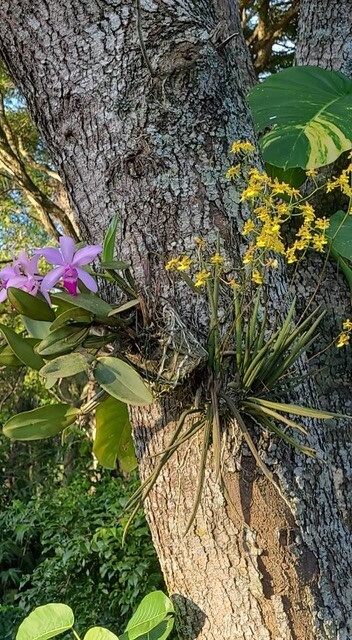
Over the course of their long history, orchids have undergone several major climatic transformations. One of their most remarkable adaptations is the shift from terrestrial growth, whereby a plant is rooted in the soil, to epiphytic growth, whereby a plant is attached to tree branches. In some cases, plants became epiphytes to benefit from more sunlight when vegetation cover was so dense that it prevented light from reaching the ground. It has also been discovered that some orchids likely became epiphytes to escape waterlogged soil during periods when their habitat was flooded by heavy rainfall. Consequently, some plants were compelled to abandon the ground and cling to trees or elevated rocks in order to survive.
This radical change to their growing environment caused major morphological modifications in epiphytes, particularly to their roots. As they cling to trees, they no longer have access to the water and nutrients present in the soil. Therefore, the plant had to develop a completely new structure for capturing and retaining water: the velamen. This velvety covering surrounds the roots and becomes saturated with water at the slightest downpour. It is believed that the velamen appeared in several locations around the globe at different times during periods of climatic upheaval.
For more details on the extraordinary evolution of orchids, see the article published last year on this subject.
The velamen performs the same environmental functions as soil
This spongy coating (the velamen) is made up of an accumulation of plant cells. It serves as both a sunscreen for the central part and an absorbent structure that captures rainwater. Depending on sun exposure and ambient humidity, the velamen’s thickness can vary significantly, but its overall structure remains the same. At its centre is a network of vessels that transport sap to the foliage, as well as several smaller vessels that carry sugars produced by photosynthesis back to the roots. The root itself closely resembles its terrestrial ancestor.
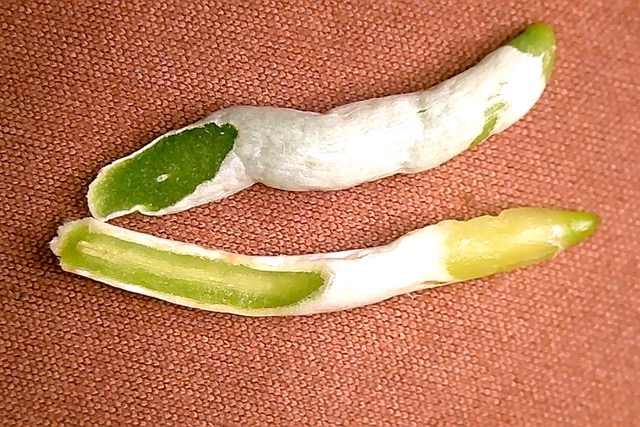
The protective velamen lies all around these vessels. This greenish tissue is hidden beneath the outer greyish sheath, as can be seen in photo below. The top root belongs to a Phalaenopsis orchid and is quite plump, which should provide the plant with an excellent water reserve. The bottom root is from a Cattleya orchid. The central section of this root has been exposed to demonstrate its longitudinal continuity. The proportions of the velamen root components vary considerably from one botanical species to another; some are fleshier than others, probably to meet the species’ increased requirements in its natural habitat.
The velamen adapts to its surroundings as it develops
Significant morphological variations in the roots of the same orchid can often be observed. To illustrate this phenomenon, I conducted a small experiment. I deprived some growing roots of light, as if they were developing in an opaque substrate. Three roots of a vigorous Phalaenopsis from my collection were covered with synthetic felt wrapped in reflective tape, while a fourth root from the same group was left above ground to develop in the open air (see photo below, on the left). This small setup was designed to block light before it reached the three lower roots in order to observe the effect on their development. The setup remained in place for approximately six months, which is the time required for these four roots to emerge completely.
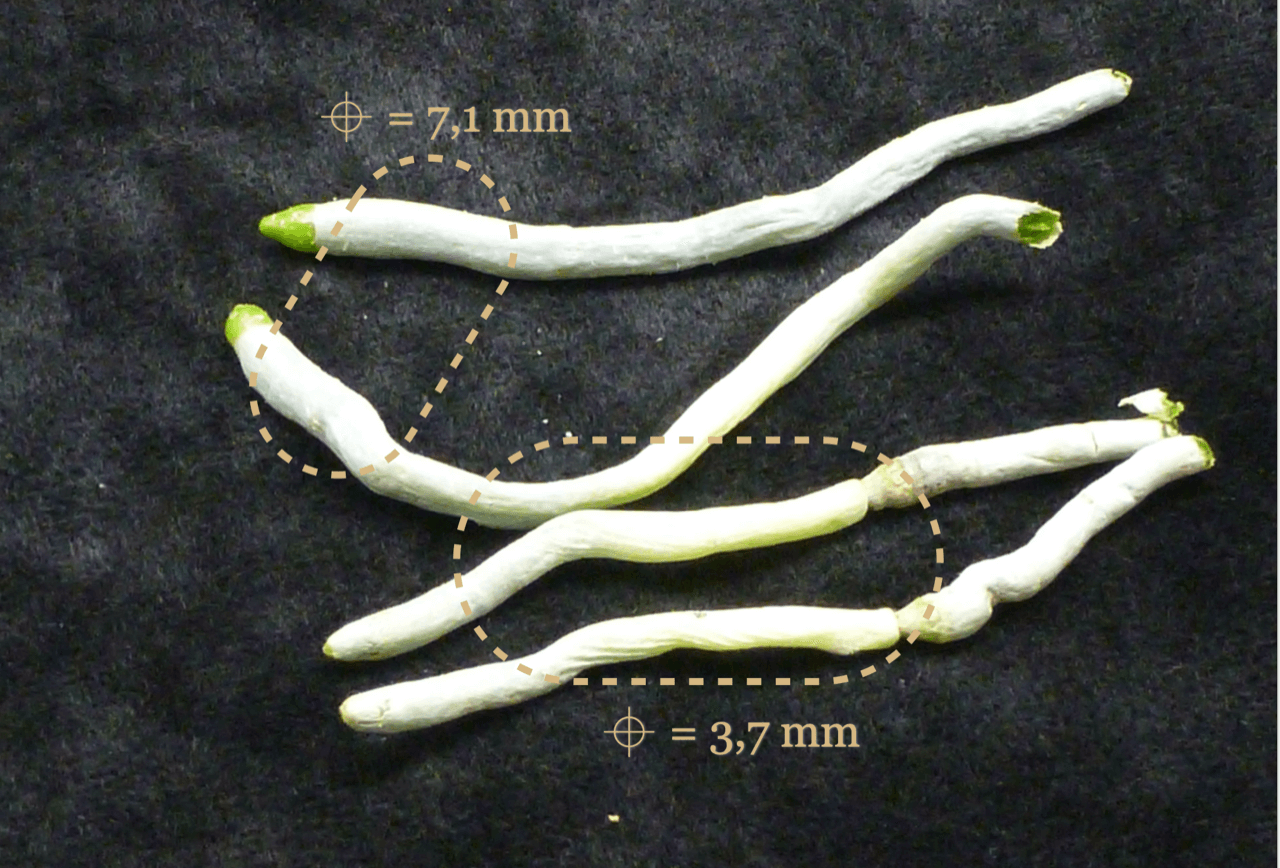
The photo on the right shows a close-up of the three roots that developed within the protective packaging, highlighting the significant difference in diameter. On average, the diameter of the light-protected roots is half that of the reference roots that remained above ground. In terms of velamen volume, therefore, the aerial root is four times larger per unit length than the sections located under the protective packaging. One of these roots emerged from the packaging and resumed vigorous growth when exposed to light once again. The difference in diameter between the ‘dark’ and illuminated sections is striking.
To facilitate observation of morphological changes, the roots in this small-scale experiment were cut and arranged against a black background, as can be seen in the following photo.
Once they have been established, aerial and substrate roots can no longer be interchanged
Velamen roots exhibit variable geometry as they adapt to their surroundings during formation. Aerial roots are typically plump and highly absorbent, but they can dry out relatively quickly as they are exposed to the air. Roots hidden in the pot are thinner and less absorbent, but they can draw moisture from their immediate surroundings to compensate for the limited velamen reserves. In this case, the spaces between the substrate particles allow sufficient gas exchange to prevent root rot.
However, this balance between moisture and gas exchange is fragile. Aerial roots and their counterparts hidden in the substrate are not interchangeable. A root that has developed in the substrate is less absorbent and will struggle to survive in the open air unless it is watered frequently enough to replenish its water reserves regularly. Conversely, an aerial root (which is plump and more absorbent) will eventually rot if forced into the pot because the constant humidity will reduce its ability to breathe normally.
For more details on orchid roots, see the article on this topic.
Implications for growing epiphytic orchids
To successfully grow orchids, you must learn to strike the right balance between hydration and root respiration. In general, the substrate should be allowed to dry out between waterings to enable gas exchange. The hydration/respiration cycle will obviously differ depending on whether the root is aerial (drying in 24–48 hours) or substrate (requiring several days, often 7–10, under normal growing conditions).
For orchids with primarily aerial roots, such as Vandas, it is essential to water them frequently to rehydrate these roots. Once the orchid has developed a robust root system in the potting mix, ensure you water it thoroughly to saturate both the roots and the substrate. This creates a water reserve that lasts longer.
However, it’s important to allow the potting mix to dry out between waterings in all cases, as this facilitates the gas exchange necessary for the internal chemistry of the roots. Dry periods also reduce the risk of bacterial and fungal infections. To check whether the potting mix is sufficiently dry before watering, simply lift the pot; it will feel much lighter when the substrate is dry. If you are unsure, you can also insert small bamboo sticks into the substrate to check for any remaining moisture.
More tips
Many experienced orchid growers gently redirect emerging aerial roots towards the substrate, encouraging their development within it rather than in the open air. This enables the roots to adhere to a hydration/respiration cycle of seven to ten days instead of the one- to two-day cycle required by aerial roots. However, this isn’t always possible or desirable. Some botanical genres are unsuitable. When it is possible, though, maintaining the collection can be greatly simplified.
To help redirect the aerial roots towards the substrate, apply a topdressing of sphagnum moss. After lifting a pinch of moss, gently tilt the moistened root towards the substrate. Then, cover the root with more damp moss to hold it in place. This will allow the young root to continue growing and optimise its morphology.

Great article. Good for beginners, starting to learn and cultivate orchids. Keep up the great work.