
With the economy in a bit of a slump, many people are looking for ways to save money. And one of the most obvious ways to spend less is to grow your own fruits and vegetables. But you don’t have to install a formal vegetable garden at home, with its rectangular shape and long, straight rows. It’s perfectly possible to incorporate edible plants into an attractive landscape design. This combination of tasty plants and tasteful landscaping is called “edible landscaping.”
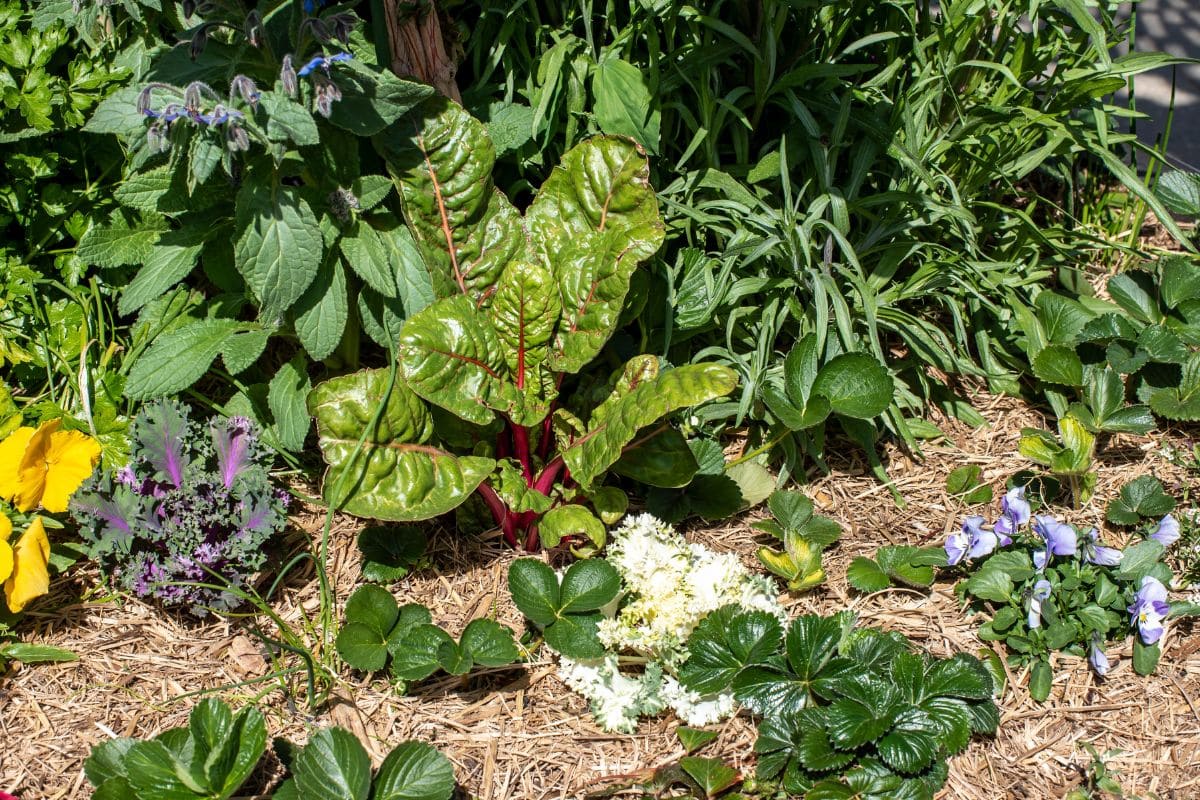
Edible landscaping
The basic principle of edible landscaping is that useful plants can be used ornamentally, allowing you to harvest fruits and vegetables without spoiling the landscape. And when you look at edible plants, you discover that many are often just as pretty as strictly decorative varieties.
For example, can you see a major difference between an ornamental crabapple tree and a fruit-bearing apple tree? Both are covered with extraordinary flowers in the spring; the main difference is that the crabapple tree produces small fruit, while the apple tree produces large fruit. Both are equally decorative while the fruit is on the tree, but at the end of the season, the crabapple fruit ends up in the compost, while the apple fruit can be eaten fresh or cooked..

The same applies to other fruit trees: plum, cherry, pear, etc. They are both ornamental and useful. And small fruits too. Blueberries, in particular, have everything going for them as ornamental shrubs: beautiful bell-shaped flowers in spring, colorful and delicious fruits in summer, and flaming red leaves in fall. Gooseberry and currant bushes are just as decorative as they are useful. Grapevines make superb climbing plants when trained on a trellis or pergola, and their hanging green, red, or purple fruits are beautiful in the fall! The hardy kiwi (Actinidia kolomikta), with its pink, silver, and green leaves, is as pretty as it is edible… provided you plant a few female plants to accompany the male plant that most nurseries only offer.
Vegetables too
It is not only fruit trees that are both decorative and ornamental, but vegetables too. All you have to do is take them out of their straight rows and use them differently to discover their appeal. For example, the potato was imported into Europe as an ornamental plant and was used as a summer bulb, much like we would grow a dahlia today. After all, its blue-violet and white flowers are magnificent and its rounded shape is impeccable. It was Antoine Parmentier who succeeded in convincing the French that its tubers were edible in 1772.

Tomatoes experienced the same situation. For almost 300 years, they were used as decorative plants, trained to climb trellises and obelisks, but no one dared to eat their fruit. At the time, they were thought to be poisonous. In France, they were even called “death apples”! Try growing a cherry tomato on a trellis and you’ll see: it’s just as ornamental as it was in the 18th century.
Other naturally attractive vegetables include runner beans, with their beautiful bright red flowers; cabbage, with its leaves that are sometimes blue-green, sometimes purple-red; rhubarb, with its huge leaves and massive creamy white flowers; asparagus, which looks like a fluffy bush; and Swiss chard, with its thick red, yellow, pink, or white petioles. Hot peppers produce red, yellow, purple, and many other colors of fruit and are sold as ornamental plants at Christmas under the name “Christmas peppers”… but they are the same plant and just as pretty in the summer vegetable garden as they are in pots during the holiday season. Several herbs also have undeniable decorative appeal: chives, oregano, lavender, borage, etc.
Ornamental varieties
Other vegetables are fairly ordinary in appearance, but come in ornamental varieties. Curly lettuce, for example, comes in green, but also in red, and there are varieties of beet, notably ‘Bull’s Blood’, with purple foliage. In fact, if you visit the Montreal Botanical Garden, you will see that beets are used as annuals in many flower beds. There are also ornamental (and useful) varieties of several herbs: purple basil, golden oregano, tricolor sage, etc.

Even “ordinary” vegetables can become stars… when you stop planting them in rows. Sow corn in clumps of four to five plants here and there in your garden, and you’ll end up with an extraordinary ornamental grass. Climbing beans look enchanting on a trellis, as do squash and cucumbers. And how about a border of curly parsley? How wonderful!
The unexpected sides of “ordinary plants”
But while we’re discovering the ornamental aspects of so-called useful plants, why not discover the useful aspects of so-called ornamental plants? The flower buds, flowers, shoots, and even roots of daylilies are eaten as vegetables in Japan. Monarda, with its fragrant and delicious flowers and leaves, is considered an herb in many countries. The fragrant flowers of roses can be eaten, as can their fruits. The flowers of tuberous begonias are edible and delicious. And the list goes on and on. Many of the plants in your current flower bed may be edible: you just need to do a little research to find out. (Never taste a plant without first finding out about it, as some ornamental plants are poisonous.)

Larry Hodgson has published thousands of articles and 65 books during his career, in both French and English. His son, Mathieu, has made it his mission to make his father’s writings accessible to the public. This text was originally published in the newspaper Le Soleil on January 14, 2012.
Men buni bir necha marta sinab ko‘rdim va hozirgacha hammasi yaxshi ishladi. Pul qo‘yish tez bajarildi, pul chiqarishda hech qanday muammo bo‘lmadi. Sayt sodda va qulay, agar kimdir sinab ko‘rmoqchi bo‘lsa, mana havola: https://coldbet-uz.net/registration/
. Umuman olganda hech qanday qiyinchilik bo‘lmadi va ishonchli ko‘rinadi.
I’m going to try this on my allotment this year, thank you 🙂
I already plant out strawberries in my flower beds as they are nice to nibble while weeding!