
You have a friend with a beautiful garden visited by hummingbirds, and you’d love to attract them too. But how do you do it? Should you add shrubs, perennials, annuals, or a little of everything? First, it helps to know which hummingbirds live in your area.
We’ve all heard of hummingbirds, but there are some things many people don’t know about them. When you want to attract them to your garden, it’s best to understand who you’re trying to invite. In eastern North America, gardeners are visited by a single regular species: the ruby-throated hummingbird.

Encountering the ruby-throated hummingbird
The ruby-throated hummingbird is a member of the large Trochilidae family, which includes 366 species of hummingbirds. It is a species found only in North America, east of the Mississippi River. This species is also found in Central America, where it migrates.
The male is easily distinguished from the female. It has a ruby-colored throat, which is where it gets its name. The young and the female have white throats and white tail feathers. If, in August, you see an individual with a white “checkerboard” pattern dotted with green spots on its throat, it is a juvenile male. Our featherweight champion weighs only 3 grams, the weight of a letter you would put in the mail!
Okay, enough about this gardener’s favorite. I have to admit something: I am a huge fan of this tiny winged visitor to my garden. It was to attract them that I first started researching books to find out which flowers to plant that would appeal to him. A fault confessed is half forgiven, as they say, so I confess that it was around a hummingbird feeder that I first saw my star flying around me.
How to attract hummingbirds to your garden
It is not difficult to attract it to your garden. Simply plant flowers with large, deep corollas, such as beebalm or petunia. It is often written that they prefer red flowers. In fact, there is a reason for this choice: it feeds on flowers that are not sought after by other pollinators, such as bees. Flowers with deep corollas are not accessible to pollinators because, with their short proboscis, they cannot reach the bottom of the corolla where the nectar is found!
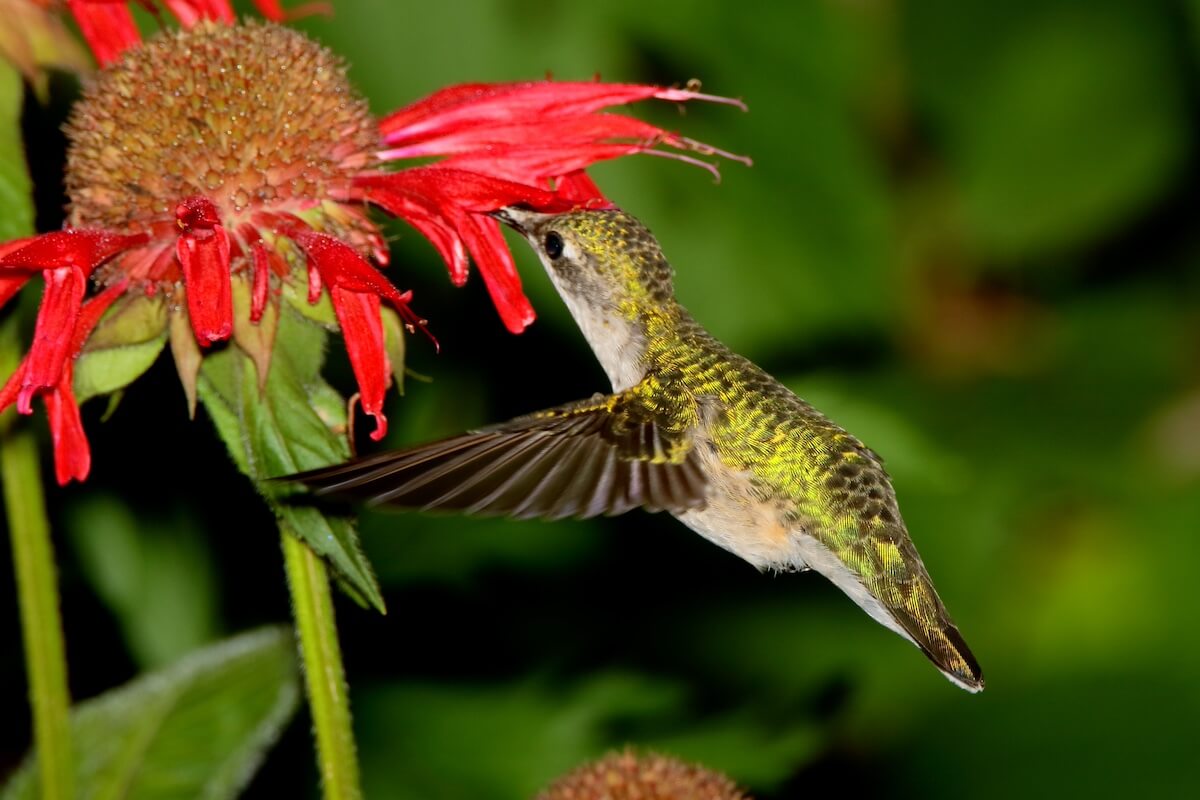
There is a wide selection of deep-corolla flowers, both annuals and perennials, that thrive in full sun or partial shade. In my search for plants, I took these options into account, as well as the layout of my garden. With a 15-meter-wide (50 feet) silver birch (Betula pendula) shading three-quarters of my front yard, I opted for hostas and daylilies. The latter are not necessarily a favorite of hummingbirds, but you have to indulge yourself a little, right?
Based on my research aimed at attracting my idol, I opted for safe choices such as bee balm, a perennial that perfectly matched the description of the flowers he was looking for. However, my choice brought me a problem: powdery mildew, a fungal disease that affected my plant.
Now I know that there are varieties that are resistant to this disease. It’s true that some people find this plant invasive, but that’s because it spreads through its stolons on the surface of the soil. There is a positive side to this, as it is easy to control by pulling them up and making people happy when you give them away (yes, I must admit that I am not capable of throwing a plant away). I give them away and put the surplus in a corner of the garden to distribute later. My “compulsive” side makes a lot of people happy!
Plants that have proven themselves
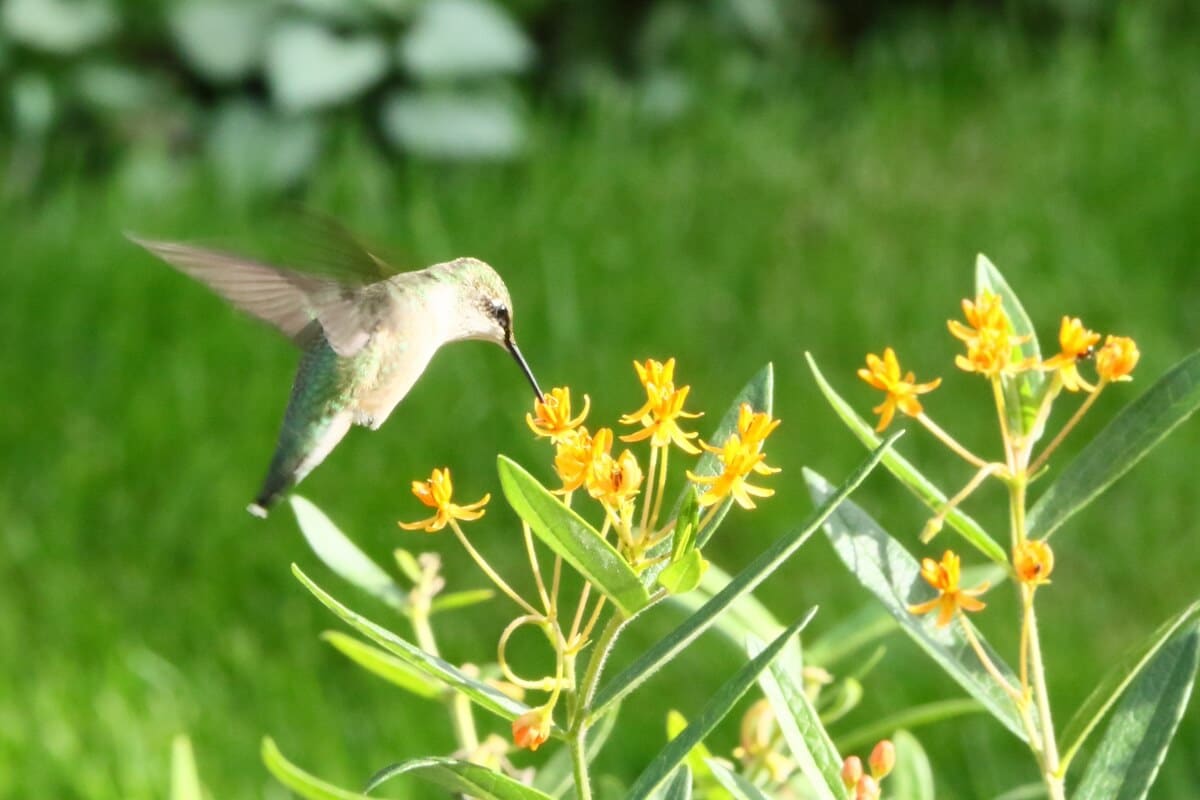
My list contains a large number of plants for this favorite bird. Some people have told me that there are plants that are not included, even though I mention them as being popular with birds. Here is a very simple explanation: I am still making happy discoveries that I haven’t had time to record. One example is the tuberous milkweed (Asclepias tuberosa), which is very popular at the end of August, a few days before the hummingbird’s departure south.
Below, I will try to name plants that have proven successful in my garden. I therefore make it my duty to recommend those that have proven themselves. Let’s be clear: I am wary of plants that are not mentioned in my list and that are “claimed” to attract birds! It’s fairly easy to put a label on a plant in a garden center or nursery without being certain of the success of a particular species.
Another example: new varieties, such as the ‘Vermillionnaire’ cigar plant. Cuphea hybrid Vermillionnaire® is said to attract birds, but I haven’t tried it. So I won’t recommend it, as I don’t know how successful it really is.
So now I’m going to tell you what red-throated hummingbirds like, giving you the names of a few plants that attract them and that I’ve been able to try out. Let’s go by category.
Annuals
- Bat-face cuphea (Cuphea llavea)
- Black-eyed Susan vine (Thunbergia alata ‘Terra Cotta’), a climbing plant that I use as a trailing plant. There are other varieties, but this one works very well.
- Calibrachoa Calitastic® ‘Pumpkin Spice’. Calibrachoas are known for attracting hummingbirds. I tried several varieties from the Million Bells® series. They’re not my favorites… but what color!
- Cigar plant (Cuphea ignea)
- Cuphea (Cuphea spp.)
- Dianthus (Dianthus spp.), bright red varieties.
- Fuchsia (Fuchsia × hybrida)
- Fuchsia ‘Insulinde’ (Fuchsia triphylla), a pretty little shrub that likes shade or partial shade. Annual in our northern climates.
- Jewelweed (Impatiens capensis), native, self-seeds abundantly, invasive, but easy to pull out.
- Lantana (Lantana camara), so pretty with its orange flowers.
- Ligularia (Ligularia japonica), attracts American goldfinches and dark-eyed juncos.
- Nasturtium (Tropaeolum majus)
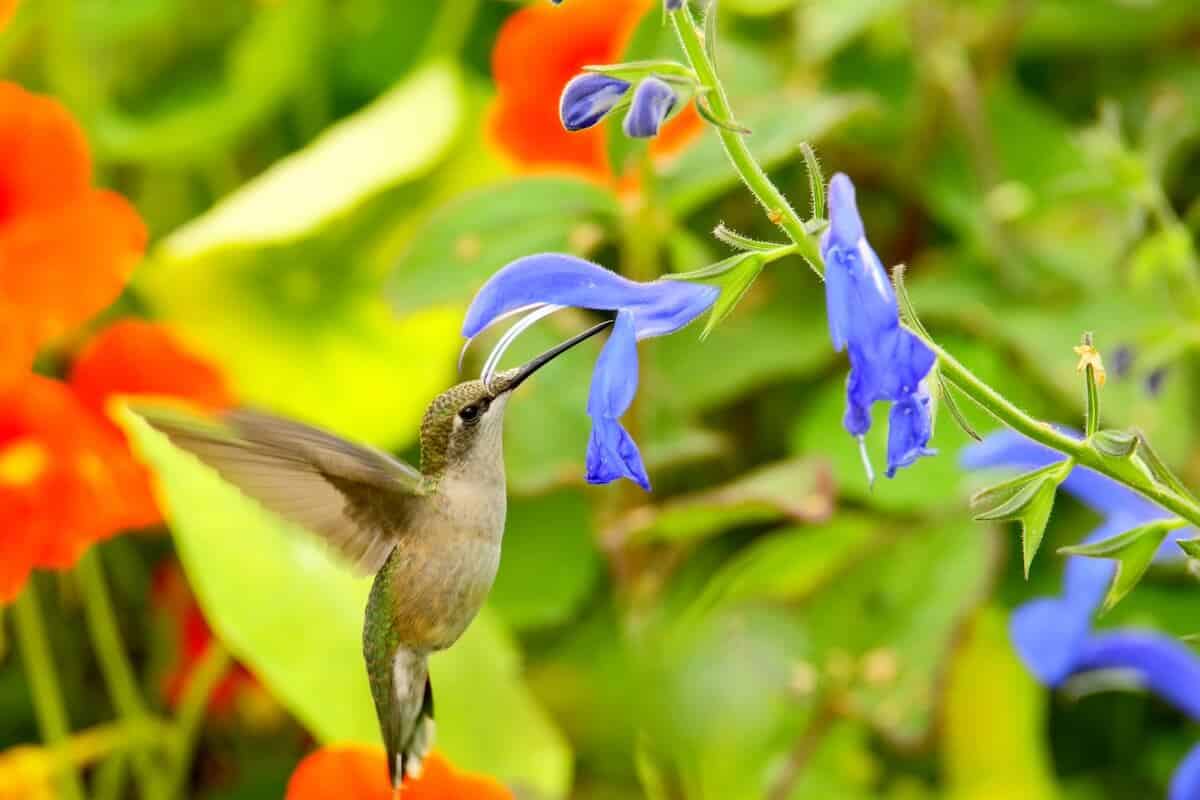
- Salvia ‘Blue Angel’ (Salvia patens ‘Blue Angel’), so pretty!
- Salvia ‘Cherry Blossom’ (Salvia ‘Cherry Blossom’)
- Salvia ‘Lady in Red’ (Salvia coccinea ‘Lady in Red’)
- Salvia ‘Lighthouse Red’ (Salvia splendens ‘Lighthouse Red’)
- Verbena ‘Red Obsession with Eye’ (Verbena × hybrida)
Perennials
- Columbine (Aquilegia spp.), early in the season.
- Canadian columbine (Aquilegia canadensis), native.
- Butterfly weed (Asclepias tuberosa), late in the summer season.
- Monkshood (Aconitum napellus), a reliable and very beautiful perennial.
- Bicolour monkshood (Aconitum × cammarum ‘Bicolor’)
- Globe thistle (Echinops ritro)
- Turtlehead (Chelone obliqua), late in the season.
- Maltese cross (Lychnis chalcedonica). It’s magical. A tender perennial sometimes treated as a biennial.
- Purple coneflower (Echinacea purpurea). Attracts American goldfinches, pine siskins and butterflies.
- Hosta ‘Albomarginata’ (Hosta fortunei var. albomarginata). Many other hosta varieties also attract hummingbirds—I’ve seen them feeding on the flowers.
- Indian tobacco (Lobelia inflata). Native; considered an annual, biennial or perennial depending on hardiness zone and winter protection (snow cover, wind, etc.).
- Scarlet beebalm (Monarda didyma). There are varieties more resistant to diseases such as powdery mildew.
Climbing plants
- Cypress vine (Ipomoea quamoclit). Be aware that the leaves and flowers are quite small to admire up close…
- Scarlet morning glory (Ipomoea coccinea)
- Scarlet runner bean (Phaseolus coccineus)
Shrubs
- Dropmore scarlet honeysuckle (Lonicera × brownii ‘Dropmore Scarlet’)
- Mandarin honeysuckle (Lonicera × brownii ‘Mandarin’)
- Weigela ‘Bristol Ruby’ (Weigela florida ‘Bristol Ruby’)
I wish you would be a little more careful with your usage of the term “invasive”. Some native plants are vigorous, aggressive growers but they don’t meet the definition for invasive. Many of those aggressive native plants are very important for butterflies, moths and bees.
I think many Canadian growers use biologicals for pest control in their operations, but consumers should ask if any systemic pesticides have been applied to the plants they are purchasing. Systemic pesticides enter every cell of the plant, killing non-target insects and contaminating pollen and nectar. People forget that plants don’t exist for us to enjoy their beauty – they are food for other living organisms.
What amazing photos. These little birds are beautiful. I’m in the UK and sadly, we don’t get any humming birds here. However, I often see pheasants in the garden and they land on the fence outside my window.