


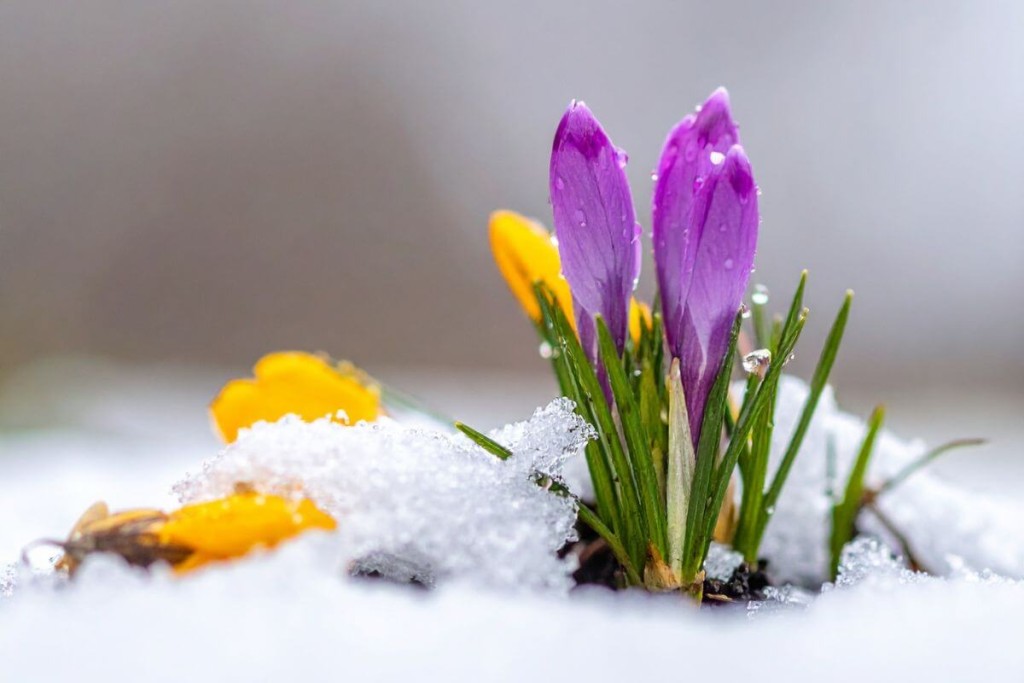
Around March 20th, spring officially arrives.
Yet at this time of year, the landscape often seems to hover between winter and spring. Depending on the region and the year, there may still be plenty of snow… or it may have almost disappeared.
I can assure you, however, that spring has indeed arrived and that plants are responding to its presence, despite the cold.
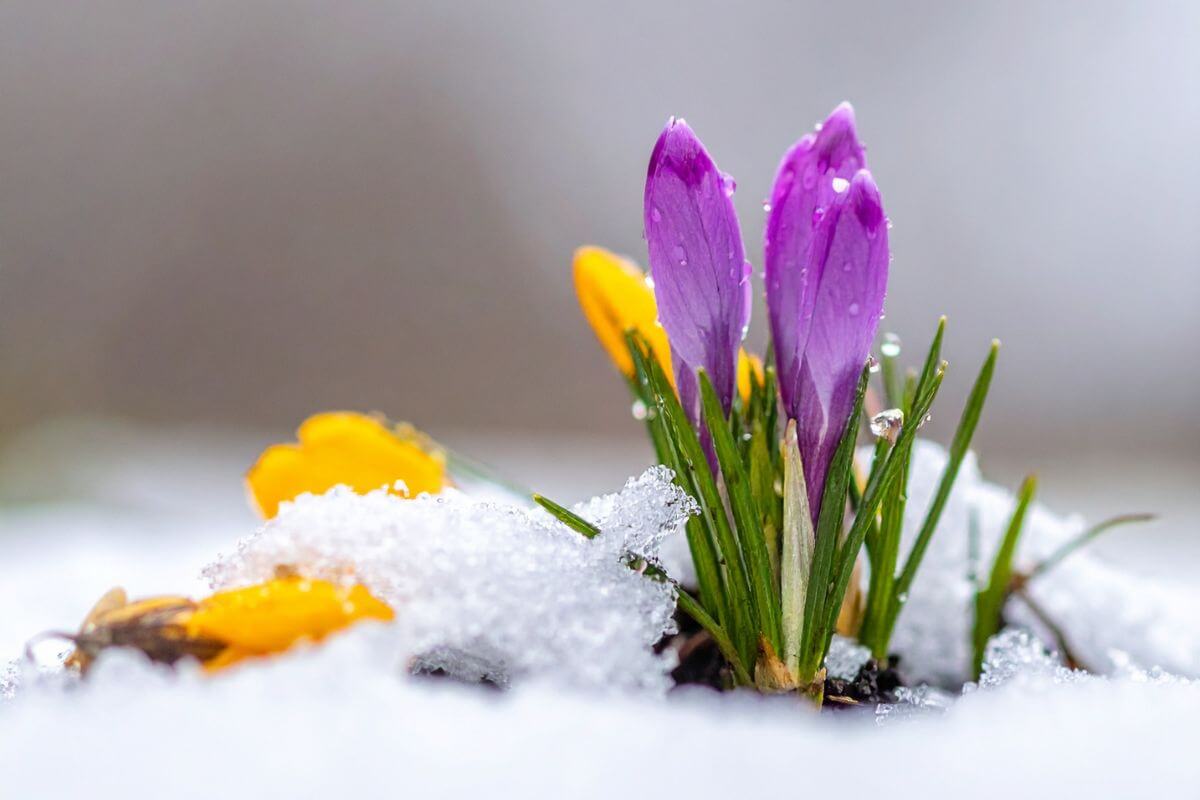
Bulbs in full bloom
Did you know, for example, that beneath that thick layer of snow, some plants are already growing? It seems almost impossible, and yet spring bulbs are already beginning to sprout. Often, the ground begins to thaw beneath the snow, and as soon as that happens, the shoots of snowdrops, crocuses, winter aconites, reticulated irises, and other early-blooming bulbs pierce through the soil. Right now, the shoots are still pale yellow, but as soon as the sun touches them, they’ll turn green. Their flower buds, in fact, are already ready to bloom.
When the snow finally melts, the flowers may sometimes open on the very first day (snowdrops and winter aconites), or within the following week. The winter aconite (Eranthis hyemalis) does even better: when it is ready to bloom, it begins to generate heat to melt the snow. Some springs, you can see the bright yellow flowers of the winter aconite blooming from small holes in the snow that the bulb’s heat has caused itself.
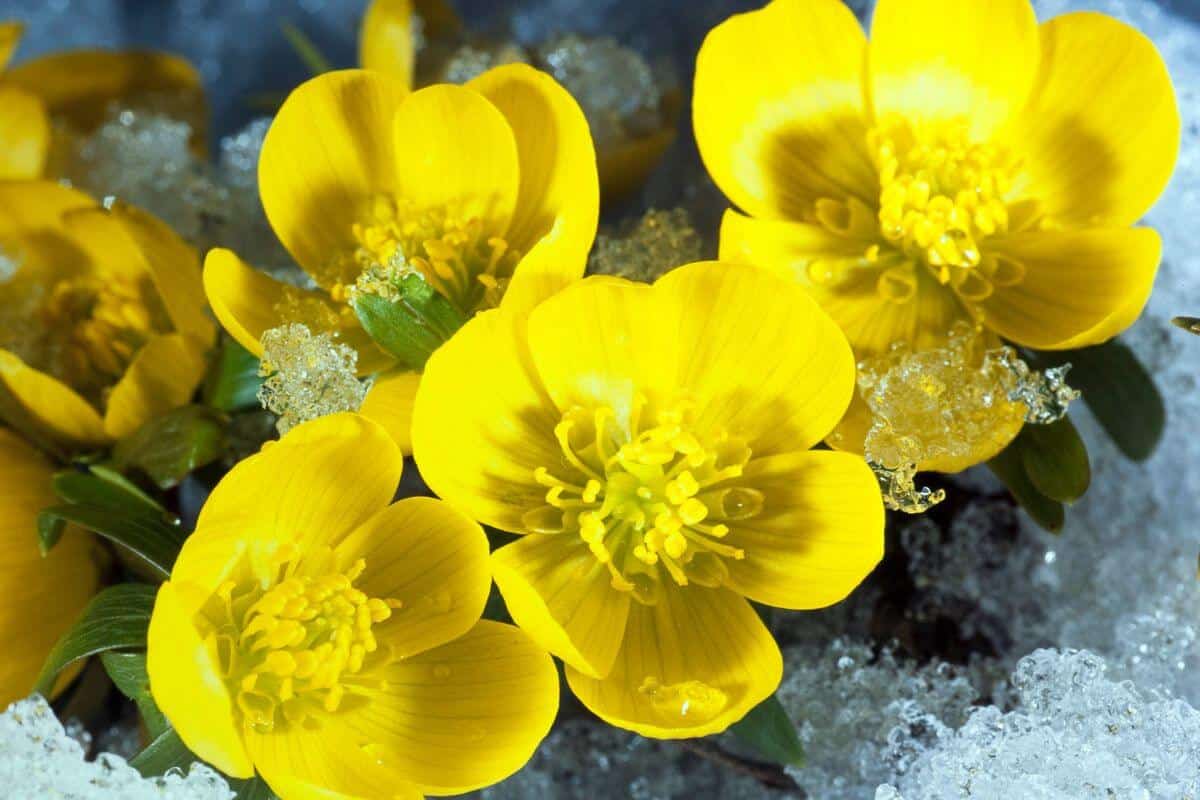
All these small bulbs are readily available at garden centers, but they must be planted in the fall. They can be planted in any well-drained spot that gets plenty of sun in the spring. Since the bulbs go dormant in the summer and don’t need sunlight during that season, they thrive under deciduous trees.
A heating cabbage
The winter aconit isn’t the only plant that melts snow. In our damp woodlands, another plant—this time a native species—is getting ready to bloom. The stinkcabbage (Symplocarpus foetidus) produces a large bud shaped like a monk’s hood in the spring. As a result of a chemical reaction, the bud is 15 to 30°C (59 to 86°F) warmer than its surroundings, allowing the inflorescence to break through the snow and ice. Obviously, the stinking cabbage isn’t as attractive as the winter aconite or a snowdrop. Its large inflorescence is more of a purplish-brown, and with a name like stinking cabbage, I don’t need to point out that the plant’s scent leaves much to be desired. In its defense, know that this odor is only noticeable if you stick your nose right into the flower. It serves to attract the carrion flies that pollinate it.
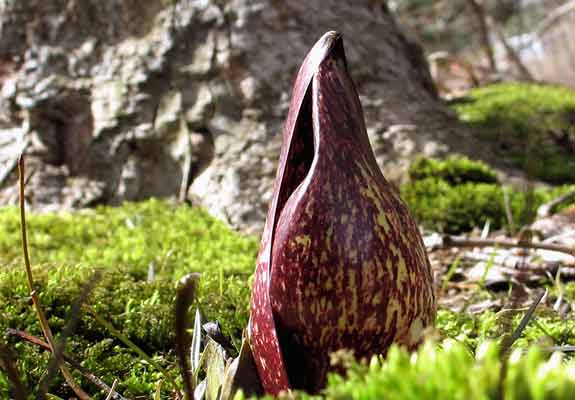
I can hardly recommend stinkweed as an ornamental plant, and in fact, it’s generally not available at garden centers. That said, the flowers are intriguing, and the large, paddle-shaped leaves are quite attractive. It grows abundantly in the wild in the Quebec City area, particularly in marshes and near waterways. With a little luck, the stinking cabbage will be in bloom this week; if not, then next week.
Catkin season
Willows with their catkins also bloom very early. They usually start to bloom as soon as the plant’s roots thaw, even if the ground is still covered with snow. So, to admire them up close at the start of their blooming season, you’ll need to put on some snowshoes! Come back with a few armfuls: they make excellent fresh or dried flowers.
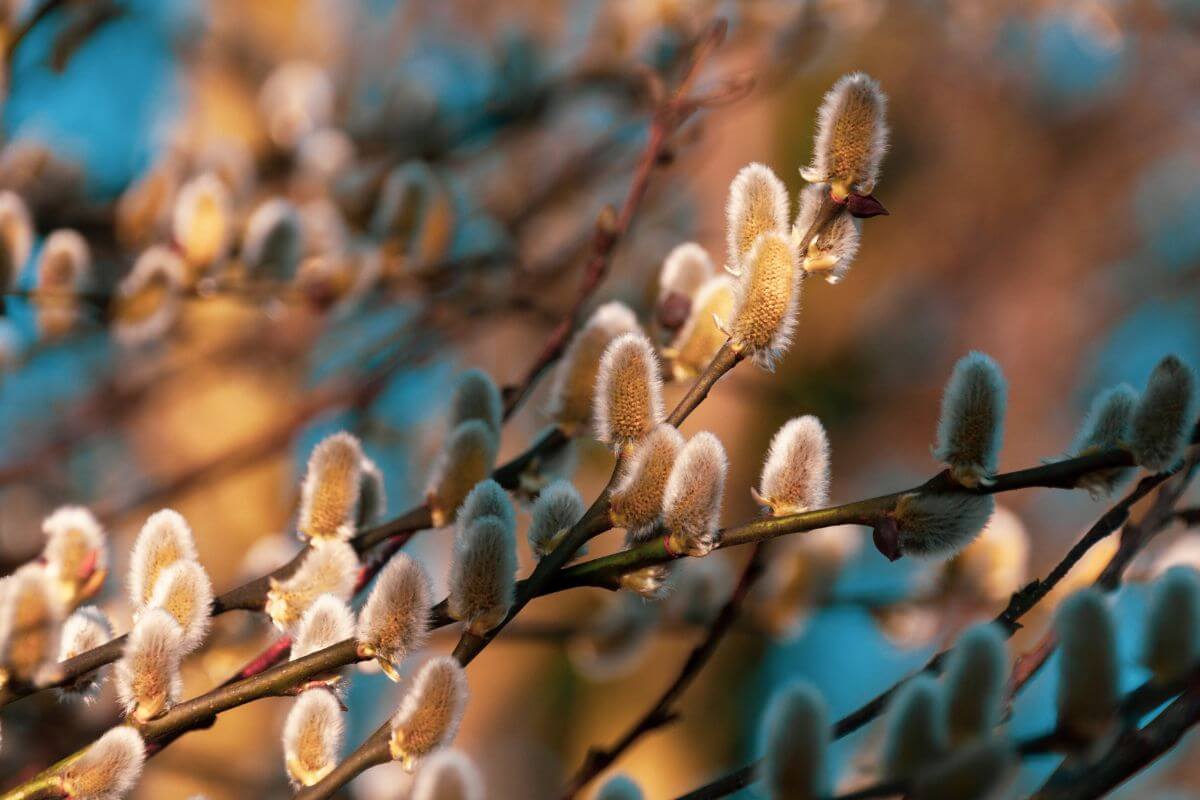
The catkins truly live up to their name, as they are covered in silvery-gray hairs, much like a kitten’s paws. These hairs protect the more delicate flowers from the cold. Although the catkins are already clearly visible, the true blooming begins a little later, when the yellow stamens of the male flowers emerge and cover the catkins with a golden halo. Sadly, the female flowers, which grow on separate plants, are not as attractive as the male ones.
The most spectacular
All willows produce catkins, but the most spectacular ones are those of the goat willow (Salix caprea), which is native to Europe, and the white willow (Salix discolor), which is native to North America. The most commonly sold form of goat willow is the weeping goat willow (S. caprea ‘Kilmarnock’), but it is not a good choice for our climate because, like most standard-grafted shrubs, its graft union is often damaged in winter, and as a result, it does not live very long: 2 or 3 years, rarely more. The species, with its upright stems, is more hardy. Zone 5 m × 4 m (16 × 13 ft).
The American pussy willow (S. discolor), a large shrub or small tree, is completely frost-hardy and is an excellent choice for our region. Zone 1. 5–8 m × 5 m (16–26 × 16 ft).
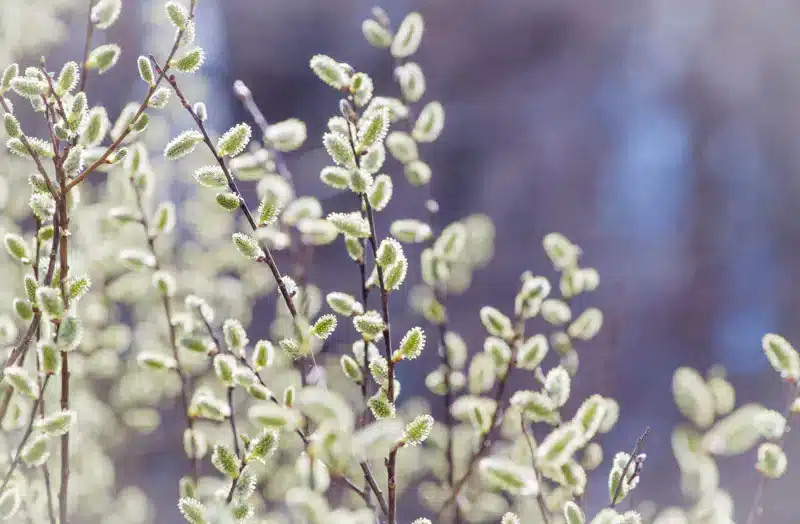
There are other catkin willows that you can occasionally find at garden centers with pink, red, or even black catkins! It’s up to you to create a multicolored bouquet!
All willows thrive in full sun and fairly moist soil, and can even tolerate soil that floods in the spring. Unlike large willows, such as the black willow (S. nigra) and the weeping willow (S. x sepucralis‘Chrysocoma’), the willows recommended here are shrubby and their roots do not spread widely. Thus, they do not damage pipes or foundations and can be grown without worry.
And your houseplants
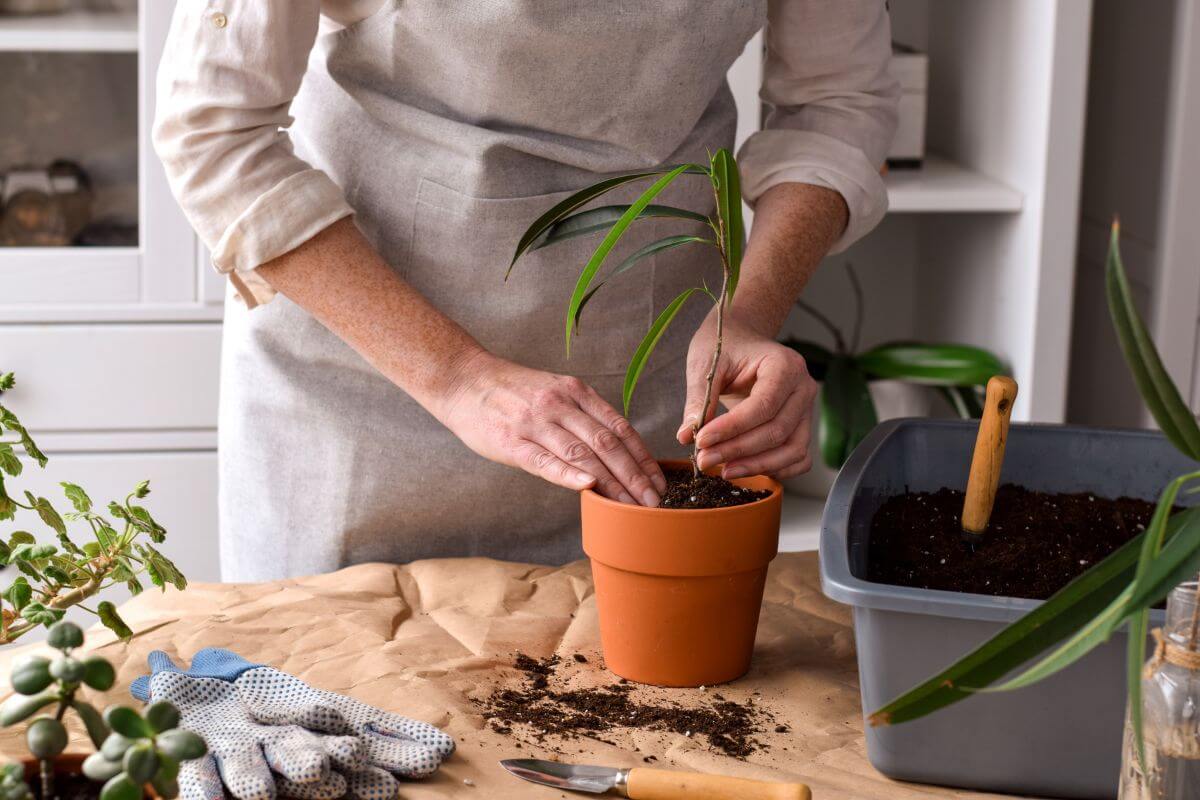
Finally, one last sign that spring has truly arrived: your houseplants. Most haven’t changed much since winter, but they’re now producing new leaves, new shoots, and even new flowers. It’s the increasingly longer days that are encouraging them to grow, despite the cold outside. So now is the time to start fertilizing them again and perhaps repot them.
There you go! I’ve proven to you that spring is definitely here, despite the weather outside. Learn to appreciate this rebirth of nature: it can help snap you out of your winter slump!