


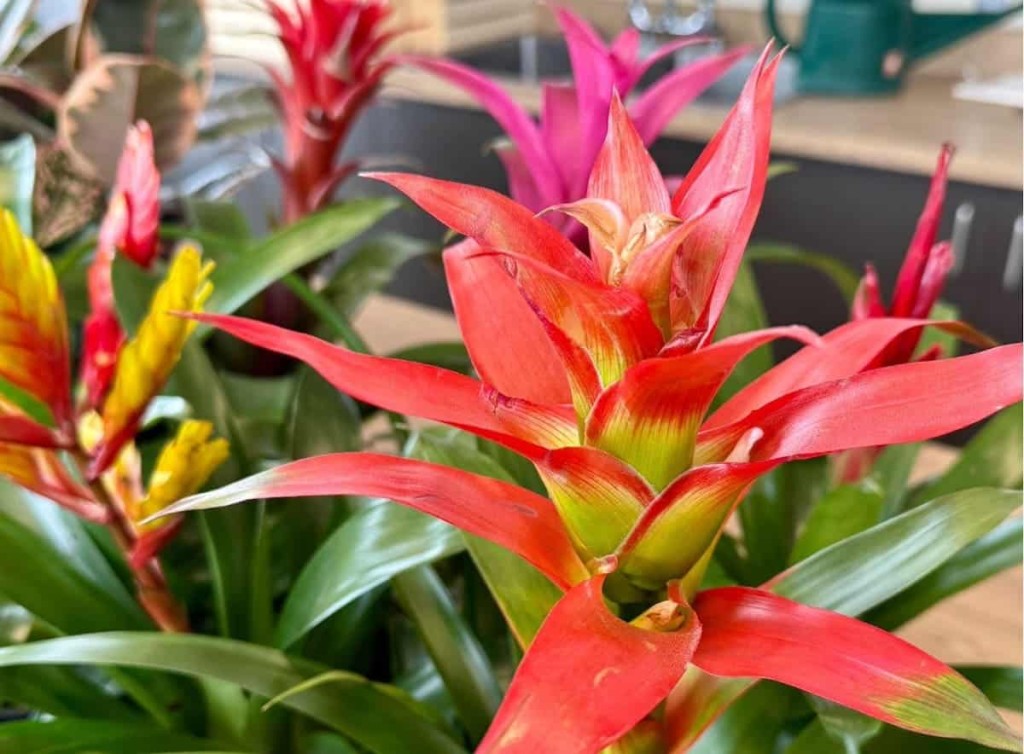
The Bromeliaceae family includes plants that are particularly fascinating, both for their sometimes unusual shapes and their highly spectacular inflorescences. But this botanical family also exhibits several unique characteristics among its members. According to many experts, what makes it unique is that it is the only family primarily associated with the “New World”—assuming that the two hemispheres of the Americas can be grouped together here as a single continent. Today, we invite you to discover these plants with their unique morphology, incredibly resilient adaptations, and distinctive ornamental appeal. A family that has quickly won the hearts of horticulturists!
A tropical family that turns out to be fascinating and delightful
Bromeliads grow freely in the Amazon rainforest and coastal dry forests, where they are often found alongside orchids and ferns, creating fascinating ecosystems that are both mysterious and enchanting.

More than half of the 3,000 known species in this family are epiphytes and lithophytes, meaning they grow attached to tree trunks or rocks without parasitizing their hosts, simply drawing water and nutrients from the air, rain, dust, and organic debris captured by their leaves. Meanwhile, other Bromeliads are strictly terrestrial and dot the tropical landscape with often exceptional botanical surprises.

For history buffs, Christopher Columbus is associated with the discovery of this family through the delicious pineapple (Ananas comosus). For indeed, the pineapple is part of this prestigious family. We would like to thank Christopher Columbus, posthumously of course, for this tasty discovery. However, we must not overlook the role of the friendly gardener to Charles I of England (16th century), who captivated the court by presenting his first cultivated pineapple. This first exotic harvest certainly popularized the fruit and, incidentally, contributed to the horticultural craze for Bromeliaceae. A horticultural success that was also deemed significant enough to be immortalized on canvas.

Morphological characteristics
Rosettes, leaves, and water
Bromeliads are generally herbaceous plants with simple leaves arranged in tight rosettes. These rosettes often form natural reservoirs that collect and retain rainwater, creating small “pools” at the center of the plant.
In some species, these water reservoirs become microecosystems, harboring a surprising diversity of invertebrates or even small amphibians.

The sessile leaves (without petioles) are often serrated, leathery, or stiff, forming a compact cluster adapted to bright and sometimes dry environments.
Flowers and inflorescences
Bromeliad flowers have three sepals and three petals (very similar to those of lilies, but much more inconspicuous), usually surrounded by colorful bracts that attract pollinators, such as birds or insects. Bromeliad flowers have evolved to adapt to a wide variety of pollinators.
The flowers of most Bromeliads are rather inconspicuous, but their inflorescences can be quite spectacular with colorful bracts.

Unlike many lush tropical plants, bromeliads aren’t always very large: some epiphytic species grow to only a few dozen centimeters in height, while other genera, such as Puya, can reach several meters in height.

A family with surprising adaptations
Whether epiphytic or terrestrial, Bromeliads retain this characteristic rosette structure. The roots, when present, serve primarily to anchor epiphytic species rather than to absorb water; in several genera such as Tillandsia—known as air plants—specialized leaf trichomes capture moisture from the air.

A striking example: the pineapple
Ananas comosus (Bromelia ananas), the first species discovered in the Bromeliaceae family and also the most familiar, is a prime example of this family’s ingenuity: a fleshy fruit that is actually a modified inflorescence, in which numerous individual flowers fuse to form a single edible aggregate fruit.
Bromeliads and horticulture
Historical accounts note that bromeliads quickly gained popularity as ornamental plants. Thanks in part to their ability to withstand long sea voyages, they were quickly adopted in their new homes. The Belgians were the first to contribute to the popularity of bromeliads as houseplants. Thus, these plants could be found in homes until the early 20th century. However, it wasn’t until the 1980s that Bromeliads secured a prominent place on garden center shelves in America—a gentle paradox for a continent where they first originated several centuries earlier.
Hybridization also played a role in this craze by bringing new cultivars and varieties to the market. Grown as ornamental plants, Bromeliads add a unique touch of exoticism. Whether hung, placed in a terrarium, or potted, their striking rosettes and sculptural flowers are admired by plant lovers.
Since most are epiphytes that thrive on filtered light beneath the forest canopy, bromeliads prefer bright but indirect light. A slightly moist growing medium is best: allow the surface to dry out between waterings before watering again. For some species, it is also possible to water directly into the rosette, where water naturally collects.
Some popular genres in culture


How can you tell a bromeliad apart?
Here are a few characteristics that set this family apart:
- Leaves arranged in a rosette, often forming a natural bowl.
- Often epiphytic, but also terrestrial depending on the species.
- Flowers surrounded by bracts that are often colorful and divided into three parts.
While all Bromeliads are perennial herbaceous plants, they also exhibit an incredible and surprising diversity in many ways: sometimes epiphytic, sometimes terrestrial, they fascinate with their unique morphology and ingenious adaptations to life in environments that can be hostile. Their distinctive shape, the sometimes vibrant color of their leaves, and the incredible originality of their inflorescences are all characteristics that make them highly sought-after horticultural specimens. Their ease of cultivation contributes to their growing popularity and undoubtedly ensures a prosperous horticultural future for them. So, will you be a future fan of Bromeliads?
Next family: the Fabaceae!