
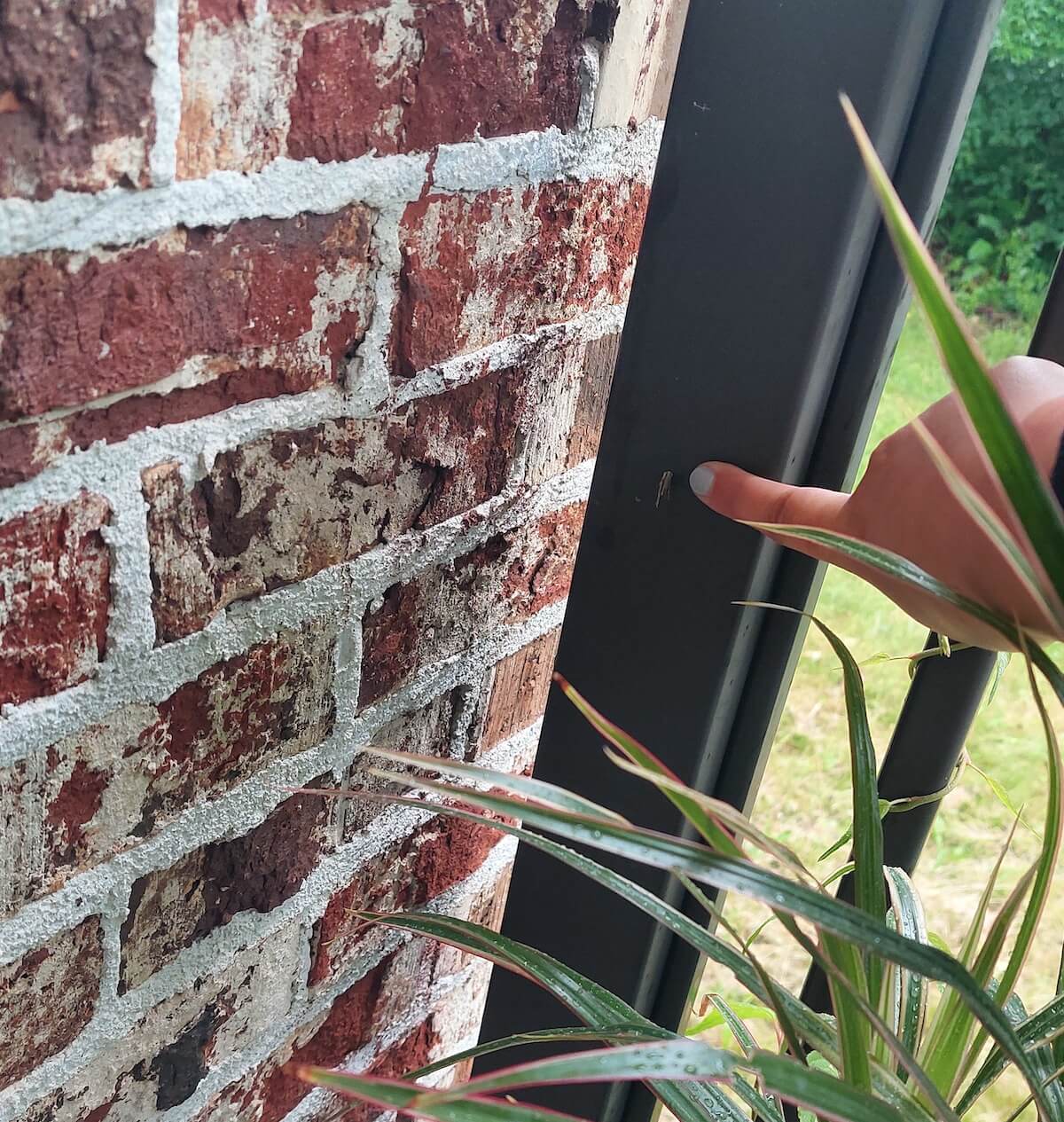
While most people were busy with summer chores, I found myself staring at my patio table with perhaps a little too much concentration, admiring one of the tiniest mobile homes I’d ever seen.
A curious discovery
J’avais repéré ce qui ressemblait à une «schmoutte».
I’d spotted what looked like a tiny piece of dried grass.
At least, that’s what I thought it was.
It was no more than half an inch (1 cm) long and looked like the sort of windblown bit of plant debris that lands on outdoor furniture all the time.
Without thinking, I blew on it.
Nothing happened.
The little bundle was firmly attached to the table. Then, just as I reached over to brush it away, it started wriggling all by itself.
There was somebody home.
Judging by the way it squirmed, its occupant wasn’t particularly thrilled with the unexpected gust of wind.
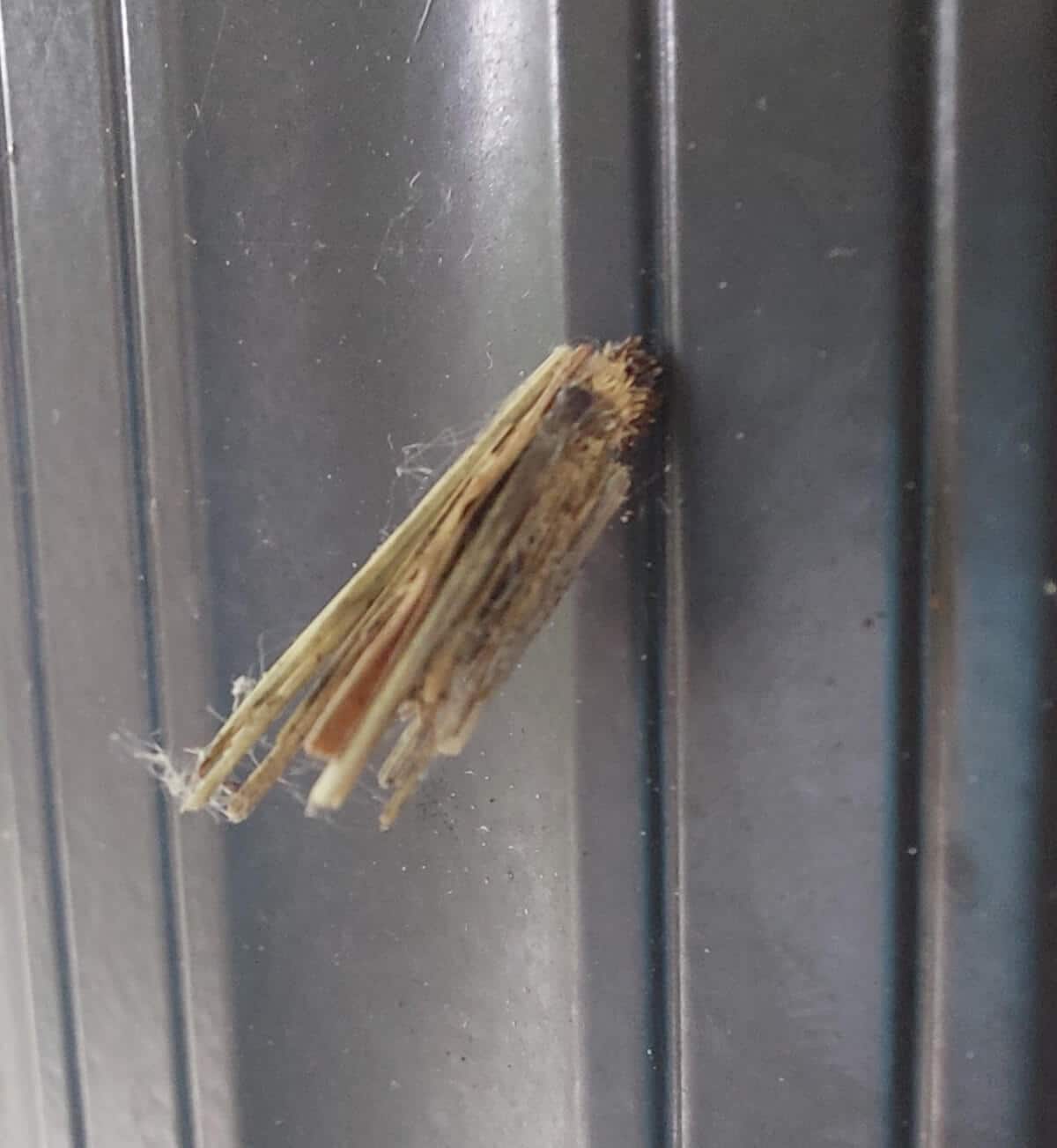
This summer, I’ve been finding these tiny bundles everywhere: on my windows, my deck, the siding of my house, and even on my outdoor flower pots. Curiously, I almost never notice them on trees or in the garden itself, though that’s probably because they’re so well camouflaged.
Architecture in miniature
The mysterious tenant is the caterpillar of a bagworm moth (family Psychidae), a group of moths whose larvae build themselves portable homes almost as soon as they hatch.
The caterpillar spins silk—much like a silkworm—and carefully glues bits of dried grass, twigs, bark, lichens, or whatever else is lying nearby onto the outside of its case. The result is a neat little bundle that looks remarkably like a miniature bundle of sticks.
That silk is no ordinary thread, either. Researchers have shown that bagworm silk can actually be stronger than spider silk, making it of interest for advanced materials research. A Japanese company has even combined it with carbon fiber to develop specialty textiles for aerospace applications.
Not bad for a little critter most people would mistake for a speck of yard debris.
As the caterpillar grows, it enlarges its portable home by adding new material to the front while trimming away the narrow rear end. It never completely leaves its case. Only its head and front legs emerge to crawl around and feed, while the rest of its body remains safely tucked inside.
At the slightest sign of danger—or an unexpected puff of air from an overly curious gardener—it instantly retreats back into its tiny home.
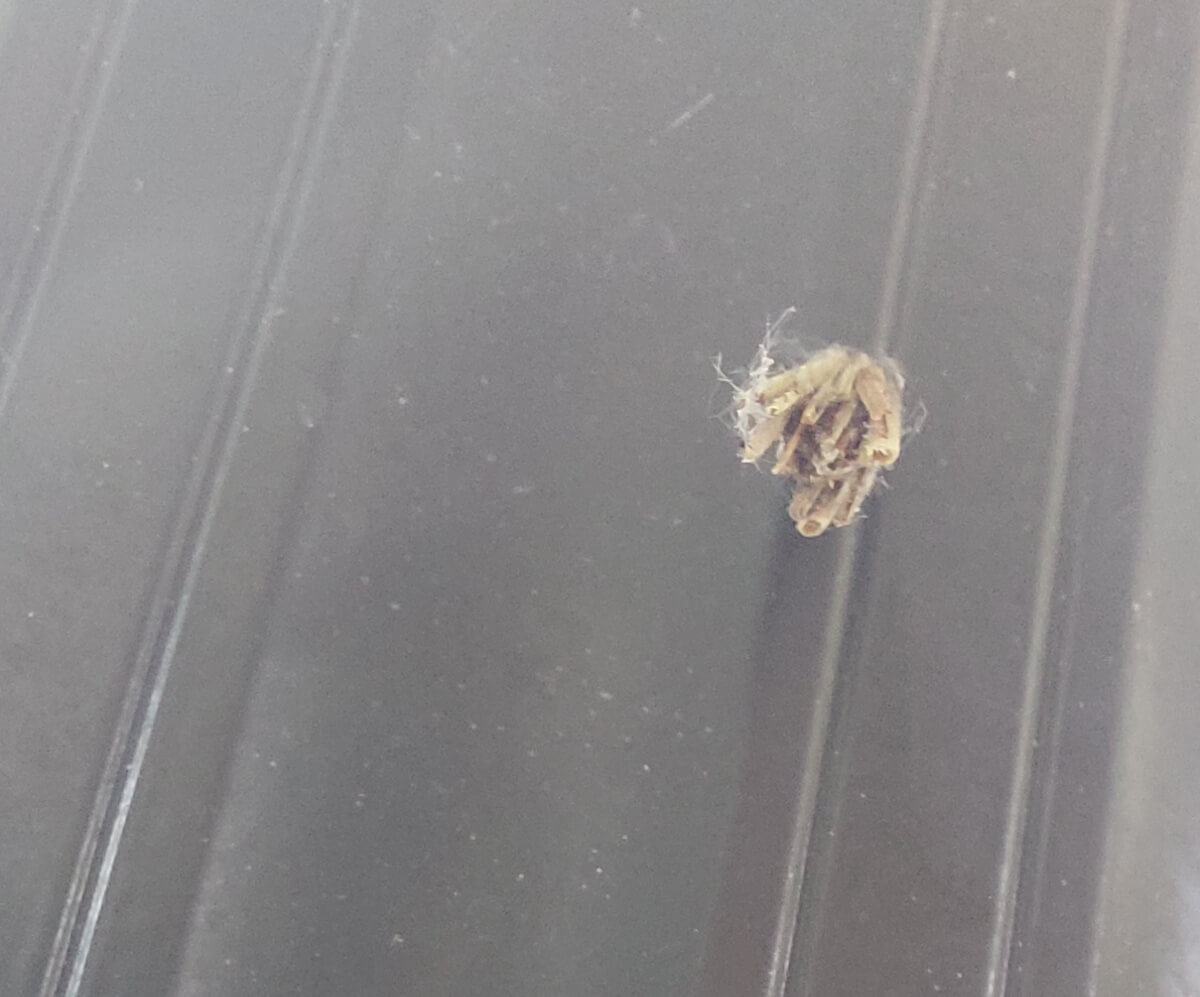
I even tried peeking underneath the case to catch a glimpse of the rest of the caterpillar, but it refused to cooperate.
Who is this tenant, anyway?
I didn’t dissect the case or send a specimen to an entomologist, so I can’t guarantee the exact species. But based on a comparison of my photos with the available literature, the most plausible candidate would be Psyche casta, sometimes called the common bagworm moth. I mention this with all due caution: it could very well be a very similar relative, as the Psychidae family includes hundreds of species that look extremely similar to the naked eye.
What makes this hypothesis interesting is that the caterpillars of this species feed primarily on lichen and microalgae found on the surfaces of various materials, as well as on grasses and the foliage of birch, willow, poplar, and even blueberry bushes. That would explain very well why I find them on my walls, windows, and planters: these surfaces happen to host the kind of thin layer of lichen or microscopic algae that they seem to feast on, rather than on the living foliage in my flower beds. So it’s not a pest—phew!
A tenant’s life cycle
After spending its entire larval stage wandering around with its home on its back, the caterpillar eventually chooses a permanent spot—often a surface such as a wall, a fence, or a window frame. It then securely attaches its chrysalis to that spot, and that is where it will transform into a chrysalis.
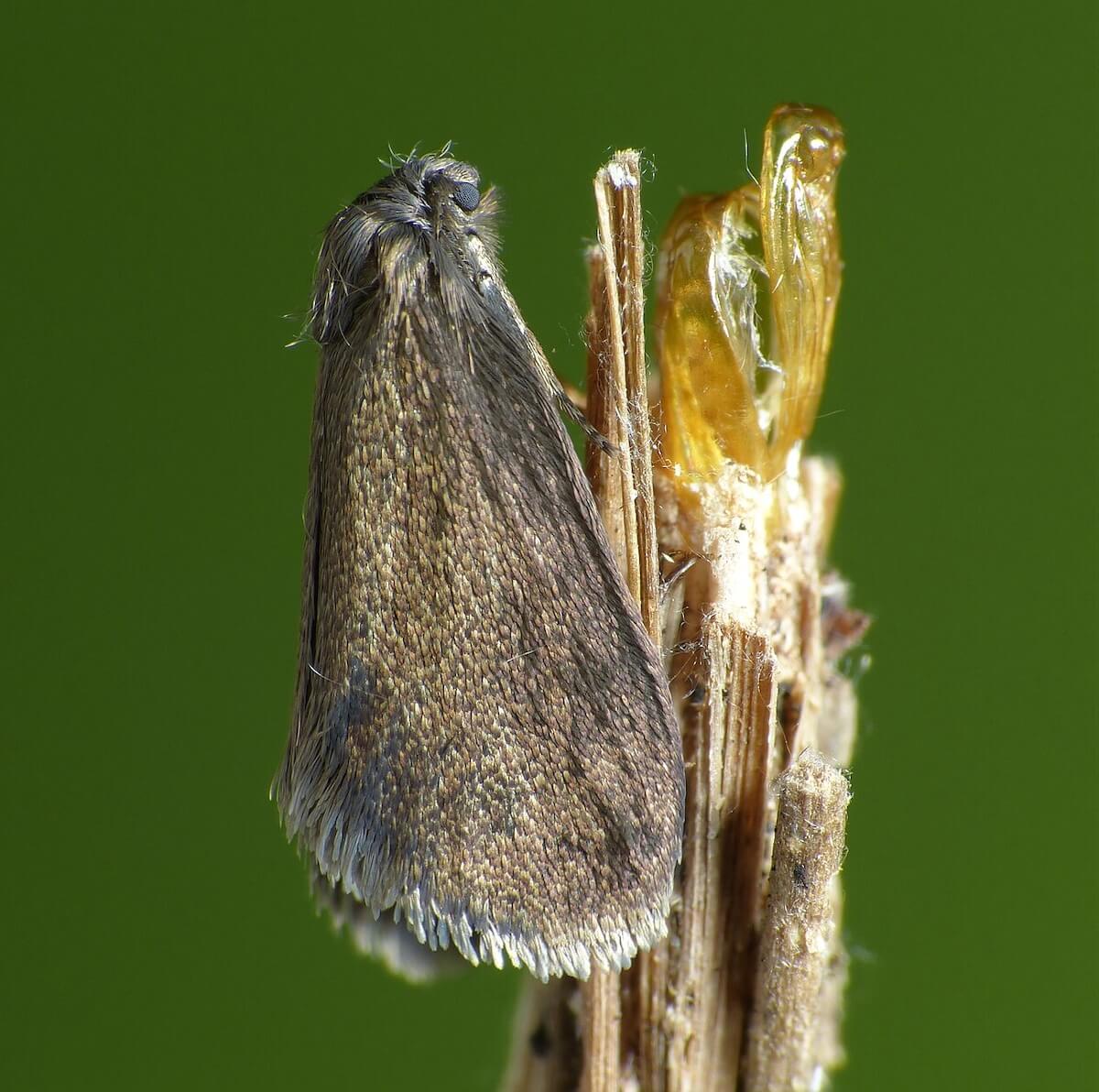
The male that emerges will be a tiny butterfly with metallic wings. The female, on the other hand, remains a resident: as an adult, she has neither wings nor functional eyes. She stays inside her chrysalis, releasing a pheromone to attract a male, who comes to fertilize her. Without leaving her chrysalis, she then lays her eggs and lives out the rest of her life, leaving behind a small chrysalis filled with eggs that will hatch the following spring.
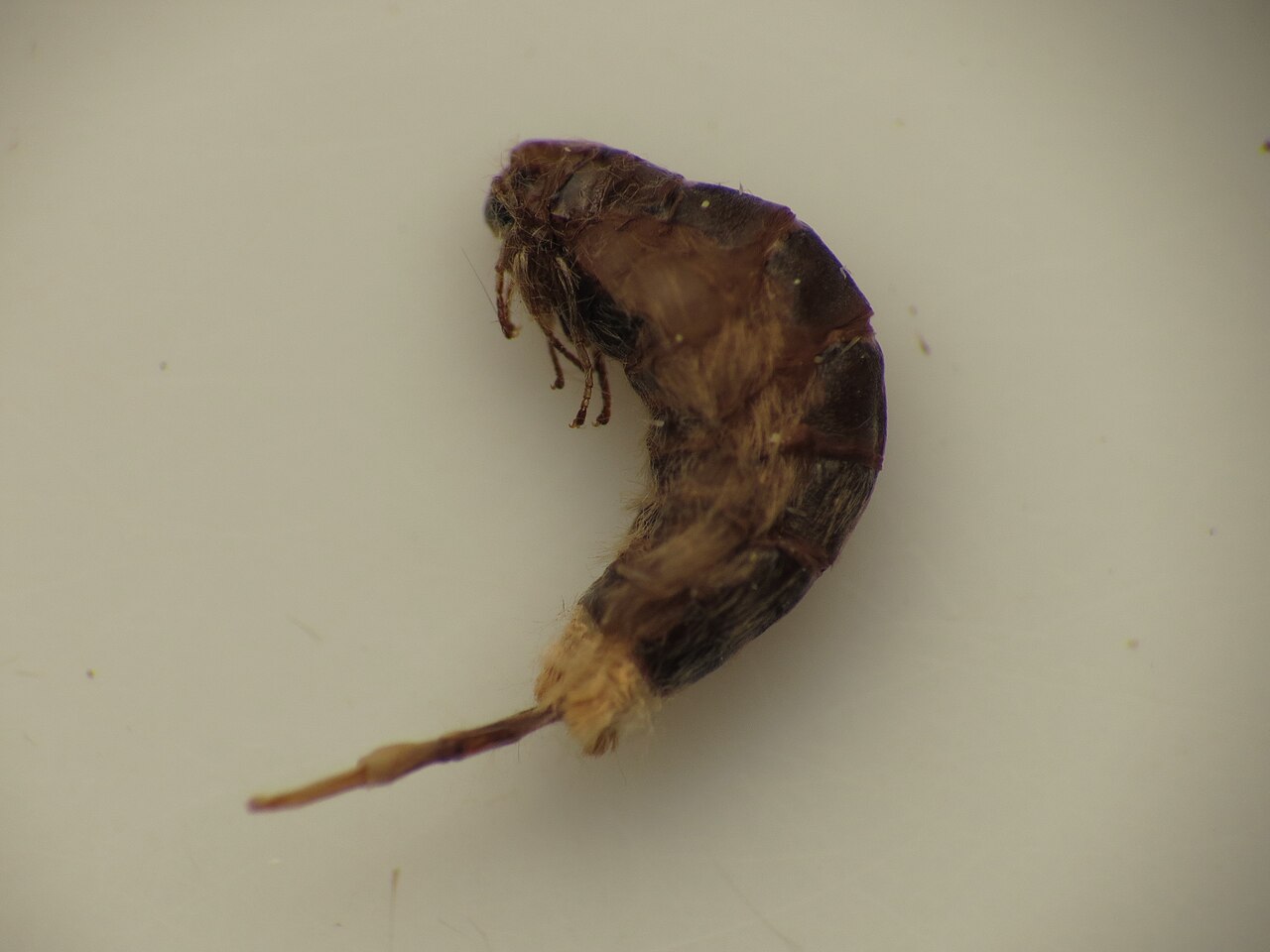
Not a clothes moth, and not a threat to your woolen garments
A quick clarification, because I stumbled over this myself while researching these fascinating little creatures.
Bagworm caterpillars are sometimes confused with caddisfly larvae, another group of insects famous for building portable cases. But the resemblance is only superficial. Caddisflies are aquatic insects whose larvae live in streams and ponds, constructing their protective cases from sand, pebbles, sticks, or leaves. They’re well known to fly anglers, who imitate them with artificial flies. They have nothing to do with our tiny terrestrial tenants.
Bagworms are also occasionally mistaken for tent caterpillars, which live communally and spin the large, silky tents that are so conspicuous in the branches of trees each spring. Bagworms couldn’t be more different. They’re solitary insects, with each caterpillar living alone inside its own portable case.
And despite the name bagworm moth, they won’t damage the wool sweaters tucked away in your closet. The confusion comes from the fact that the English word moth includes thousands of very different species. While clothes moths do feed on natural fibers, bagworm moths are an entirely different group and have no interest whatsoever in your wardrobe.
A newcomer, but not a threat
Another interesting detail: if my hypothesis holds true, this species is not native to this area. Psyche casta is thought to originate from Europe and Asia and is believed to have been introduced to North America, where it is now established, including in Canada. Before any of you native plant enthusiasts start to worry, rest assured that nothing in the scientific literature points to any environmental or economic problems associated with this species.
At worst, it’s considered an occasional minor pest for some blueberry growers or ornamental shrubs—nothing more. No endangered plants, no disrupted ecosystems. It’s simply a newcomer that has quietly settled into the landscape for some time and is now part of our daily lives without us really noticing.
What about you?
The next time you spot a little bug on your porch or in your flower pots, I hope you’ll take a moment to blow on it—just to see what happens! It might be someone’s little home.
What about you—have you ever noticed these tiny little wandering houses around your place? If your answer is no, I have a feeling you’ll be seeing them soon! They’re so inconspicuous that you don’t notice them… unless you know they exist, and then suddenly you start seeing them!
… Following that logic, I’m going to start believing wholeheartedly in unicorns!
Interesting facts about bagworms: they are actually quite different from the caterpillars that nest in trees.
This is one of the most useful articles I have read recently. The content is easy to understand, and the advice seems practical enough to apply in real situations. Thank you for sharing your knowledge and helping readers learn something valuable through your blog. ????????????
Wow! Great article. A new critter to look forward to discovering. Thank you.