
I’ve been visiting gardens around the world for over 40 years, and each time I learn a little more about their history. And there’s one thing in particular that fascinates me: how is it that, all over the world, people have taken to beautifying their surroundings with plants? It seems there’s a bit of the horticulturist and a bit of the artist in all of us, and that the marriage of the two comes to life in the garden.
Here’s a “quick tour” through the history of European gardens—the ones that have so greatly influenced our own gardens.
Antiquity
The origins of gardens are lost in the mists of time, but we know that prehistoric peoples actively protected desirable plants—particularly fruit trees—and eliminated competing species. Gradually, they began to group together varieties considered more desirable: this marked the beginning of gardening.
But it was with the emergence of the first cities, about 10,000 years ago, that ornamental gardens first appeared. Typically, it was wealthy individuals who created these gardens: who else would have the means to afford a green space intended solely for aesthetic purposes?
Mesopotamia
It was in Mesopotamia 3,000 years ago that we began to see tangible evidence of these gardens, whether in the form of their ruins or written accounts about them. These were enclosed gardens (surrounded by walls) designed for the enjoyment of their owners, featuring raised paths forming squares in which fruit trees and medicinal plants were grown. Soon, simple fountains were added. Royal gardens were often large enough to host grand celebrations. The Hanging Gardens of Babylon were the most famous of this period and were considered one of the Seven Wonders of the World. The catch is that it is not certain whether these gardens ever actually existed. It is possible that they were instead a composite of descriptions of various Mesopotamian gardens provided by travelers.
In Egypt, the earliest confirmed gardens date back to around 1600 BCE, as paintings from that era depict water lilies surrounded by symmetrical rows of acacia and palm trees. These gardens were often incorporated into temples.
The tradition of gardens has long been well established in Persia (modern-day Iran), and indeed, the Persian garden can be said to be one of the main influences on the European gardens that would follow. Darius I (550–486 BCE), in particular, owned a “garden of paradise.” This type of garden was typically rectangular, divided into squares by four canals (the four rivers of the Garden of Eden) and featuring a fountain at its centre. The squares contained neatly aligned fruit trees. This garden represented the paradise that all humans hoped to reach at the end of their lives. Gardens of paradise can still be found in Iran, in several Islamic countries, and in India (notably the gardens of the Taj Mahal).
Europe
Curiously, the Greeks were not considered particularly avid gardeners (in fact, even today, Greece is not well known for its gardens), although gardens could be found around certain temples.
The story is quite different when it comes to the Romans. They adopted the enclosed courtyards and fountains of the Persians and added statues, staircases, grottoes, and more. In fact, the word “garden” comes from the Late Latin gardin (meaning “enclosed space”). There were even public gardens, open to all citizens of Rome—a very generous concept for the time!
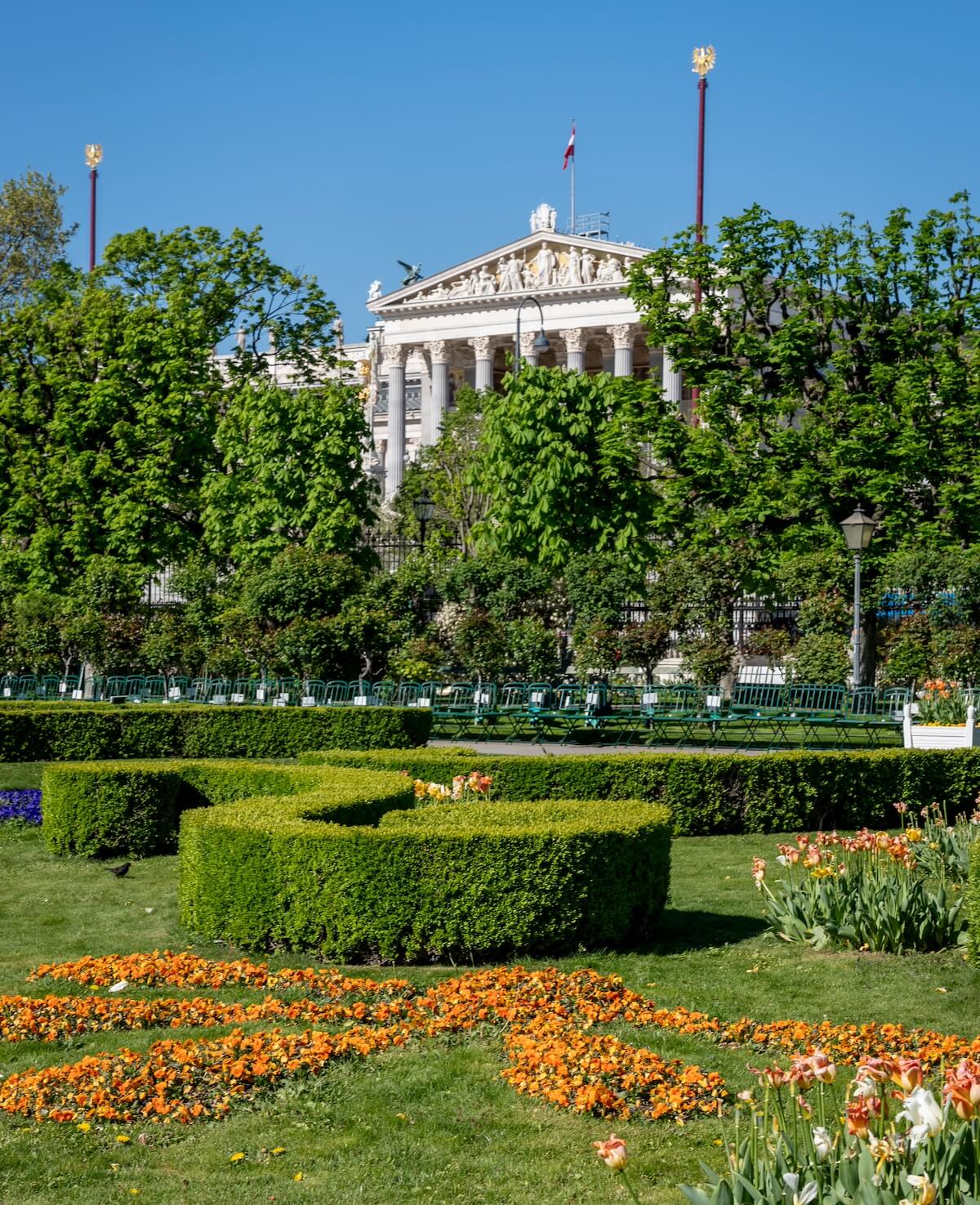
The typical Roman garden consisted of a raised terrace, the xystus, overlooking a flower garden below, the ambulatio, which was surrounded by a tree-lined arched path, the gestatio. In addition to the large gardens reserved for the wealthiest, the middle class maintained small gardens in the inner courtyard of their homes, located behind the atrium. Topiary—shrubs sculpted into geometric and even animal shapes—was popular in atria.
Over time, the Romans competed to see who could grow the most exotic or rare plant, and Roman gardens became increasingly flower-filled. It was also in Roman cities that the first flower boxes appeared. There were even rooftop gardens in some Roman cities.
Middle Ages
The fall of Rome essentially wiped out ornamental gardens in Western Europe (though they continued in the East under Byzantine influence). During the Middle Ages—that is, between the 5th and 15th centuries—the art of gardening retreated to monasteries and convents. Behind the walls of these sanctuaries, one would often find a vegetable and fruit garden, a medicinal herb garden, or a contemplative garden—the latter located in the cloister and designed for meditation. Typically, these gardens were rectangular in shape, with four paths intersecting at the centre, like the Persian Garden of Paradise. Except that the intersection was no longer seen as the four rivers of paradise, but as representing the cross of Christ.
The influence of the Moors
In Spain and Portugal, the tradition of ornamental gardens was revived thanks to the Moors. During their presence between the 8th and 15th centuries, they introduced a style of garden heavily influenced by the Persian Garden of Paradise, but one that made greater use of water. As a people of desert origin, the Moors greatly appreciated water. Jets, fountains, streams—you could say water was gushing everywhere! They also loved pleasant scents and introduced jasmine, perfume roses, and citrus trees to Europe. However, almost no statues adorned their gardens: figurative depictions of living beings were generally avoided due to their religion (although there are rare architectural exceptions, such as the famous Fountain of the Lions at the Alhambra). Moorish gardens can still be seen in Spain, notably El Generalife in Granada.

When it comes to the history of the ornamental garden’s return to Europe after the Middle Ages, the word “Renaissance” is perfectly chosen, because the ornamental garden was about to rise spectacularly from its ashes… but we’ll get to that next week.
Larry Hodgson has published thousands of articles and 65 books throughout his career, in both French and English. His son, Mathieu, has made it his mission to make his father’s writings accessible to the public. This article was originally published in Le Soleil on August 16, 2014.
0 comments on “A Brief History of Gardens (Part One)”