


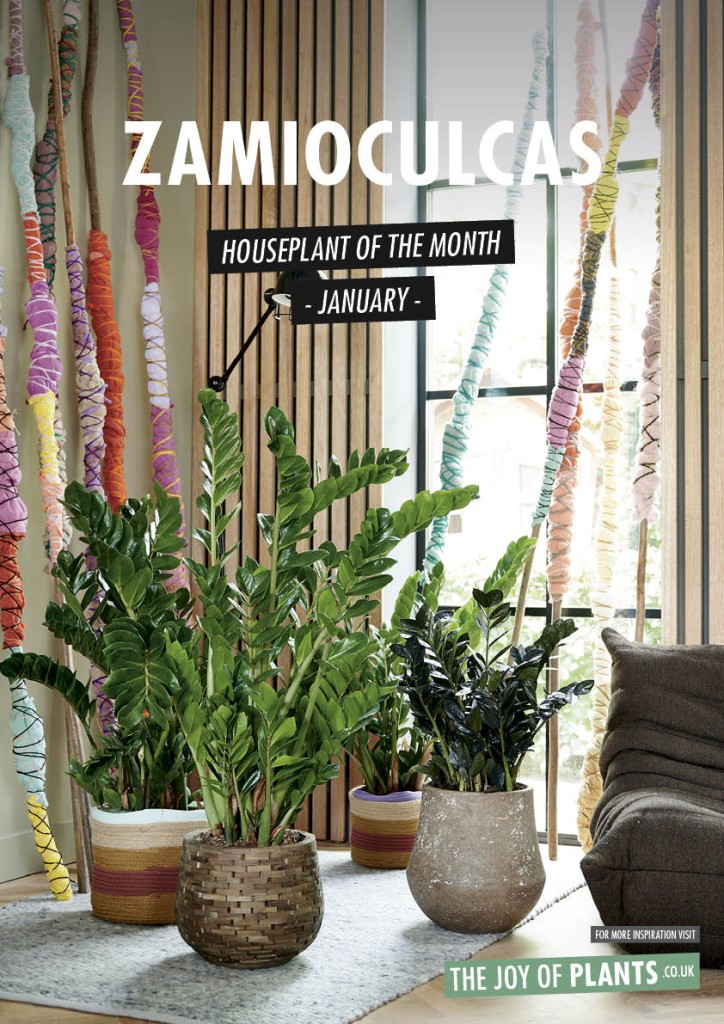
The powerhouse zz plant is the Houseplant of the Month for January 2020. It’s trendy, stylish and incredibly easy to care for. Plus, with its great tolerance of low light, it’s a perfect choice for carrying your decor through the dark days of January!
The Story of the ZZ Plant
Zamioculcas zamiifolia, probably better known as the zz plant or zeezee plant, is a member of the Araceae, the arum family. It’s a perennial with pinnate leaves that grows to a height of 15 to 24 inches (40 to 60 cm). The leaves on the thick petiole are smooth, shiny and dark green. The plant does flower occasionally, especially when it is stressed, but the arum-like blooms that grow from the base of the plant are not very showy.
The plant has only been grown as a houseplant since 1996, so has no particular symbolism. In terms of its indestructibility, though, words like ‘strength’, ‘survivor’ and ‘resilient’ are very appropriate.
Origin of the ZZ Plant


The zz plant’s natural environment consists of rocky soil in the lowlands or the base of the highlands of East Africa. It’s found in countries like Kenya, Zimbabwe, Tanzania, Malawi and Zanzibar. If it’s grown as a houseplant today, that’s thanks to ambitious Dutch growers, who discovered the plant in the mid nineties and thought this unusual exotic might make a good indoor plant.
They were right! It’s definitely not hard to grow, but it certainly takes its time in doing so! The plant grows at a snail-like pace. To produce zz plants for the houseplant market, growers have developed special techniques so as to be able to deliver well-developed plants within a reasonable timescale. A warm and humid greenhouse environment in very bright light certainly helps!
Assortment
The range of zz plant varieties is limited, although the species itself is offered in a wide choice of sizes, so you can buy a large one or small one, depending on your budget.


There are only two cultivars: a mini zz plant called ‘Zamicro’ and ‘Raven’, a standard-size variety with very dark leaves, almost black. Even these two cultivars can be hard to find.
What to Look for When Buying a zz plant


When buying a zz plant, the most important thing is to be sure that the plant is free of pests and diseases, although, fortunately, the zz plant is not very prone to either.
- The number of leaves determines the plant’s price range. A leaf is counted if it is at least half the length of the tallest leaf on the plant. Plants with more leaves will appear fuller … and will cost more.
- If the plant has a yellow leaf or two, that could mean it may have been stored with no light in a warehouse for too long or has been kept too wet. It won’t make the best choice.
- Black spots on the stem are normal for this plant and are not a sign of a problem.
- Also check the pot size in relation to the plant’s rootball, the number of leaves and their length. On some plants, the pot will be somewhat warped due to the enormous pressure the underground tubers put on it. This can sometimes even cause the pots to split open. In that case, do repot without delay.
Care Tips

The zz plant is an ‘easy care’ plant that is very tolerant of average household conditions.
- Put it almost anywhere you want: it will thrive in both bright light and partial shade. It will live, although not thrive, even in shade.
- A room temperature of 65–72°F (18–22°C) is fine. Don’t keep it too cold, although it generally won’t react badly to cooler temperatures in winter.
- What the zz plant really cannot cope with is overwatering. Always allow the potting mix to dry out at least a bit before you water again. The plant is a succulent and stores plenty of water in its tubers and its thick leaves, enough to get it through periods of drought. You can easily leave it without water for over a month if you’re away on vacation.
- Some people fertilize lightly once a month from spring through summer, others not at all, and it seems to do equally well in both situations.
- Do not spray the leaves “to increase ambient humidity”: it isn’t needed (the plant is very tolerant of dry air) and can leave annoying stains.
- Remove damaged and yellowing leaves as required. New ones will form if there is sufficient light.
- As mentioned, the underground tubers are incredibly strong and can, over time, cause the pot to warp or even crack. It’s best to repot a zz plant every 2 to 3 years, before it gets to that stage.
- In the summer, when the temperature no longer dips below 55 °F (12° C), you can place your plant in the garden or on the patio. Do make sure you acclimatize it gradually, exposing it to brighter and brighter light over a week or so, before putting in full sun.
- The plant is only for decoration and not for consumption. It is possibly somewhat toxic, although this has not yet been confirmed, so keep it out of reach of children and pets.
Display Tips


The strong vertical lines of the upward reaching pinnate leaves make the zz plant an ideal eye-catching plant to bring greenery into an interior. The fact that it is a very easy houseplant makes it appealing for students and busy people and for offices and public spaces. The plant works in both modern and traditional interiors, depending on the cache-pot. For a trendier look, try your ‘zamio’ in a colorful handcrafted container.
For more information on the zz plant, read The ZZ Plant: The Aberran Aroid.
Text and photos adapted from a press release by Thejoyofplants.co.uk.
Styling by Elize Eveleens, Klimprodukties