


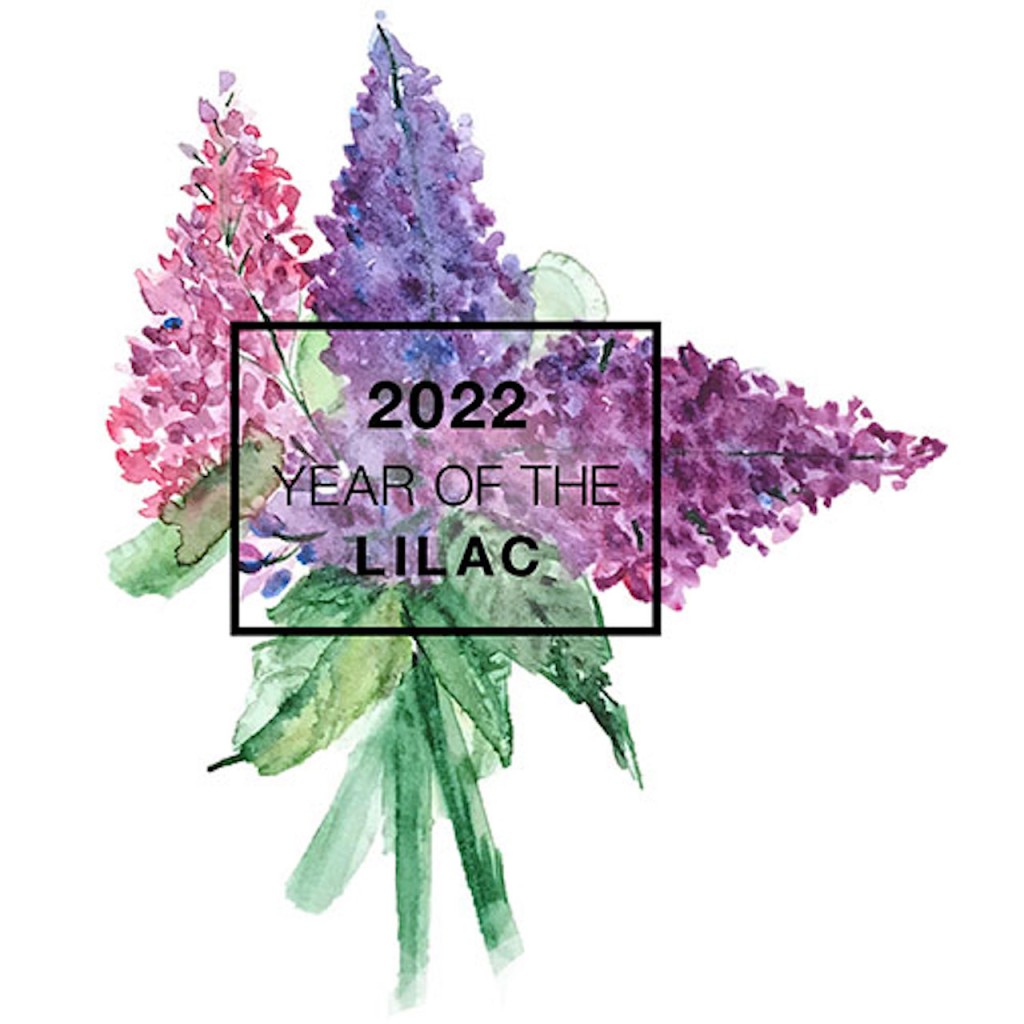
Lilacs are among the most carefree spring-flowering, multi-stemmed, deciduous shrubs (or small trees), well loved for their toughness, reliability, and fragrance.
Every year, the National Garden Bureau, a non-profit organization promoting the pleasures of home gardening, selects one annual, one perennial, one vegetable, one shrub, one bulb and, for the first time this year, one houseplant to celebrate. It’s a great way to discover a new plant or to learn a bit more about a plant you may already be growing.
Let’s look at the shrub chosen for 2022, the lilac.
Overview and History

Clusters of small, four-lobed flowers are borne in conical to narrow pyramidal clusters (panicles) up to 8 inches (20 cm) long that stand out from the green heart-shaped leaves.
Carl Linnaeus first described the lilac genus, Syringa, in 1753. The name is derived from the ancient Greek word syrinx, meaning pipe or tube. The stems of the common lilac have a spongy pith that can be removed, leaving hollow tubes that were used to make pan pipes.
Syringa vulgaris, the common lilac, originated in southeastern Europe. Other species came from Western Asia. The French imported lilacs and developed many new varieties that were soon grown throughout Europe and then made their way to North America.
Lilac blooms go far beyond every imaginable shade of lilac/purple from very pale to very dark. Look for lilacs in hues of red, pink, blue, yellow, cream and white—even picotee (white-edged, like deep purple ‘Sensation’). The color may change from bud to bloom as the flowers mature. Individual flowers can be single or double.


Lilac Species
There are about 30 different species and hybrid species of lilac. Among the best known and prized lilacs are:
Syringa × chinensis—Chinese Lilac—Grows 8 to 12 feet (2.5 to 3.5 m) tall and 6 to 10 feet (1.8 to 3 m) wide. USDA hardiness zones 3 to 7. Rose-purple flowers. Susceptible to powdery mildew.

Syringa × hyacinthiflora—Early Flowering Lilac—Grows 10 to 12 feet (3 to 3.5 m) high and wide. USDA hardiness zones 3 to 9. Exquisitely fragrant flowers may be single or double, opening 7 to 10 days before those of the common lilac. Unlike other lilacs, the foliage has multi-season interest, turning shades of gold, red, or purple in fall. Resistant to powdery mildew. Attracts butterflies and hummingbirds. ‘Pocahontas’ panicles are packed with fragrant, single, rich violet flowers.
Syringa josikaea—Hungarian Lilac—Grows 8 to 10 (2.5 to 3 m) feet tall and 10 to 12 feet (3 to 3.5 m) wide. USDA hardiness zones 5 to 7. Late-blooming with deep lilac-purple, slightly fragrant flowers.
Syringa laciniata—Cutleaf or Feathered Persian Lilac. Grows 6 to 8 feet (1.8 to 2.5 m) tall and wide. Hardy from USDA hardiness zones 4 to 8. Can grow in partial shade. Very unique looking with airy, finely textured foliage—lacy, deeply cut, dark green leaves that turn yellow-green in fall. Loose panicles of fragrant, soft lavender flowers are borne on willowy, arched branchlets.

Syringa pubescens patula (formerly Syringa patula) ‘Miss Kim’—Manchurian Lilac—Slow grower reaching 6 to 8 feet (1.8 to 2.5 m) tall and wide. Hardy from USDA hardiness zones 3 to 8. Late flowering, with purple buds that open to very fragrant, lavender-blue blossoms that attract butterflies and hummingbirds. Three-season interest with burgundy-tinged leaves in the fall.
Syringa meyeri—Meyer or Korean Lilac—Grows 5 to 8 feet (1.5 to 2.5 m) tall and 6 to 10 feet (1.8 to 3 m) wide. USDA hardiness zones 3 to 7. Fragrant, pale lilac to violet-purple flowers bloom in small, dense clusters that attract butterflies and hummingbirds.
Syringa × persica—Persian Lilac—Grows 4 to 8 feet (1.2 to 2.5 m) tall and 5 to 10 feet (1.5 to 3 m) wide. USDA hardiness zones 4 to 7. Intoxicatingly fragrant, showy, pale violet flowers attract butterflies.

Syringa × prestoniae—Preston (Canadian) Lilac—Developed in Canada by Isabella Preston, it grows 8 to 12 feet (2.5 to 3.5 m) tall and 6 to 10 feet (1.8 to 3 m) wide. Late-blooming—two weeks or more after common lilacs. Exceptionally hardy—to Zone 2 to 7. ‘Miss Canada’ is upright, growing 6 to 12 feet (1.8 to 3 m) tall and wide; reddish buds open to rosy-pink flowers that attract butterflies. ‘Redwine’ grows 8 to 12 feet (2.5 to 3 m) tall and 6 to 10 feet (1.8 to 2.5 m) wide; magenta flowers with a spicy fragrance that attracts butterflies and hummingbirds.

Syringa reticulata—Japanese Tree Lilac—Grows to 30 feet (9 m) tall and 20 feet (6 m) wide. USDA hardiness zones 3 to 7. Creamy white, upright flowers very late, in early summer. Attracts hummingbirds and butterflies. ‘Snowdance’ grows 15 to 20 feet (4.5 to 6 m) tall and 15 to 18 feet (4.5 to 5.5 m) wide, producing a profusion of large clusters of fragrant, tiny, creamy-white blooms in early summer, followed by loose clusters of seed capsules that last into winter. Reddish-brown peeling bark completes the four-season interest.

Syringa vulgaris—Common Lilac—Grows 12 to 16 feet (3.5 to 5 m) tall and 8 to 12 feet (2.5 to 3.5 m) wide. USDA hardiness zones 3 to 7. Lilac-purple flowers attract hummingbirds and butterflies. Shrubs are deer and rabbit-resistant. This species tends to produce many suckers. There are more than 600 cultivars of this species. They’re often called French lilacs or French hybrid lilacs, as many were developed in France by hybridizer Victor Lemoine and his descendants starting in 1870. Standouts include:
- ‘Ludwig Spaeth’—6 to 10 feet (1.8 to 3 m) tall and 6 to 8 feet (1.8 to 2.5 m) wide, this sweetly perfumed, late bloomer bears dark purple flowers and is used in firescaping (landscape design that reduces house and property vulnerability to wildfire).
- ‘Président Grévy’—8 to 14 feet (2.5 to 4.25 m) tall and 3 to 7 feet (0.9 to 2 m) wide with fragrant, showy, light blue flowers that attract hummingbirds and butterflies.
- ‘President Lincoln’—8 to 10 feet (2.5 to 3 m) tall and wide, this heirloom cultivar was introduced in 1916 and is considered one of the bluest lilacs with its fragrant panicles of lavender-blue flowers that attract butterflies and hummingbirds.

- ‘Sensation’- 8 to 15 feet (2.5 to 4.5 m) tall and 6 to 12 feet (1.8 to 3.5 m) wide with outstanding fragrant, single, white-edged purple (picotee) flowers.


New and Unique Lilac Varieties
Has It All:

- Syringa × ‘Josée’—Not only is it small and a rebloomer, but it also has one of the widest hardiness ranges of any lilac—from USDA hardiness zones 3 to 9! Slowly growing into a 4- to 5-foot (1.2 to 1.5 m) mound, highly fragrant, lavender-pink, large flower clusters bloom heavily in spring and continue to blossom sporadically through summer, attracting butterflies and hummingbirds.
Heat Tolerant:

People living in USDA hardiness zone 8, especially those who formerly lived in cooler areas and have treasured having lilacs in their gardens, can now enjoy all the virtues of lilacs thanks to breeders who have worked on heat and humidity tolerance to hardiness zone 8.
- Blue Skies® quickly grows to 10 feet (3 m) tall and 6 feet (1.8 m) wide, with both cold and heat tolerance (USDA hardiness zones 3 to 8), this outstanding shrub with spectacular clusters of lavender-blue flowers can be used in firescaping and firewise gardens.
- ‘Old Glory’ grows 8 to 11 feet (2.5 to 3.25 m) tall and 10 to 12 feet (3 to 3.5 m) wide with an abundance of fragrant, purple-blue flowers that attract butterflies and hummingbirds in USDA hardiness zones 5 to 8.
- Syringa × chinensis ‘Lilac Sunday’ arches to 10 feet (3 m) tall and wide, blooming profusely from lateral buds all along the stem as well as the typical branch tips with sweetly scented, lavender flowers. Hardy in USDA hardiness zones 3 to 8, it is used in firescaping.
- Syringa × oblata ‘Betsy Ross’ grows 8 to 10 feet (2.5 to 3 m) tall and wide. Good hardiness ranges from USDA hardiness zones 2 to 8. Showy panicles up to 14 in (35 cm) long packed with fragrant, pure white flowers that glow as the light fades at twilight. Attracts butterflies and hummingbirds.
Small Lilacs
Many gardeners, especially those in urban spaces, just don’t have the room for the traditional larger lilacs, yet want all their beauty and fragrance. Breeders have been hard at work creating compact varieties. There’s no excuse now for not having the joy, fragrance, and beauty that lilacs bring in spring: these beauties will even grow will grow happily in a container on your balcony!
- Baby Kim® is the smallest lilac, growing only 2 to 3 feet (90 to 120 cm) high and 3 feet (90 cm) wide, giving it a nicely rounded shape. Its shiny green leaves beautifully set off the non-fading, purple flowers that attract butterflies. Extended hardiness from USDA hardiness zones 3 to 8.

- Flowerfesta® series (Syringa meyeri) comes in three colors; purple, pink, and white. What makes them unique is they stay compact, under 50 inches (130 cm) in height. Use it in the landscape in mass plantings and as a border planting or in containers in small gardens, balconies or patios. The flower panicles are larger than other S. meyeri varieties and are repeat blooming with a sweet fragrance. Hardy in USDA hardiness zones 3 to 7.
- Little Lady™ (Syringa x) is a new compact introduction that matures to 4–5’ feet (1.2 to 1.5 m) tall and wide with dark pink buds that open to lilac-pink flowers. Bred in Canada, Little Lady™ is hardy in USDA hardiness zones 2 to 7.
- ‘New Age Lavender’ and‘New Age White’ (Syringa vulgaris) are super-compact, growing from 4 to 5 feet (1.2 to 1.5 m) tall and wide, and were bred for mildew resistance. Their names perfectly describe the colors of their fragrant flowers that attract hummingbirds and butterflies. USDA hardiness zones 3 to 7.
- Pearl Potion™ (Syringa meyeri) has an upright shape, growing 4 to 5 feet (1.2 to 1.5 m) tall and 5 to 7 feet (1.5 to 2 m) wide. Fragrant, pure white flowers bloom in late spring, perfuming the air like their big cousins. USDA hardiness zones 3 to 7.

- Pinktini™ Lilac (Syringa × prestoniae) is new in garden centers in Spring 2022. Upright, compact and cold hardy to Zone 2 to 7, measuring about 5 feet (1.5 m) tall and 4 feet (1.2 m) wide, this new pink-blooming variety is great for small spaces and early-season blooms in cold climates. Pinktini™ is more compact and tidier than the classic ‘Miss Canada’ Lilac.
- Scentara® lilacs (Syringa × hyacinthiflora)—This series is ideal for warm climates to USDA hardiness zone 8 and yet is hardy to the cold of zone 2. With a dwarf form and some of the best fragrance from their parentage combined with good resistance to powdery mildew, they fit into any garden. Scentara Pura® grows 4 to 6 feet (1.2 to 1.8 m) tall and wide, bearing deeply scented, pure purple flowers. Scentara® Double Blue grows 6 to 8 feet (1.8 to 2.5 m) tall and wide and is a showstopper with its large clusters of highly perfumed, lavender-blue, double flowers.
- Sugar Plum Fairy® (Syringa vulgaris) grows to 4 feet (1.2 m) tall and 5 feet (1.5 m) wide. Hardy from USDA hardiness zones 3 to 8, it’s a late bloomer bearing spicy scented clusters of rosy-pink flowers that attract butterflies and hummingbirds.
- Tinkerbelle® grows to 6 feet (1.8 m) tall and 5 feet (1.5 m) wide. USDA hardiness zones 3 to 7, it’s a superb lilac with wine-red buds that open to deep pink flowers with a spicy fragrance that attracts hummingbirds.
Reblooming Lilacs
- Little Darling® Lilac—What’s better than a fragrant lilac? One that blooms twice a year! Large clusters of dark-purple buds open to classic lilac-hue flowers. Blooms heavily in spring, with a second, lighter bloom set in fall. Compact (4 feet/1.2 m tall × 4 feet/1.2 m wide) with a nicely rounded shape, perfect for containers and mixed borders. Tolerates mild, periodic drought when established. Deciduous. USDA hardiness zones 4 to 8.
- Syringa meyeri ‘Palabin’—Dwarf Korean lilac is a spreading shrub that grows 4 to 6 feet (1.2 to 1.8 m) tall and 5 to 7 feet (1.5 to 2 m) wide, bearing reddish-purple buds that open to pale purple flowers with a jasmine-like scent. It flowers in spring and then from summer to frost., attracting butterflies and hummingbirds. Cut back early flowers as soon as they fade. USDA hardiness zones 3 to 7.

- Bloomerang® Lilacs are outstanding reblooming lilacs with a profusion of stunning, sweetly scented clusters of star-like flowers in spring that seem to cover the plant and then rebloom less profusely from midsummer until the first frost. The fragrant flowers attract butterflies and other pollinators and are both disease and deer-resistant. USDA hardiness zones 3 to 7. Bloomerang® Dark Purple grows 4 to 6 feet (1.2 to 1.8 m) tall and wide with dark purple flowers. Bloomerang® Dwarf Pink grows 2 to 3 feet (60 to 90 cm) tall and wide with pure pink flowers. Bloomerang® Dwarf Purple grows like Bloomerang® Dwarf Pink, but with purple flowers. Bloomerang® Pink Perfume grows 4 to 5 feet (1.2 to 1.5 m) tall and wide with highly fragrant, pink flowers. Bloomerang® Purple grows 4 to 5 feet (1.2 to 1.5 m) tall and wide and bears purple flowers.


Lilacs in the Garden
Lilacs have myriad uses in the garden. In addition, new sizes, a wider range of growing zones, and reblooming characteristics make them attractive and accessible to gardeners who may not have thought about growing them in the past.

These plants are at home in so many types of themed gardens, including pollinator, butterfly, cutting, fragrance, cottage, deer-resistant and single-color (white, purple) gardens. In USDA hardiness zone 8 and other fire-prone areas, some are used for firescaping and firewise gardens. Lilacs are great in mass plantings in a flowering hedge, border, windbreak, foundation planting and privacy or screening hedge. Lilacs of any size can be impressive specimen plants. These versatile shrubs are equally comfortable at the edge of a woodland garden or in an urban setting. In containers, small varieties are moveable accent plants. Lilac colors blend so well, they are beautiful in a grouping or hedge of many different cultivars.
10 Lilac Planting Tips

- Most lilacs do well in USDA hardiness zones 3 to 7—climates that provide a chill period in winter. American readers can find their hardiness zone by clicking here. Just enter your zip code. Canadian and European readers can find their zone map here.
- Lilacs grow best in full sun, so avoid planting them where they will be shaded for more than a few hours.
- Lilacs need good drainage and fertile soil. Soil should retain sufficient moisture to nourish the root system, yet drain freely when rainfall is abundant.
- Test drainage before planting: Dig a hole 8 inches (20 cm) across and 12 inches (30 cm) deep. Fill it with water. If any water remains in the hole after an hour, choose another planting area.
- Lilacs love fertile soil that’s a bit more alkaline than most other shrubs. A pH of 6.5 to 7 would be perfect. If your soil is very acidic, add garden lime in the fall.
- Choose a planting space that will allow for future growth. Read the plant label for the height and spread of the mature plant.
- Dig the planting hole as deep as the root ball and twice as wide.
- Set the plant in the hole; it should be at the same soil level as it was in its container. It may be necessary to sprinkle the rootball with a mycorrhizal soil inoculant, especially when it will be planted in a disturbed soil.
- Fill in around the sides with soil using backfill. Press it in firmly.
- Water well.
Some Patience Required

Lilacs are often in bloom when you buy them. After all, that’s likely what attracted you to that particular plant! However, they need time to “settle in” before blooming again. Most plants start flowering after 3 or 4 years, but some can take up to 6 or 7 years. Or yours may bloom only weakly at first: don’t worry, flowering will increase over time.


8 Lilac Growing Tips
- Water your lilacs regularly for the first couple of years—at least 1 inch (2.5 cm) of water a week.
- Apply granular organic fertilizer early each spring at the base of the plant. Water it in well. Buds are set the previous year, so the fertilizer feeds this year’s leaves and next year’s blooms.
- Annual pruning is not necessary, but many people like to cut off spent flower heads. Do so within a month after bloom, or this can negatively affect flowering the following year.

- Cut back root suckers as they appear to keep the common lilac from spreading into a colony.
- Rejuvenate an overgrown plant or one that blooms sparsely by cutting one-third of the oldest branches back to 12 to 15 inches (30 to 40 cm) from the ground. Do so over a three-year period to refresh the plant without sacrificing blooms. That’s because the plant responds to heavy pruning by producing fast-growing young vegetative growth that takes 2 or 3 years to start reblooming.
- Powdery mildew can be unsightly, but generally does not harm the plant. To try to prevent it, you can make a spray of 2 tablespoons (28 g) of baking soda in 1 gallon (3.75 l) of water with a couple of drops of Ivory liquid or insecticidal soap. Spray it on the leaves, but not if the temperature is over 80°F (27°C). The alkalinity of the solution helps to kill the fungus.
- Rake fallen mildewed leaves from around the plant in autumn. Just add them to your compost pile.
- Anytime: Prune out any dead or broken branches from storm or winter damage.
This article was adapted from a fact sheet written by Cathy Wilkinson Barash for the National Garden Bureau and provided as an educational service. Unless otherwise mentioned, all photos are courtesy of the National Garden Bureau. Purchase Lilacs at NGB Member Online Stores and at your local garden retailer. Please consider NGB member companies as authoritative sources for information.