
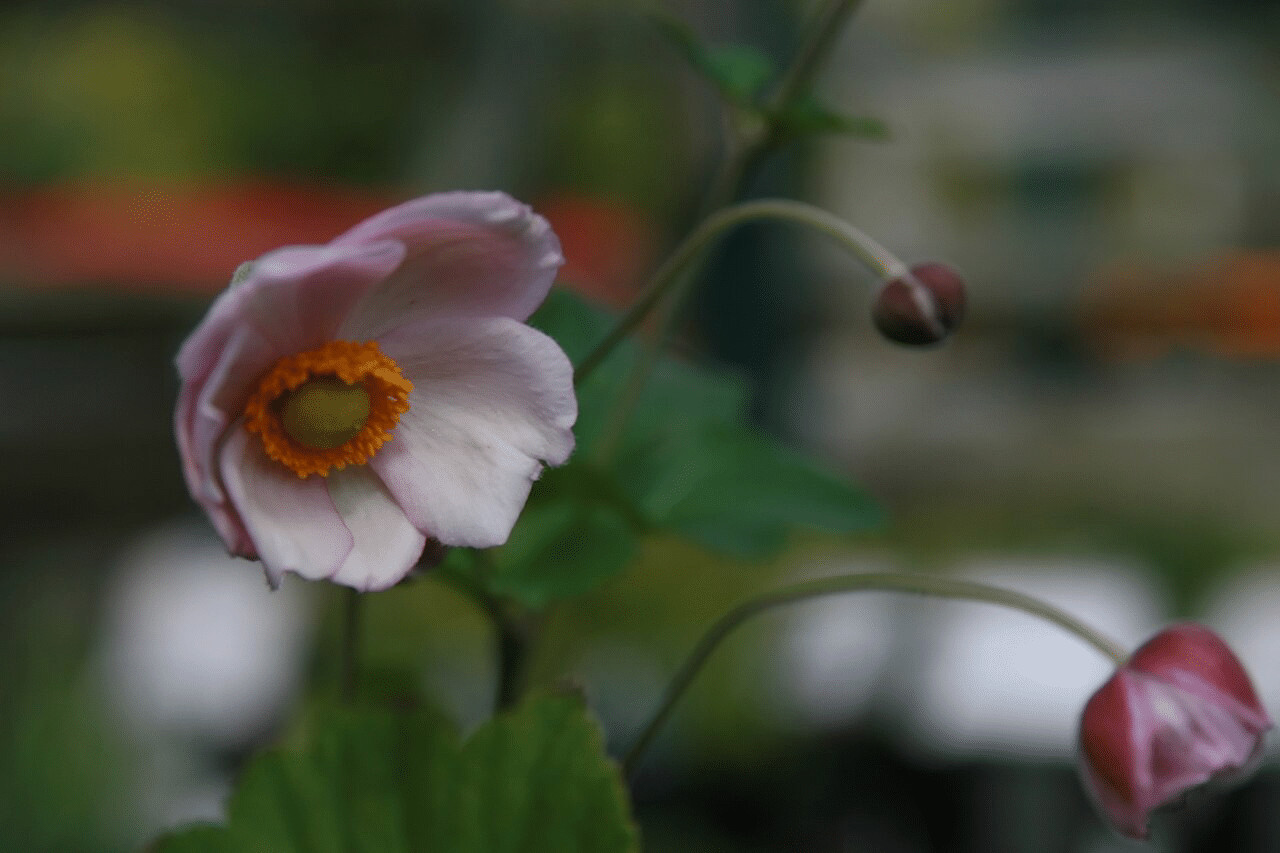
The Japanese anemone (actually three species: Anemone x hybrida, A. huphensis. and A. tomentosa) is among the last perennials to bloom. Indeed, it is only at the very end of August or in September that the many round flower buds, borne on slender branching stems, unfurl to reveal large single or semi-double white, pink or rose flowers. The plant can vary in height from 3 to 5 feet (1 to 1.5 m) for conventional varieties to only 18 inches (45 cm) for some of the recently introduced dwarf cultivars. Its dark green maplelike foliage appears in spring and continues throughout the summer.

Warning! This plant will eventually become invasive through its creeping underground rhizomes. When you first plant it, you’ll have a hard time believing that: it is so slow to really take off, spending 3, 4 or even 5 years in a nice tight clump. But then, off it goes! The saying is: first it sleeps, then it leaps! Do plant your Japanese anemone where you can control its spread… or where its wandering habit won’t be a problem.
Growing Conditions
Ideally, you should plant your Japanese anemone in partial shade, perhaps in an open woodland or at the forest edge, but it tolerates full sun too… and will grow in shade, although in may not bloom well there. It will grow in any well-drained soil. Once established, it is quite drought-tolerant, but it’s better to water it well the first season until its roots are firmly established.
The typical Japanese anemone does well in zones 5 to 9 and is perfectly hardy in zone 4 if you mulch it well. I just let dead leaves cover it up in the fall and it does wonderfully for me.
Favorites of the Laidback Gardener

A. hupehensis japonica ‘Pamina’
A compact variety, less invasive than most, it grows almost in clumps. Its semi-double flowers, a very deep pink (sometimes described as red), add a vibrant touch at the end of summer.
- Hardiness: Zone 4 (USDA 4–8)
- Light: partial shade or light sun
- Bloom time: August to November
- Size: 75 cm x 60 cm+ (30 in x 24 in+)
A. × hybrida ‘Robustissima’
A magnificent brute! The hardiest of the fall anemones, very vigorous and frankly invasive. Ideal as a groundcover in a partially shaded woodland. Its simple mauve-pink flowers are produced in abundance starting in late July.
- Hardiness: Zone 3 (USDA 3–8)
- Light: partial shade (tolerates sun if soil stays moist)
- Bloom time: late July to September
- Size: 100 cm x unlimited spread (40 in / 3.3 ft x unlimited)

A. × hybrida ‘Whirlwind’
An elegant and easy-to-grow cultivar, offering numerous semi-double flowers with narrow white petals tipped with green. Very decorative in fall borders.
- Hardiness: Zone 4 (USDA 4–8)
- Light: partial shade or light sun
- Bloom time: August to October
- Size: 90–120 cm x unlimited spread (36–48 in / 3–4 ft x unlimited)

A. × hybrida ‘Honorine Jobert’
A great classic introduced in 1858, still popular thanks to its abundant late bloom. Its simple white flowers are slightly smaller than modern cultivars, but bloom profusely and brighten up the fall garden.
- Hardiness: Zone 4 (USDA 4–8)
- Light: partial shade or light sun
- Bloom time: September to October
- Size: 90–120 cm x unlimited spread (36–48 in / 3–4 ft x unlimited)
This text was first published on this blog on September 15, 2015. It has been revised and its layout adapted.
92 jeeto game app is a mobile gaming application developed for Android users who want a smooth and convenient gaming experience. The app features a simple design that allows users to browse different game sections quickly while maintaining reliable performance across supported devices.
reminds me of the patience needed in 99 Nights in the Forest, where growth, endurance, and quiet observation reveal beauty that only time and care can truly bring to life.
I absolutely love my anemone – rose and white. They are in areas that can be controlled. In four years in Niagara Region I have never been able to get them to bloom before the second week of September. Probably due to only partial sun, but they are large and lovely and worth the wait. I adore them. Thank you for this article.