
Here’s the story of 15 beautiful shade plants, too often overlooked because some very popular ones actually… keep them in the shade. Popular plants have earned their stripes, and rightly so. However, this great success comes at the expense of a good hundred other very interesting plants for shaded situations: the little-known ones.
Little-known plants aren’t rare, though. Nor are they new. They’ve been sitting on the shelves of horticultural retailers for years… waiting their turn. One fine Saturday morning, a somewhat hesitant gardener will reach out for one of them when, suddenly, to his right… a hosta. “Yes, I know hostas!” Off he goes with another hosta, a sure bet. The little unknown plant will have once again seen its chance slip through its leaves.
So here they are, put in the spotlight, these forgotten beauties.
1. Purple-flowering Raspberry (Rubus odoratus), zone 4 (USDA zone 3)
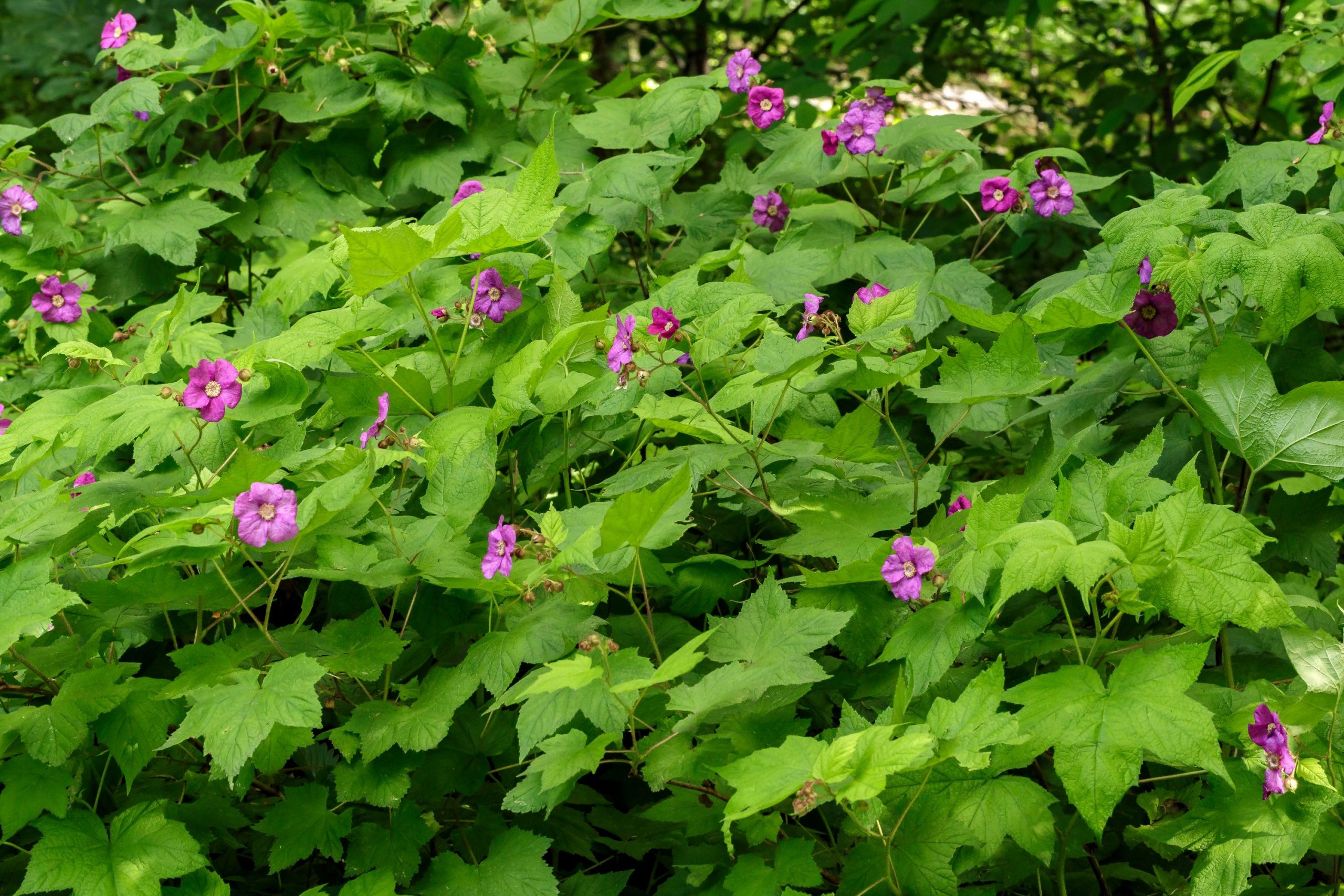
It’s a beautiful shrub native to Quebec that produces large, candy-pink flowers in July. The flowers then produce fruits that resemble large, flattened raspberries. The fruits are edible.
H.: 150 cm (5 feet); L.: 200 cm (6 ½ feet)
2. Bush honeysuckle ‘Copper’ (Diervilla lonicera ‘Copper’), zone 4 (USDA zone 3)
A small shrub that deserves to be better known. Also a plant native to Quebec, several varieties have been developed that rival each other in beauty of their foliage. The ‘Copper’ cultivar turns bronze in spring, green in summer, then red again in fall. The flowering is discreet and appears in early summer.
H.: 60 cm (2 feet); L.: 100 cm (3 ¼ feet)
3. Chokeberry ‘Viking’ (Aronia x prunifolia ‘Viking’), zone 3 (USDA zone 2)
The chokeberry is a shrub much appreciated for its foliage, which turns red in fall, and for its very decorative black fruits. The flowers are white and appear in May. Although it’s a shrub that’s usually planted in the sun, it has good shade tolerance. The plant will be a little more bare, but this still gives it a beautiful appearance.
H.: 125 cm (4 feet); L.: 90 cm (3 feet)
4. Winterberry ‘Mr. Poppins’ and ‘Berry Poppins’ (Ilex verticillata ‘Mr. Poppins’ and ‘Berry Poppins’), zone 3 (USDA zone 3)
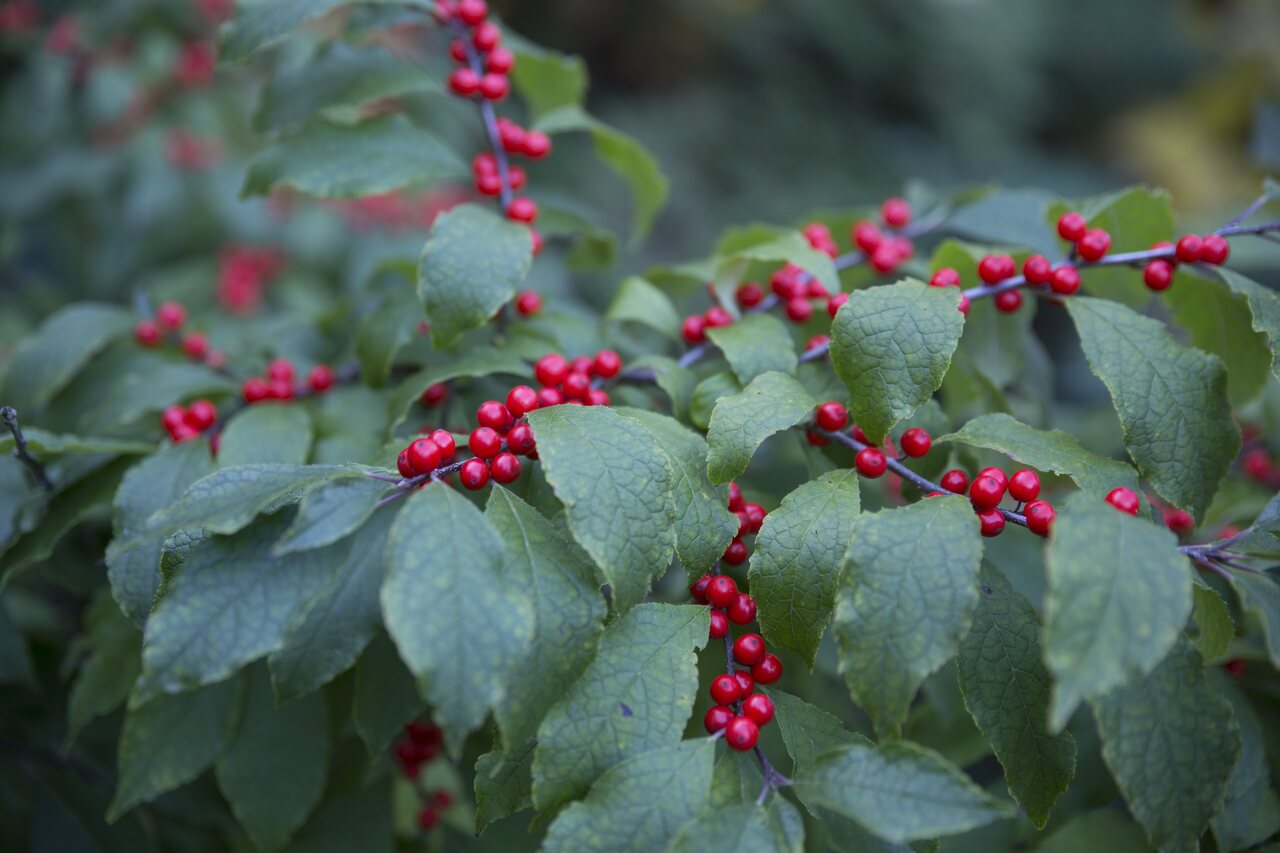
Less known than the evergreen “Christmas” holly, the winterberry is a large shrub with deciduous leaves (they fall in autumn). Fortunately, it produces the same red berries that persist throughout the winter. Winterberry is a dioecious plant, so you need to plant both a male and a female plant to produce fruit.
H.: 100 cm (3 ¼ feet); L.: 90 cm (3 feet)
5. Masterwort ‘Roma’ (Astrantia major ‘Roma’), zone 4 (USDA zone 3)
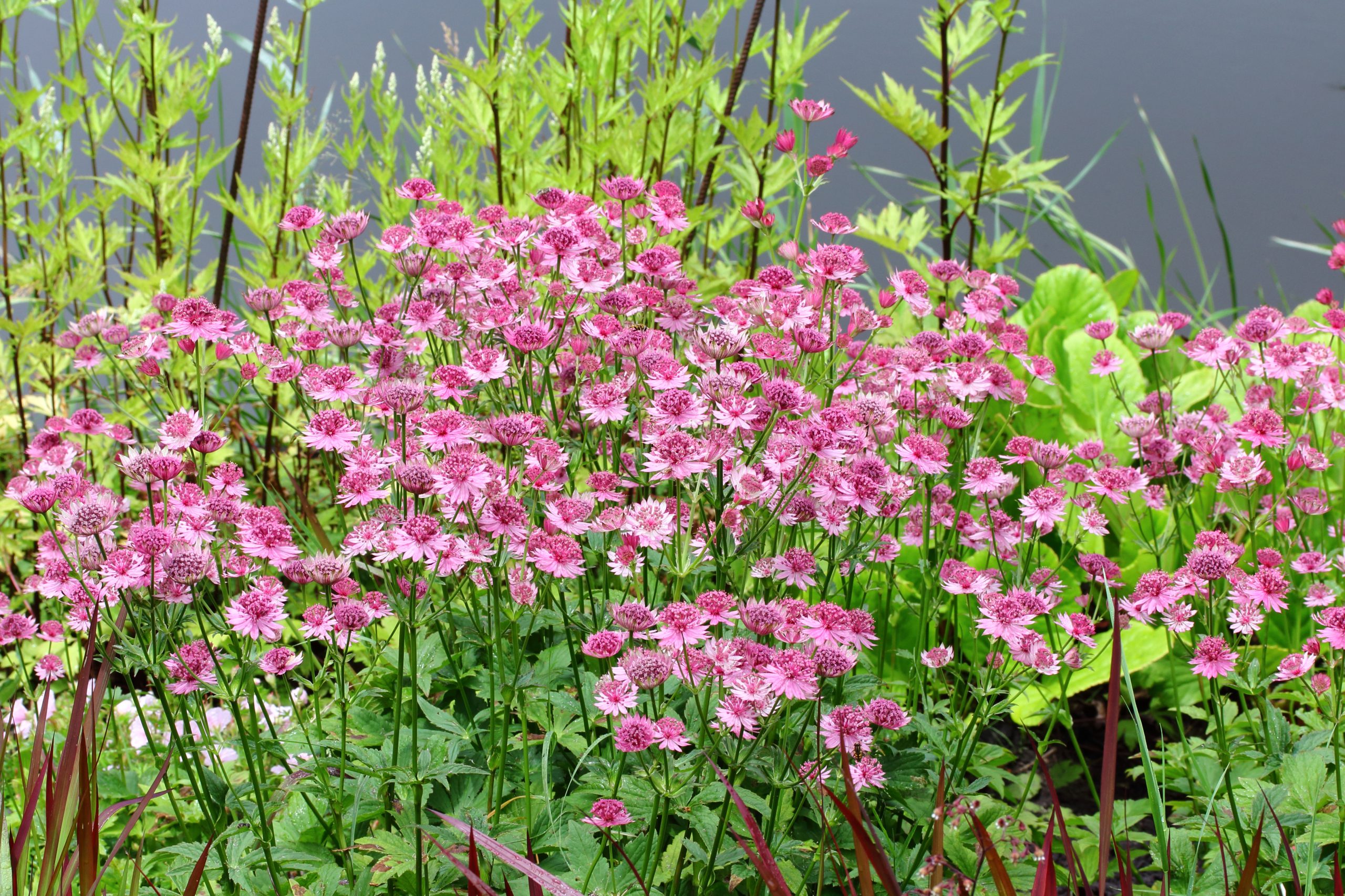
One of my favorite plants. Astrantia produces star-shaped flowers, pink in this case. The flowers have a papery texture. They appear in July and August. It’s particularly attractive in large beds.
H.: 70 cm (28 inches). L.: 60 cm (24 inches)
6. Pink Turtlehead ‘Hot Lips’ (Chelone lyonii ‘Hot Lips’), zone 3 (USDA zone 3)
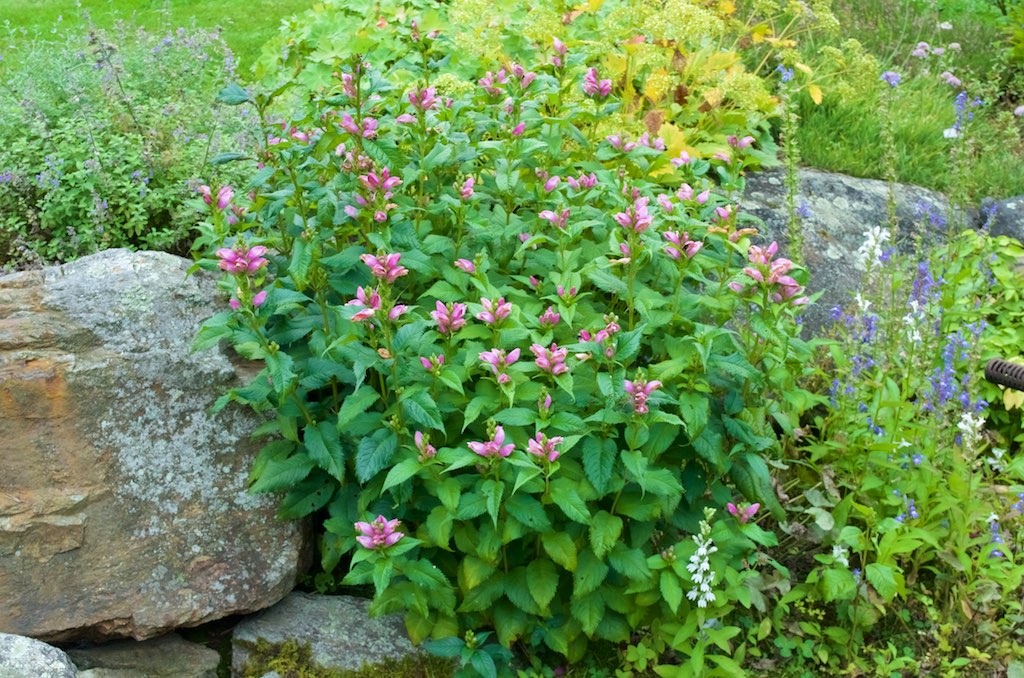
This is an old variety that never goes out of style. Its foliage is darker and shinier than the common Turtlehead. It’s also a more compact variety. Even though it’s slow-growing, it’s worth the wait. It then forms a beautiful, dense clump. Another unique quality: this plant flowers in autumn!
H.: 70 cm (28 inches); L.: 45 cm (18 inches)
7. Christmas rose ‘Royal Heritage’ (Helleborus orientalis ‘Royal Heritage’), zone 5 (USDA zone 4)
It’s called the Christmas rose because it blooms very early in spring. The rest of the summer, you can enjoy the large, dark green, glossy, cut leaves. This is a collection where you can find flowers in several shades, ranging from pure white, to speckled pink, to burgundy red. It will be like a surprise bag: impossible to guess the color of the flower when you buy it! This plant is not suitable for all gardens, as it is not very hardy. It should be planted in a place sheltered from the wind and where there is a good accumulation of snow in winter.
H.: 40 cm (16 inches); L.: 50 cm (20 inches)
8. Japanese Spikenard ‘Sun King’ (Aralia cordata ‘Sun King’), zone 4 (USDA zone 4)
This is a wonderful discovery of recent years. The ‘Sun King’ Japanese spikenard forms a large clump of golden yellow, almost fluorescent green leaves! The plant flowers late in fall, if the season is extended. Be careful, this plant comes out late in spring, which gives the impression that it did not survive the winter. So you have to be patient before rushing to replace it.
H.: 90 cm (3 feet); L.: 90 cm (3 feet)
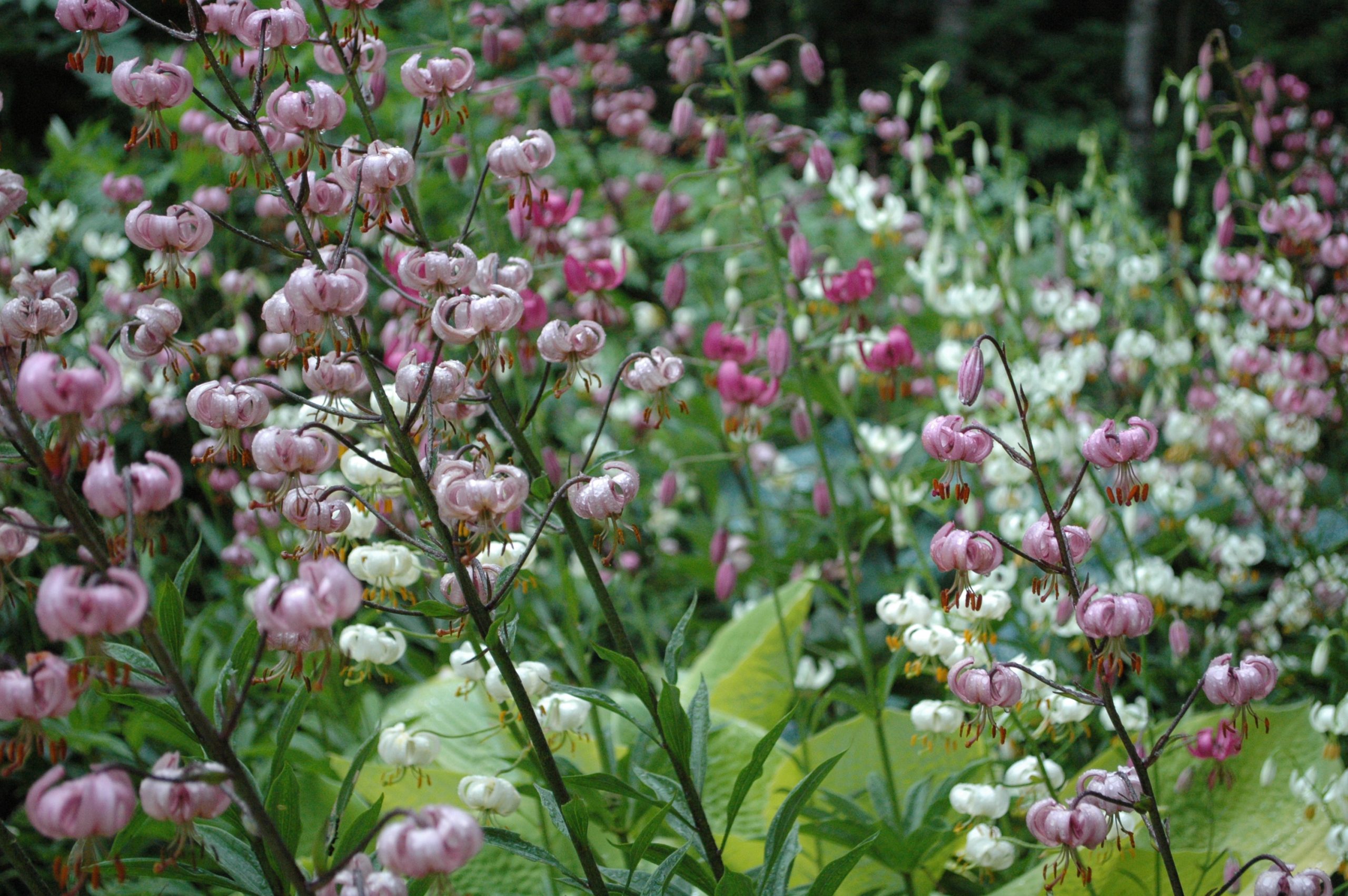
9. Turkscap Lily (Lilium martagon), zone 4 (USDA zone 3)
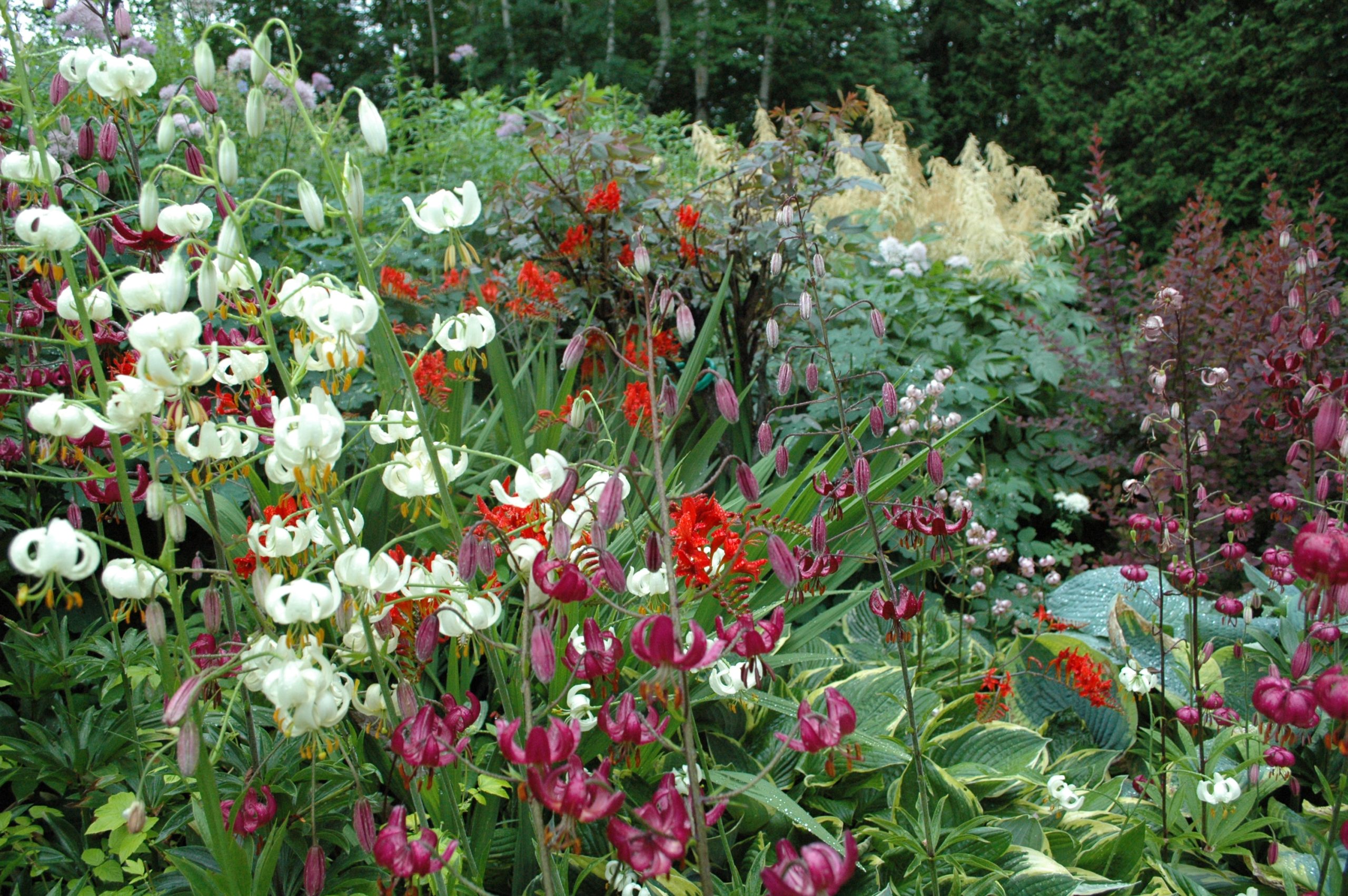
How can I not deviate a little! This very special lily, unlike the 14 other plants presented here, is a little harder to find on the market. You have to look for it in nurseries specializing in unique and rare perennials. But the find is well worth the effort! It’s a tall lily with upright stems. The flowers are numerous and smaller. The petals are turned back. And above all, It’s a shade lover. It grows well in rich soil, but mine (with white flowers) grow in sandy soil, under a hemlock, and they do well there.
H.: 120 cm (4 feet); L.: 25 cm (10 inches)
10. Bishop’s Hat Flower (Epimedium rubrum), zone 4 (USDA zone 5)
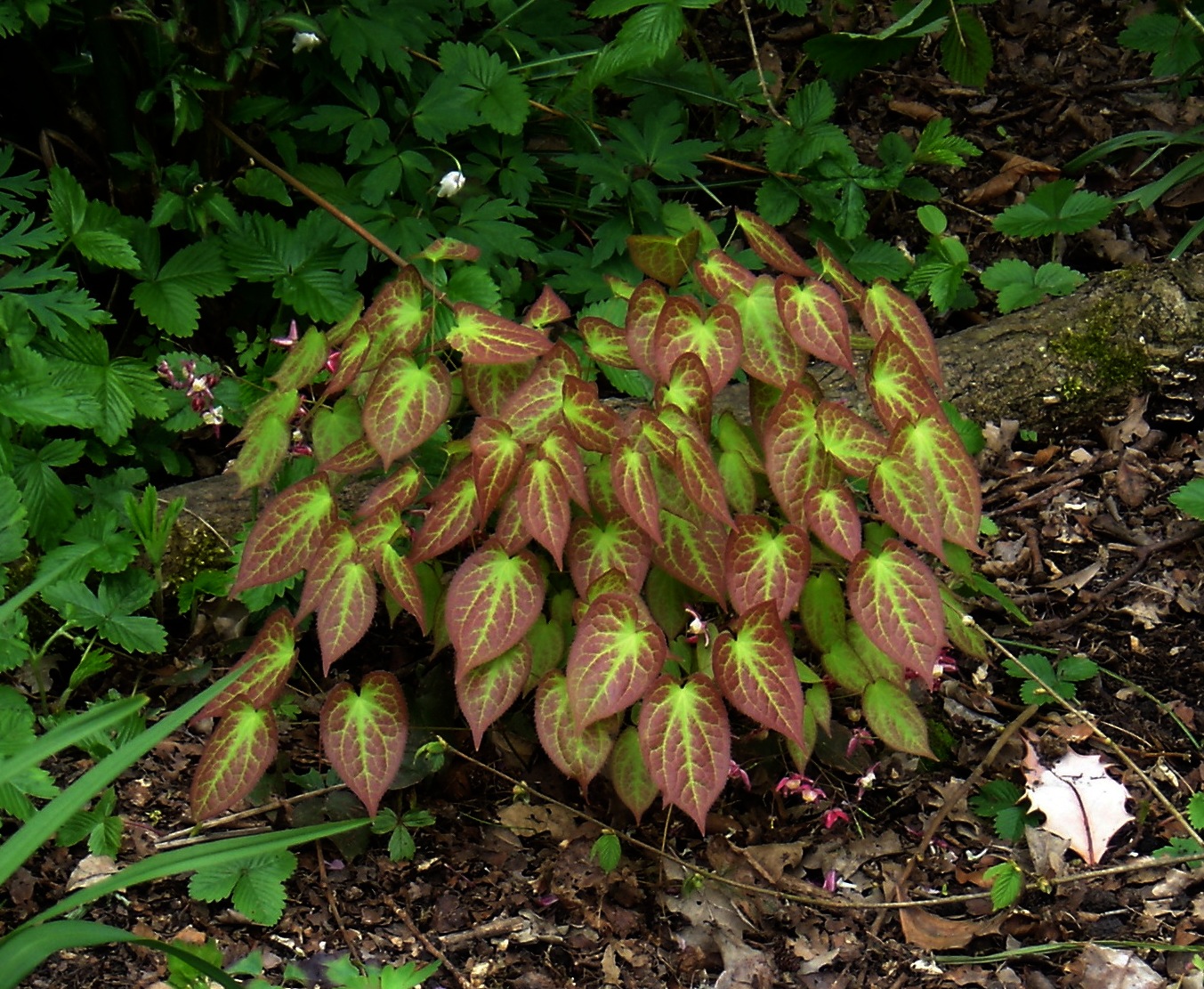
This one, I don’t understand why it’s not in every shade garden! The elf flower is a perfect plant! It forms a dense ground cover of uniquely shaped leaves. The foliage color changes from spring to fall. In spring, it produces pretty pink flowers. Being slow-growing, it takes a few years to obtain an interesting clump. But this characteristic becomes a distinct advantage, because the plant is in no way invasive.
H.: 30 cm (12 inches); L.: 30 cm (12 inches)
11. Japanese Forest Grass ‘All Gold’ (Hakonechloa macra ‘All Gold’), zone 4 (USDA zone 5)
Every time you see a clump of this grass, you fall under its spell. Unfortunately for it, it doesn’t always look pretty in a garden center. Three leaves for $20? So you have to take your courage (and your wallet) in hand and dare. Once established, this plant adds liveliness and color to a shady border. It’s particularly appreciated in Japanese-inspired gardens, where the foliage evokes water tumbling from a waterfall.
H.: 25 cm (10 inches); L.: 30 cm (12 inches)
12. Common Primrose (Primula vulgaris), zone 4 (USDA zone 3)
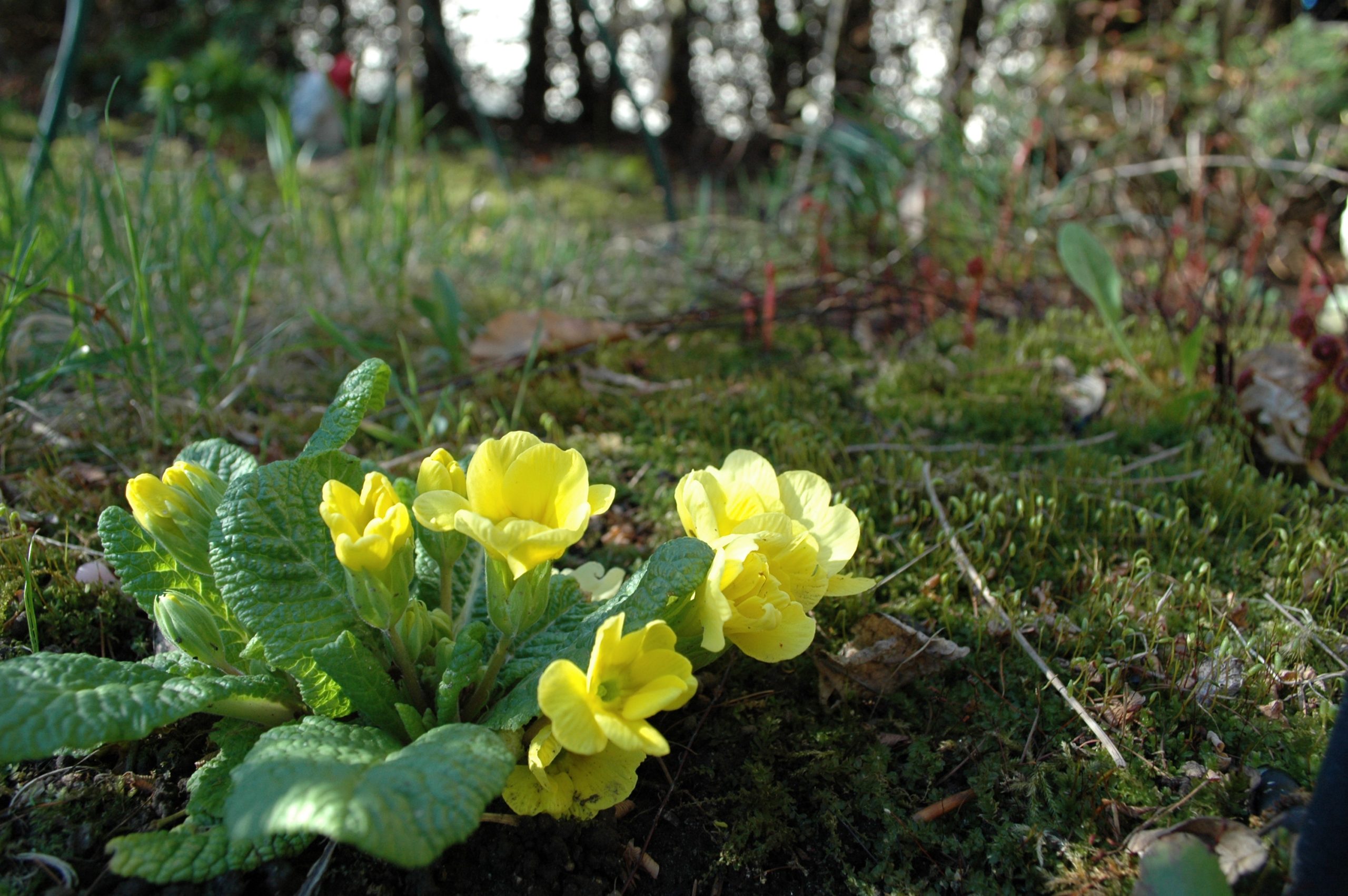
Forget the overly popular ‘Pacific Giant’ primroses, which have a short lifespan. The primroses you want in your shade garden are common primroses (Primula vulgaris). There are many interesting cultivars, so you can choose a flower color that harmonizes with the rest of the garden. They bloom in spring. In truth, there are many interesting primroses to choose from.
H.: 20 cm (8 inches): L.: 30 cm (12 inches)
13. Toad lily (Tricyrtis hirta), zone 4 (USDA zone 3)
It’s a curious and very hardy plant. The toad lily bears pretty spotted flowers in autumn. It has a slight tendency to grow obliquely. That’s why I like to plant it among ferns or geraniums. The leaves are spotted in spring.
H.: 75 cm (30 inches). L.: 45 cm (18 inches)
14. Bigroot Geranium ‘Spessart’ (Geranium macrorrhizum ‘Spessart’), zone 4 (USDA zone 3)
There are a few perennial geraniums that still grow well in the shade. The bigroot geraniums are in this group. The plant forms a small, globular bush of pretty, jagged leaves. The flowers are very pale pink and appear in summer. It even manages to grow in rather dry soils.
H.: 35 cm (14 inches); L.: 40 cm (16 inches)
15. Pulmonaria ‘Sissinghurst White’ (Pulmonaria saccharate ‘Sissinghurst White’), zone 4 (USDA zone 3)
I chose the white-flowered variety because I know it well and know it’s reliable. But, in general, lungwort flowers tend to be purple and mauve. This plant is loved for its spotted leaves, in this case with white dots. Lungworts don’t tolerate drought very well. This is the only thing you need to be careful about.
H.: 30 cm (12 inches); L.: 40 cm (16 inches)
This website is fantastic Moto X3m 2. I appreciated reading your essay. I believe this is a good document.
I love discovering overlooked plants for my shady spots! It reminds me of finding hidden solutions in games. Speaking of which, I recently used a pixel flow guide to solve tricky puzzles when I needed a break from gardening.
Really enjoyed this list—nice to see shade ideas that go beyond the usual suspects. The emphasis on texture, foliage color, and late-season interest is spot on; it’s the mix that keeps a dim corner lively through the year. I’d love a short follow-up on pairing these choices for small spaces (e.g., one structural shrub + one groundcover + one late bloomer). Also, when I take a quick break between plant notes, I sometimes unwind with a tiny game here: five nights at freddy’s 2 — then come back to the garden plan with fresh eyes.
Thanks for this wonderful list! I hadn’t heard of hole io several of these shade-loving plants before. Do you think it could thrive in a humid climate?
I was disappointed to not see the Japanese waterfall grass.
I was very disappointed that all 15 plants featured were listed as USDA
Usually gardening articles provide photographs of plants which are being discussed. Please consider.
What is suitable for Zone 10?
Rubus is native to Canada, from Nova Scotia to Ontario, which includes and financially supports Quebec. Beautiful and a very strong growing perennial. Martagón Lilies are fabulous for growing in shade and each replicate freely. Shade I find needs organic matter and I use gypsum and sheep manure. Great article thanks!
I live in the north of South Africa 1400m above sea level. The only plant that you mentioned is the toad lily that I have in my garden…the rest I would like to have because my garden is a woodland garden.I got a lot of furns and elefant ears.I would like more color and flowers .Thanks for sharing. Hannelie Rupp
Please show pictures of everything. I passed right by the ones without pictures. Who’s going to sit and google these things just to see what it looks like? Not me.
Are there any for Zone 8a-b Texas?
Wish you sold the seeds or gave recommendations on where to find them
Great read. Would be nice if all of the options had pictures though as I caught myself glazing over the blank ones without something pretty to look at.
Same!
Which of these are also deer friendly?
I grow a number of these already and am happy to discover more new to me shade plants!
Hi Christine, I’m in Vancouver, do you know where to find this Turk Cap Lily.????