
This week, thousands of families in the region will be carving pumpkins for Halloween. Most will choose a classic pumpkin: large, round, with smooth skin and—above all—orange. For a long time, that was the only option. But not anymore. Pumpkins have undergone quite a transformation, especially in the last decades… and those who love originality can take advantage of it.

But What Is a Pumpkin?
Let’s first define our subject: a pumpkin is simply a large winter squash of the genus Cucurbita. It can even belong to more than one species. The classic pumpkin, round and orange, is a C. pepo, but several of the new types of pumpkins, notably the giant pumpkin, belong to the species C. maxima.
Squashes are native to the New World. They are climbing or creeping plants with yellow flowers. Wild squash have relatively small fruits, often with green skin. But as squash was domesticated and passed from community to community, it began to vary. When Europeans arrived on the continent, they found hundreds of varieties, small and large, round, elongated, or flattened, in every color imaginable—they even found blue squash!

A Pumpkin for Carving
The tradition of carving vegetables into lanterns for Halloween comes from the Irish, but they carved turnips! It was in New England that settlers adapted this concept to a vegetable they grew more commonly and that was much easier to carve: the large orange squash they called “pumpkin.” The Chinese also carve squash, but generally to make decorative soup bowls.
Your Choices
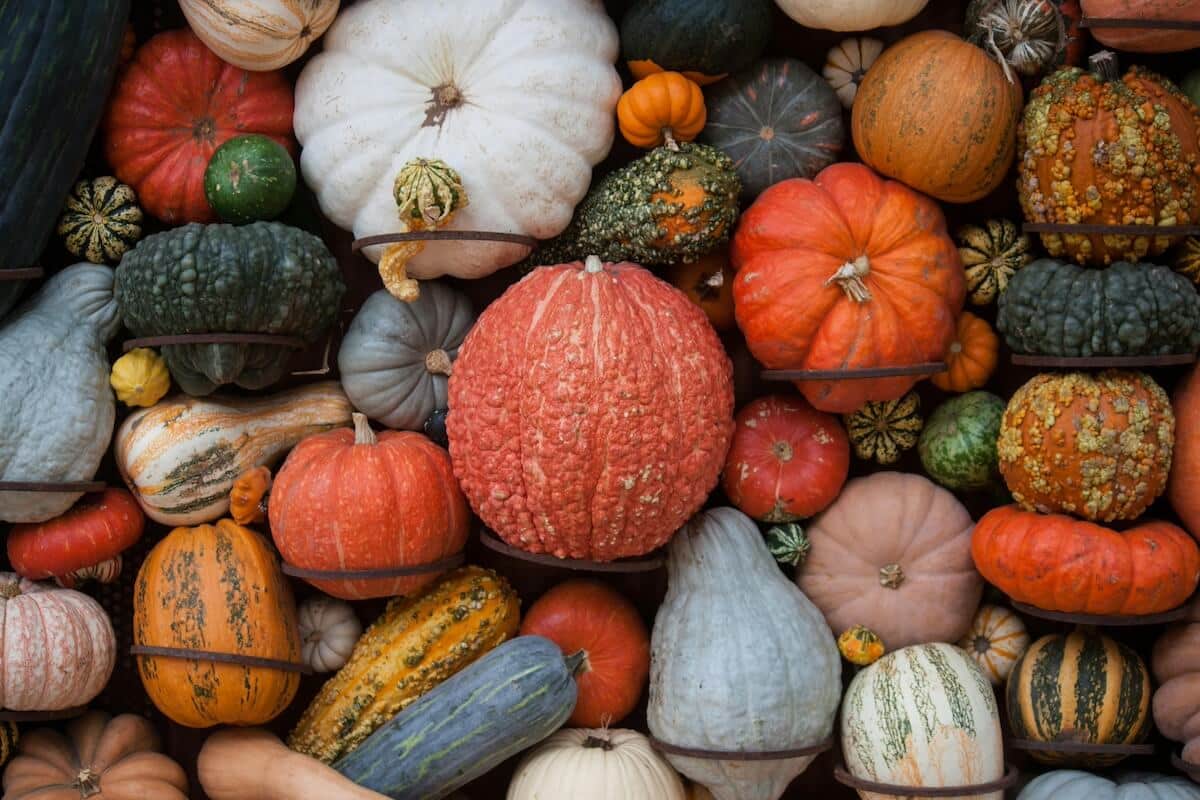
At the grocery store, there isn’t much choice: most only offer traditional pumpkins, which are orange with smooth skin, and perhaps a few decorative squash. Fruit shops and farmers’ markets offer more variety. Here are a few possibilities:
- Traditional pumpkin (orange): all sizes.
- White pumpkin: medium to small size.
- Warty pumpkin: orange, but covered with strange warts.
- Giant pumpkin: pale orange, fairly round, but very flat on the side that touches the ground. The world record now belongs to a pumpkin weighing 1,247 kg (2,749 lb) grown by Travis Gienger in Minnesota in 2023—heavier than a small car! You could almost seat three people on it!
- Pumpkin: orange-red, wider than it is tall.
- Blue pumpkin: blue-gray in color.
- Mini pumpkins: orange or white, very ribbed, they are shaped like traditional pumpkins but are too small to be carved. This group includes ‘Jack Be Little’ (orange) and ‘Baby Boo’ (white). They can be dried and kept as decorative items.
- Ornamental squash: orange, yellow, green, red, blue, striped, two-colored, multicolored; pear-shaped, egg-shaped, flat, winged, turban-shaped; smooth, warty, etc. The choice is enormous! They are usually kept as decorative items.
Pretty and Edible
Pumpkins aren’t just decorative: they’re all edible. Pumpkin soup, pumpkin pie, pumpkin chips, etc. You can make your Halloween decorations with “real pumpkins” or any winter squash. And of course, pumpkin seeds are edible. Even the flowers are edible!

So choose the pumpkin of your dreams today… but save a few seeds. That way, next year, you can grow your own pumpkin!
Larry Hodgson has published thousands of articles and 65 books during his career, in both French and English. His son, Mathieu, has made it his mission to make his father’s writings accessible to the public. This text was originally published in Le Soleil on October 30, 2010.
The variety of colors and shapes of pumpkins makes us think of slope run on Halloween days.
http://bubinga.com/ja