
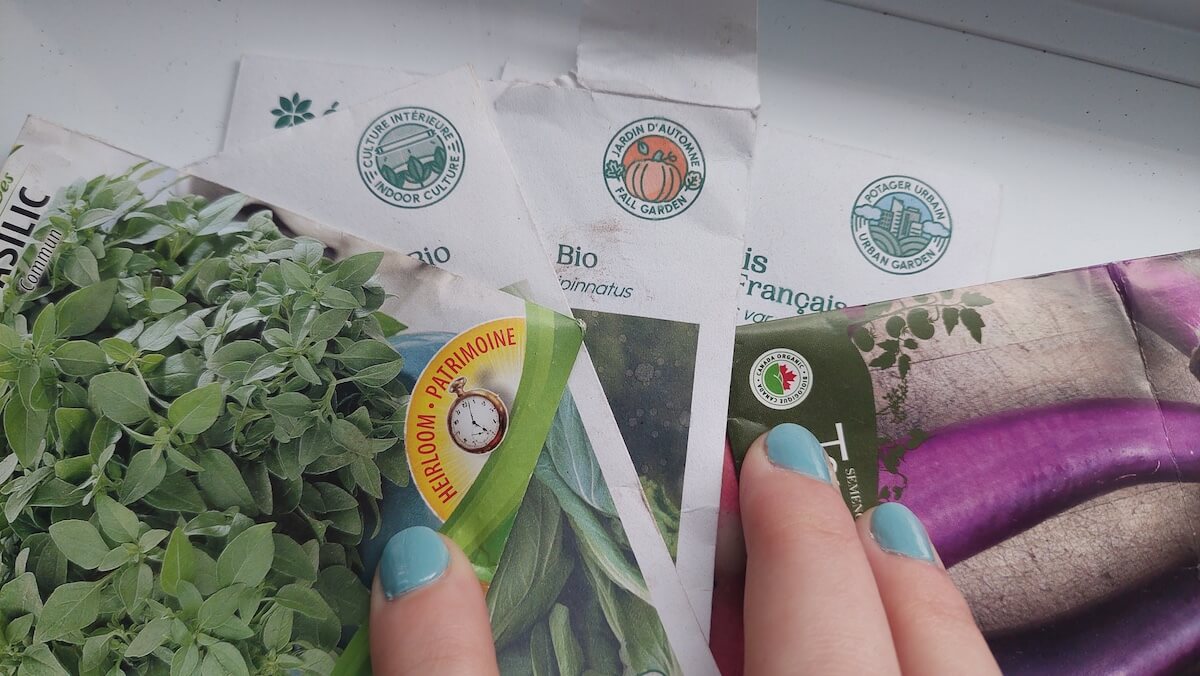
Remember my article from two weeks ago? I talked about cleaning up and organizing the seeds in our personal catalog. Now it’s time to get ready for the season, which means… buying new seeds! I have a complicated relationship with choosing seeds. I find myself looking at pages and pages of tempting photos, a basket with four types of carrots “because there’s a good joke on the packet,” and ‘Black Beauty’ eggplants that will never bear fruit. I try to be reasonable and make informed choices, but with terms like “heirloom,” “rustic,” “disease-resistant,” “natural cultivation”… I find it hard to distinguish between marketing and science on these famous packets!
Answers to my questions
I set out to find someone who could answer my questions and was fortunate enough to speak with Yves Gagnon, founder of Les Jardins du Grand-Portage and mentor to his daughter Catherine, founder of Semences du Portage. He is also a well-known author in Quebec.
Settled on his land in Saint-Didace since 1979, Yves Gagnon first grew vegetables according to his convictions, in harmony with nature. He then turned to seed production. This background is important: he knows both ends of the chain, from plant to seed.
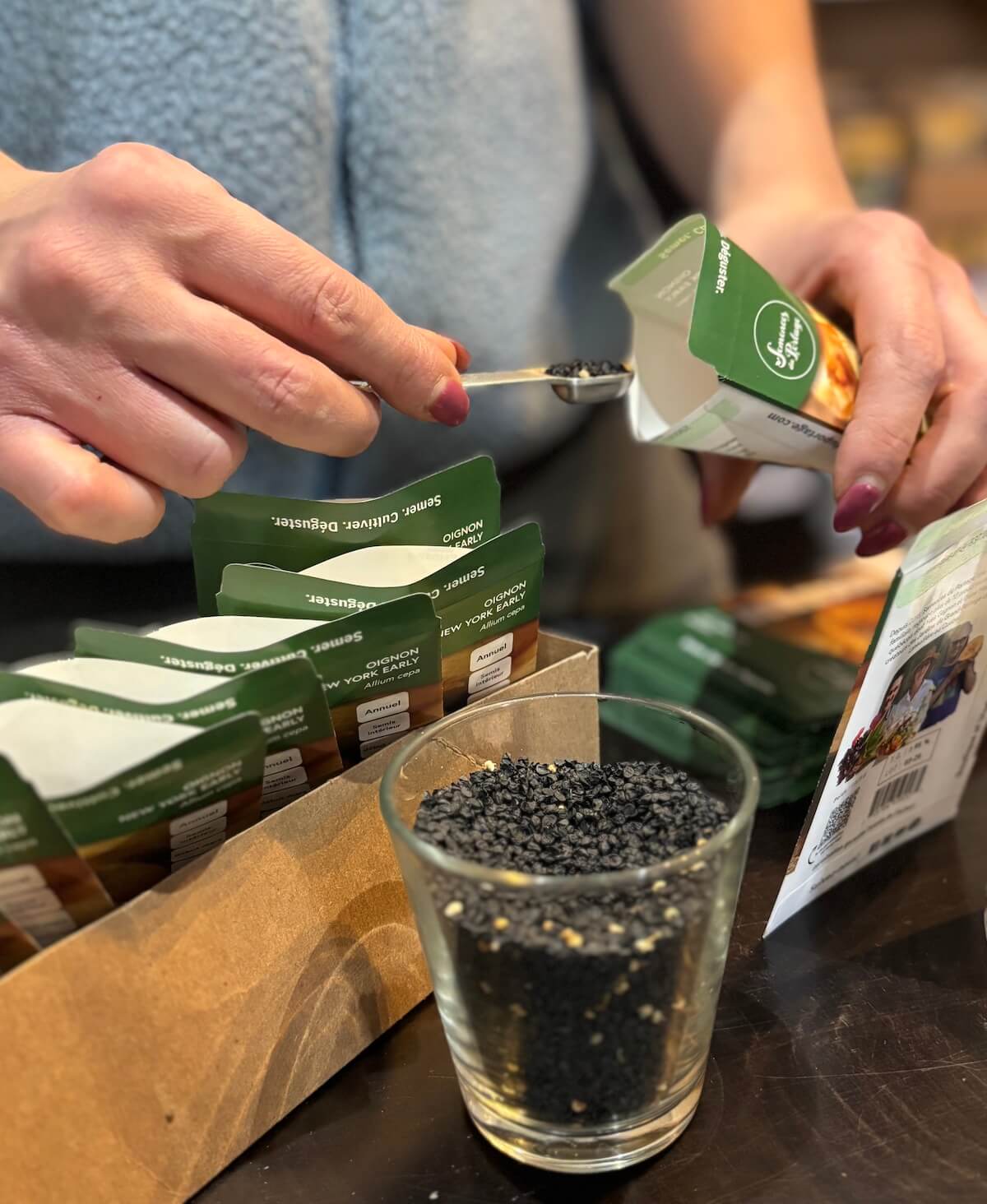
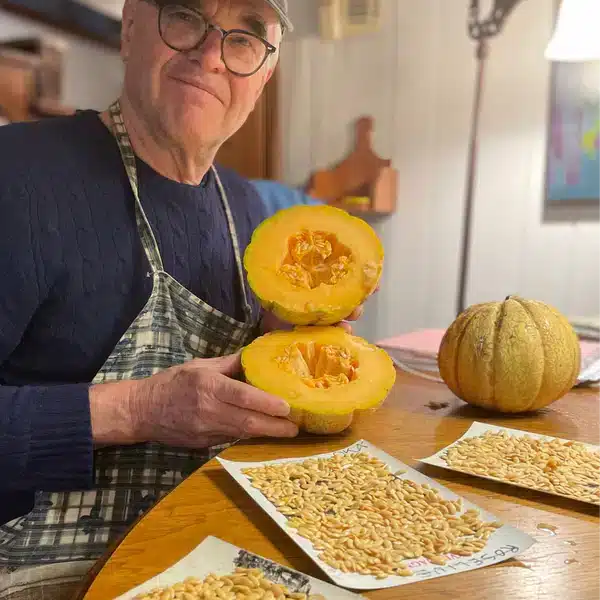
Everything he produces is done by hand: selecting the fruit, ripening it indoors, opening the fruit, counting and bagging the seeds. His only mechanical tool? A rototiller. Everything else is done by hand. That’s why the seeds he produces are called “artisan.” With over 40 years in the business, he is undoubtedly an expert in seeds… and seed bags!
What you see in the catalog
Yves summed up the reality of seed catalogs with refreshing candor: producers use the most attractive photos and the most appealing descriptions. To read between the lines and truly understand what you’re looking at, you need knowledge… and a few trials!
Take carrots, for example. A summer carrot is sweet, delicious when fresh, and develops its sugar during the summer season. A storage carrot, on the other hand, is selected to develop its sugar during the first frosts and is made to last in your basement or cold room until spring. Does your catalog tell you this clearly? Not always. You have to understand that “fresh and crunchy, delicious raw” actually means that it’s not a storage carrot!
Then, how do you choose among the eight varieties of Nantes carrots on offer? Well, try them and choose your favorite! There is also a question of personal taste when it comes to all these types of carrots. Yves told me that at Semences du Portage, the criteria for selecting seeds are flavor first, hardiness second. The variety of cultivars offered exists precisely to allow you to find YOUR favorite.
Hybrid or open-pollinated: the short version
We’ll take a closer look at this together next week because it’s a topic that really deserves some attention, but to help you understand your seed packet today, here’s the gist: a hybrid seed (often labeled “F1” on the package) will not produce plants with the same characteristics the following year.
If you like the idea of saving your seeds from one year to the next, look for seeds labeled “open-pollinated.” These will give you plants that are true to the mother plant, year after year. That is, if you follow certain spacing and selection guidelines! More to come in the next episode!
‘Heirloom,’ ‘heritage,’ ‘ancestral’: is it all just marketing?”
Yes and no. Yves was clear on this point: these three words are synonyms. They “sound good,” as he says, and therefore have a strong marketing appeal.
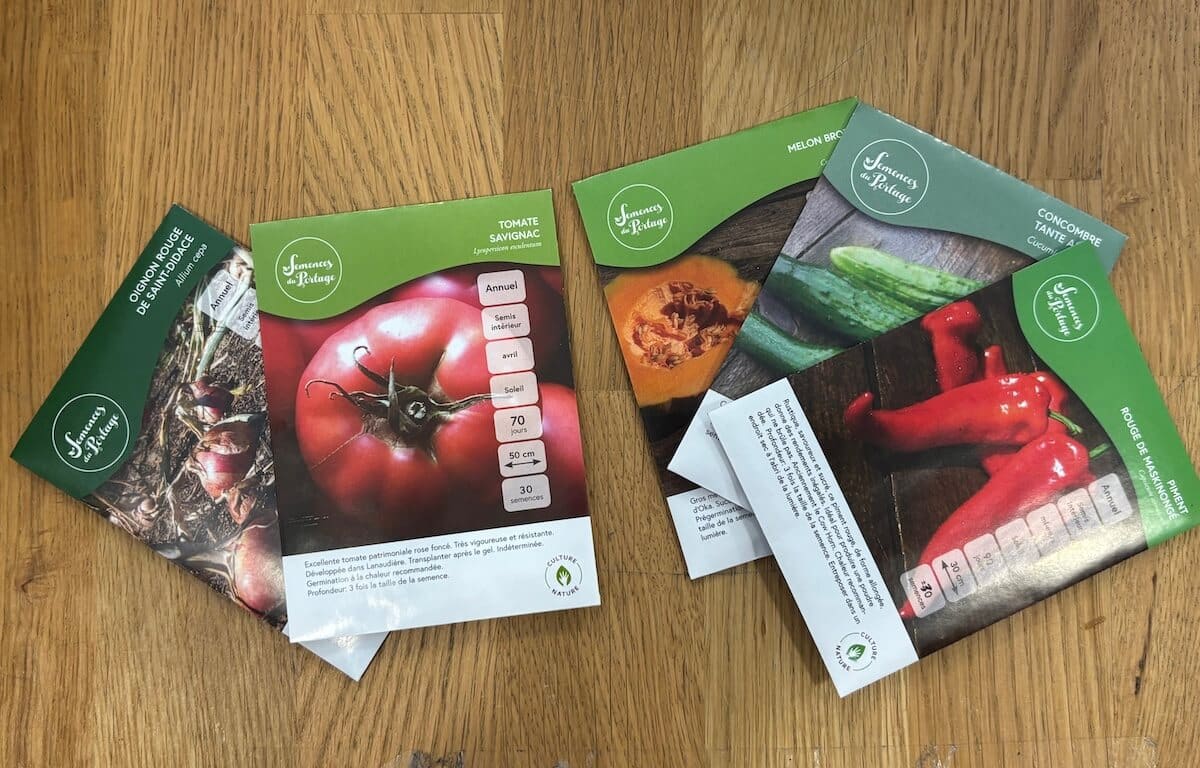
Here’s what it really means when used correctly: it’s a cultivar with a known history, cultivated for a long time, where we know who originally did the crossbreeding or selection. The Oka embroidered melon: stabilized by Trappist monks. The Savignac tomato: selected by Yves Gagnon.
And why is this important? Because, according to Yves, nearly 90% of plant genetic heritage was lost a few decades ago due to the monopoly of commercial seeds from large companies that were supposedly adapted to all climates. Flavors, resistance, local adaptations—gone forever. These heritage cultivars are a safeguard of the genetic memory of our local cultivars.
A word of caution, however: heritage cultivars can have vulnerabilities. Growing conditions have changed enormously over the past 40 or 100 years. Some ancestral cultivars are now exposed to diseases or pests that their ancestors did not have to contend with.
“Hardy”: a word that means almost nothing
We know that “hardy” in the context of plants means that they have a certain resistance to cold. But what does it mean on a seed packet? Is a hardy eggplant resistant to frost? Or only to 10°C (50°F)?
The answer is rather disappointing… It means nothing! In fact, since there are no regulations governing this term, anyone can put it on the bag, and it may (or may not) mean that the cultivar is (somewhat or much) more resistant to cold (or only cool) temperatures than others. Yep…
No control over the term
The term “hardy” may indicate that a cultivar has been selected to better adapt to cold weather, but there is no standard, no control, and no certification. Anyone can write “hardy” on a bag without having to prove it. That’s why it’s important to have a trusted seed supplier. Even within Canada, “hardy” does not mean the same thing in Quebec as it does in Manitoba!
The proof? The story of the Savignac tomato. Originally, Brother Armand grew this tomato, then called the “Dufresne tomato,” between two stone walls—a protected microclimate with no frost before mid-October. When he gave his seeds to Yves, the yield was disappointing; frosts arrived as early as September at the Jardins du Grand-Portage! Yves selected this tomato for 40 years to adapt the cultivar to our climate. It became a distinct cultivar, renamed Savignac. What this tells us is that hardiness cannot be labeled on a bag. It is built slowly, with patience and rigorous selection.
Yves also advised me to try the ‘Diamond’ eggplant this year, which is much better suited to our climate than the ‘Black Beauty’ and its pretty picture! He confessed to me that, if he wanted to, he could easily label it “hardy,” because he is certain that he has a well-selected cultivar (but the label is not there!).
Organic: true or false?
This is probably the only regulated label on your packet. What does it actually mean? The seeds have been grown in a field certified organic by a recognized body, without synthetic fertilizers or pesticides.
I must admit that I have long viewed “organic” with a certain degree of skepticism because certification does not automatically guarantee an ecological approach. There are large certified organic monocultures that are not exactly a dream in terms of biodiversity. That said, most organic producers are truly committed to offering a product that is in harmony with nature, and their work deserves to be recognized. The most important thing is to know your producer.
So I asked Yves (a little shyly, I must admit!): what difference does it really make to have organic seeds? Because, after all, there are never enough pesticides stored in this little seed to REALLY change the quality of my tomatoes!
The answer makes so much sense (and has nothing to do with what might be “stored” in the seed)! It’s a seed produced in living soil, in collaboration with soil microorganisms, and will therefore be better suited to this type of crop. Conversely, a seed produced in soil dependent on fertilizers and pesticides will produce “laidback” plants—unable to take advantage of living soil. The irony for a laidback gardener like me, who makes her own compost and never uses fertilizers, is that organic seeds are perfectly suited to my type of gardening! And I thought it was just marketing!
What your packet never tells you
The difficulty of cultivation is never clearly indicated. No one writes “complex cultivation” on a packet—because that would limit sales. And that makes sense! If you want to sell celery seeds, you don’t scare consumers by telling them it’s difficult… They would simply buy celery seeds from the neighbor (who doesn’t mention that it’s a finicky crop)! So we assume that gardeners have done their research and know what they’re getting into. Spoiler alert: I didn’t know, and I’ve never harvested celery!
Yves’ best advice on this subject: don’t look for information on a case-by-case basis when a problem arises. Rather than Googling “why are my cucumbers turning yellow,” it’s better to consult a comprehensive source to get an overview before you start.
By taking a broad view and understanding the ups and downs of gardening, you may be better able to read between the lines on the seed packet. When you see that celery requires two months of indoor sowing, followed by a substrate that must be kept moist at all times, you may better understand the implications… and choose another vegetable!
My great learning experience
When I go shopping for seeds now, I will have a different perspective. I will look for transparency about the history of the cultivar rather than labels such as “heirloom” or “good for pollinators.” I will be wary of the word “hardy” used without context. I will also spend less time looking at beautiful catalogs and more time reading good books.
It’s quite a coincidence that you asked me to present my catalog this year. I’m REALLY learning a lot as I organize it, and I hope you benefit from my learning, too! Are you the type to be swayed by a pretty picture on a package, too?
Thank you for all this info. Going forward, I will be buying organic seeds and continue to research. This is all very helpful.
Excellent article! Thank you.