
In 100 years, this insect has overrun much of eastern North America… is it an invader or a marvel of nature?
Don’t we all want to do our best? To feast and rest in the best possible conditions? To travel the world and expand our comfort zone?
What if that were exactly what the Japanese beetle aspired to as well? What if it were we who, brick by brick, had built the castle over which it now reigns?
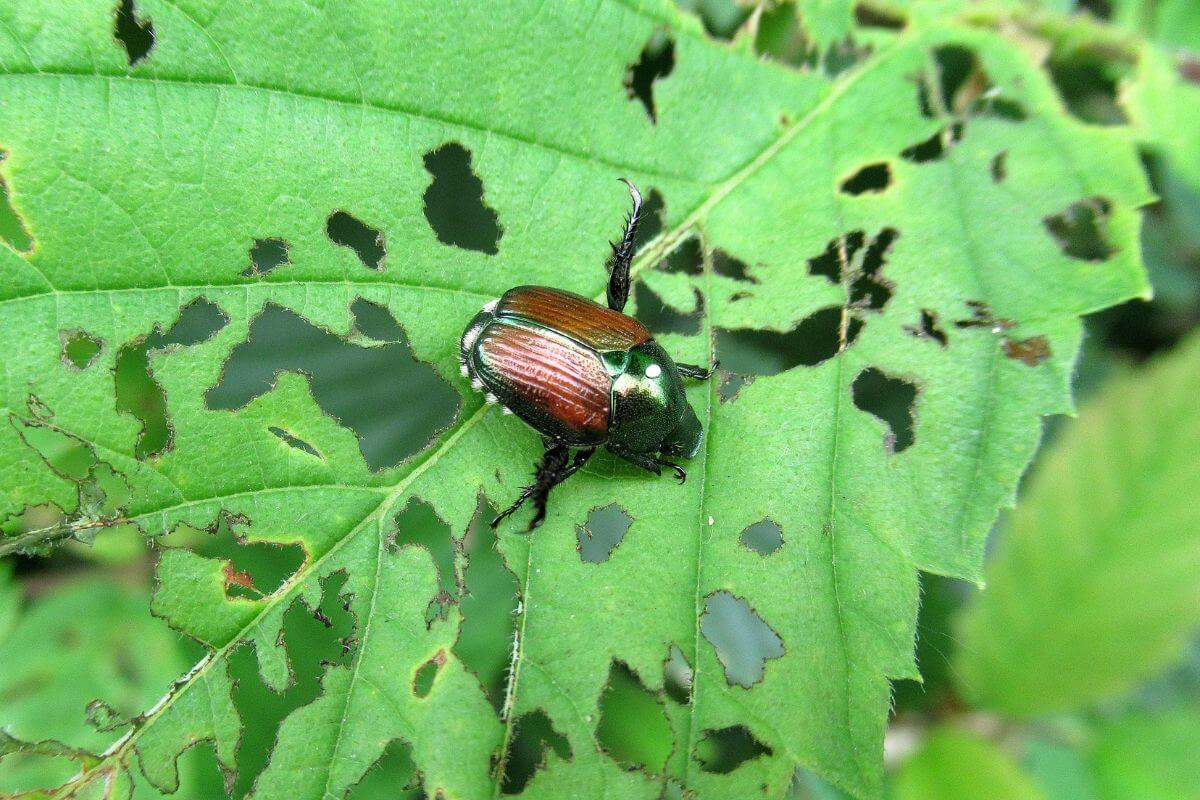
How did a tiny beetle from Japan come to pose a threat to our gardens?
The Japanese ancestors of this pest arrived in America around 1916. They came ashore in the United States – specifically in New Jersey – on a ship carrying Japanese irises. These were the first specimens observed in North America.
In Canada, the first specimens were intercepted in 1939. One was discovered in a tourist’s car on a ferry travelling between Maine and Nova Scotia. That same year, three others were reported: one in Yarmouth (Nova Scotia) and two in Lacolle (Montérégie).
What have they been doing over the last few million years?
An organism does not become so powerful overnight. Its ability to feed on almost any plant and survive freezing winters is the result of millions of years of evolution in the harsh conditions of the Japanese archipelagos.
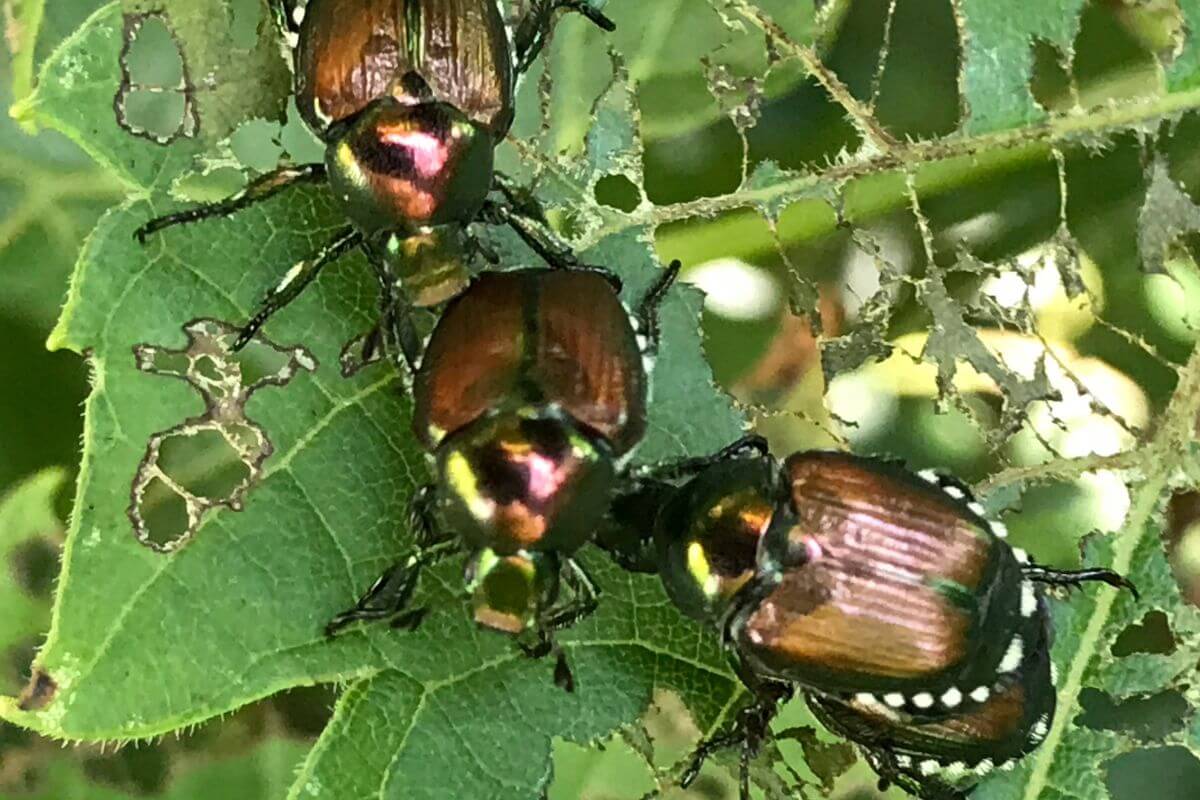
Japan is a true training ground for the species that evolve there. Its rugged terrain and dramatic climatic variations have, over the course of evolution, favored a remarkable capacity for adaptation, known to biologists as phenotypic plasticity—the ability of an organism to respond differently depending on the conditions of its environment. Isolated on this archipelago, Japanese beetles have endured countless challenges that have shaped their remarkable versatility.
If we go back about a century, this jewel-like beetle lived peacefully in its native homeland. There, in Japan, it was just one species among many. It fed quietly on grapevines and knotweed, only to become food itself for predators well accustomed to finding it, such as birds and predatory insects. Dense, rugged forests also limited how far it could spread.
Over time, it evolved alongside its environment—and alongside its nemeses: parasitoids. Among them are Tiphia, a group of parasitoid wasps that attack only the larvae, and Istocheta aldrichi, a tachinid fly that lays its eggs directly on the thorax of adult beetles.
So, in its native habitat, the Japanese beetle had its place. Predators, parasitoids, and the landscape itself kept its populations in check… until humans decided otherwise.
Atlantis, beetle version
According to legend, Atlantis was swallowed up as a punishment… The downfall of an advanced civilisation, brought about by pride, greed and the desire for domination…
Upon arriving on the new continent, the Japanese beetle discovered an open-air buffet, with no security guards in sight. North America, painted a lush green by the ‘American Dream’, was, for the beetle, an ideal environment. Safe from its enemies and in its favourite habitat – the well-watered lawn – it found a welcoming home here where it could thrive at its leisure. Our desire for ‘beauty’ (with a capital ‘B’) rolled out the red carpet for it.
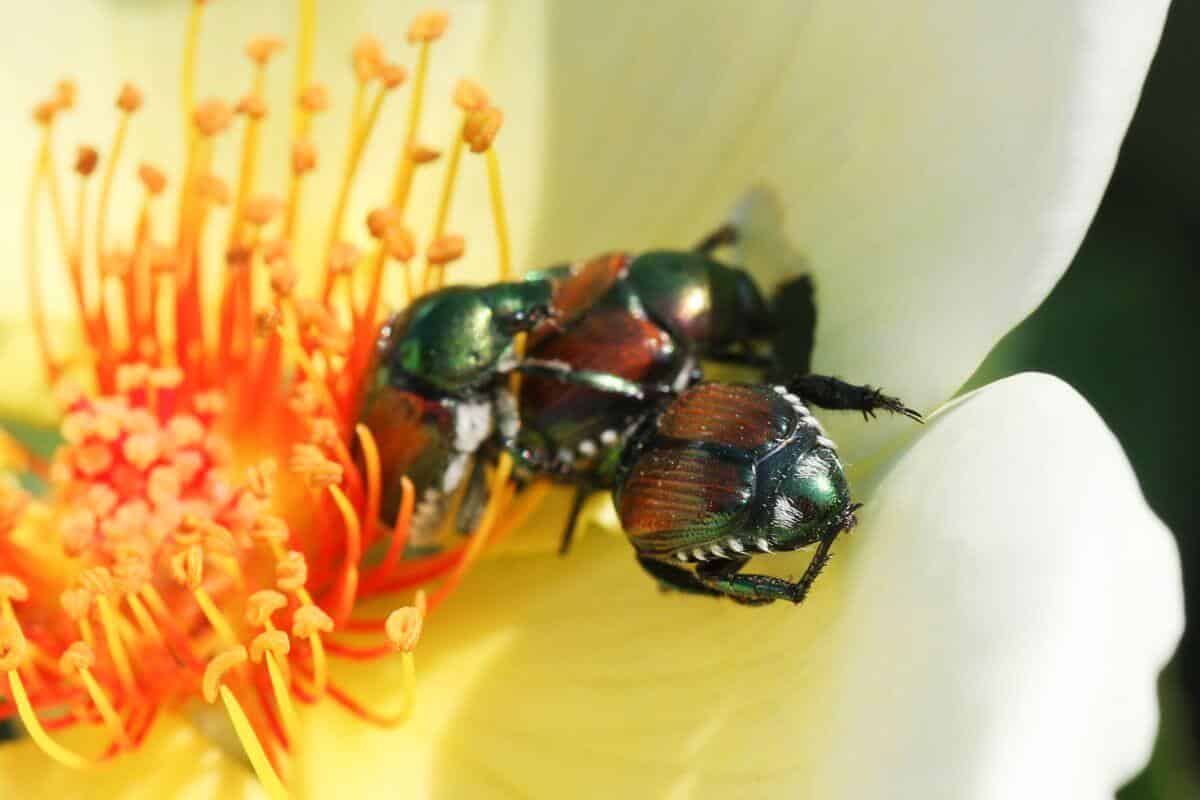
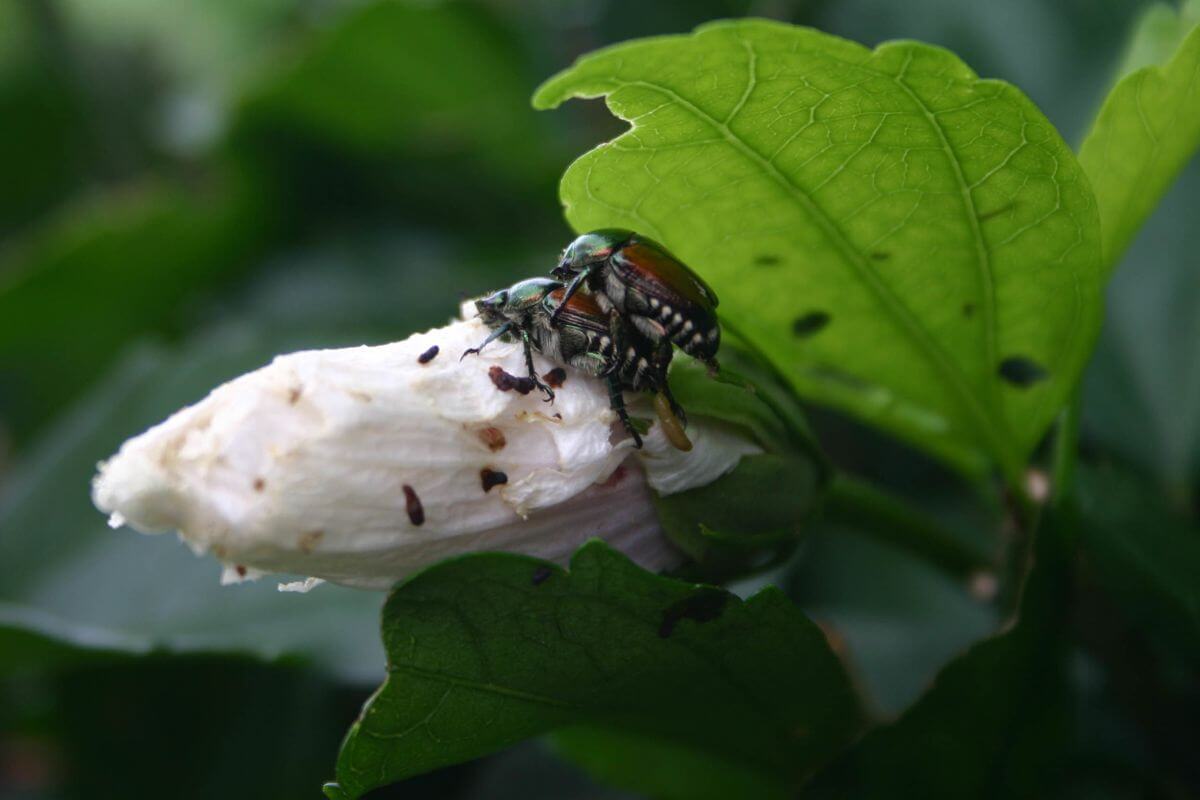
Although it has its preferences, the adult can eat more than 300 different plants. Trees, bushes, plants – it eats them all, leaving only the leaf stalks behind. Ornamental species are a real treat for it.
Winter does not bother him; he burrows quietly into the ground, sheltered from the frost, in larval form, and waits for warmer days.
His thousands of years of experience on Japanese soil serve him well… It is much easier now, with easily accessible artificial resources, attracting greed and invasion.
What he does with his life
It is easily recognised by its metallic green body, copper-coloured elytra, feather-like antennae and small tufts of white hairs dotted along either side of its abdomen. It has now become the arch-enemy of many gardeners, but it is, first and foremost, an insect with its own distinct life cycle.
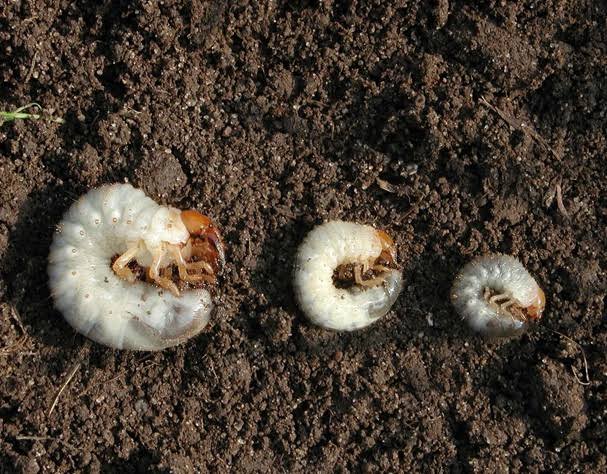
Let’s see:
- The larva
- The larva of the Japanese beetle is a white grub, similar to others in the Scarabaeidae family. It feeds on roots and thrives in well-watered lawns. It is well looked after: during dry spells, people make sure it is cared for. This is the longest stage of its life cycle, during which it builds up its strength.
- The pupa
- Having eaten its fill, the beetle larva transforms into a pupa, from which it later emerges as an adult, gleaming beautifully.
- The adult
- It takes advantage of our abundance. It feeds on what we have planted for it (or almost everything). It moves about with ease. It is far easier to hop over a fence than to cross a dense forest.
- Reproduction
- a. To lay her eggs, the female – who has a good memory – returns to places where she herself felt comfortable as a young beetle, particularly well-watered lawns. This ensures the continuity of the cycle.
OK, that’s really impressive, but what do we do now?
Our resources are not infinite – neither nature nor our energy. The Japanese beetle is opportunistic, versatile and well-adapted… What can we do to slow it down?
- In spring: It is still a vulnerable larva that has spent the winter deep in the soil; the larvae come up close to the surface to resume feeding. You can intercept it before it emerges. You wait for the warmer temperatures to lure it to the surface and kill it before it reproduces. But autumn is really the season when biological control pays off. Our weapon: nematodes.
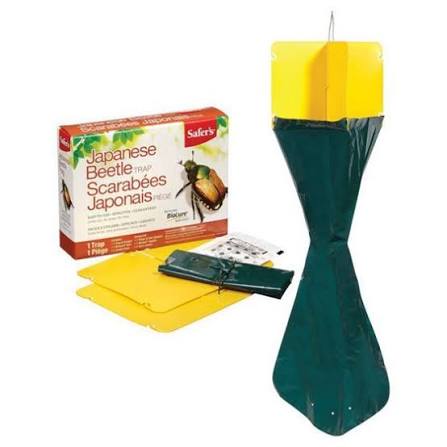
- In July: The adults are ready. They are on the lookout for abundance, food and mates. This is the ideal time to lure them. One fewer female means around fifty babies that will not be born (up to 80 eggs). They can be deceived and caught using a pheromone trap. When properly set up, in sufficient numbers and at a safe distance from vulnerable crops, the traps are used to intercept breeding adults. Some are disposable, others reusable.
- At the end of summer (mid-August to mid-September): This is the best time to take action. This year’s newly hatched larvae are particularly soft and vulnerable, making them even easier to penetrate. For nematodes, this is a feast. Applying them in damp weather to a wet surface will allow them to actively hunt down and penetrate the Japanese beetle grubs, liquefying them from the inside.
Beware of pheromone traps!
Because pheromone traps attract Japanese beetles from long distances, they can actually make the problem worse if used improperly by drawing even more beetles into your garden. Recent research has also shown that they may accidentally capture certain pollinators and other beneficial insects. If you choose to use a trap (whether a reusable model or a disposable bag trap), be sure to follow these Larry Hodgson guidelines to make it as effective as possible:
Place them well away from your plants: Position traps far from the plants Japanese beetles prefer (at least 15 m (50 ft)away). For example, mount the trap on a post in the middle of your lawn.
Empty them frequently: During peak season, this may mean every day. If the trap becomes full, newly arriving beetles won’t be able to enter and will instead head for your plants. Dispose of the captured beetles in a bucket of soapy water.
Another option is BTG (Bacillus thuringiensis subsp. galleriae), a biological control used against Japanese beetle grubs. These two approaches can also be used together. To learn more about how BTG works and how to use it, see Larry Hodgson’s article.
In conclusion
Even though we might want to hate it for wanting to eat everything, we must also admire its strength and resilience. It is simply doing what evolution has shaped it to do: making the most of favourable opportunities. And, without meaning to, we have provided it with an almost ideal playground.
We hope this article has helped you to see this infestation, which is spreading across North America, in a different light, whilst providing you with the tools to control it naturally.
It would be very helpful if your references to Larry Hodgson’s article actually linked to the article. Thank you.
Interesting article. Of course they do love places that have no well watered lawn and scrubby lawn at that. I am surprised you don’t make mention of the Winsome fly in your article. When the non affected JBs are gathered, but the affected ones re released the percentage of parasitic infected JBs increases over the years. That is my experience and my hope. My own army.