
Why do we have to grow orchids in small, narrow pots when, in nature, those same orchids develop extensive aerial roots with no confinement at all? It’s a strange paradox, and we’re going to try to clear it up in this fifth chronicle of the series on roots.
Instinctively, we’d be tempted to think that an orchid in nature, free as the air and spreading its roots in the full sun, must be happier than an orchid cramped in a small pot on someone’s windowsill. Yet when we look carefully at these two situations, we quickly realize that the plant has adapted its root morphology to the very different conditions it faces. That’s the whole ingenuity of the epiphytic orchid!
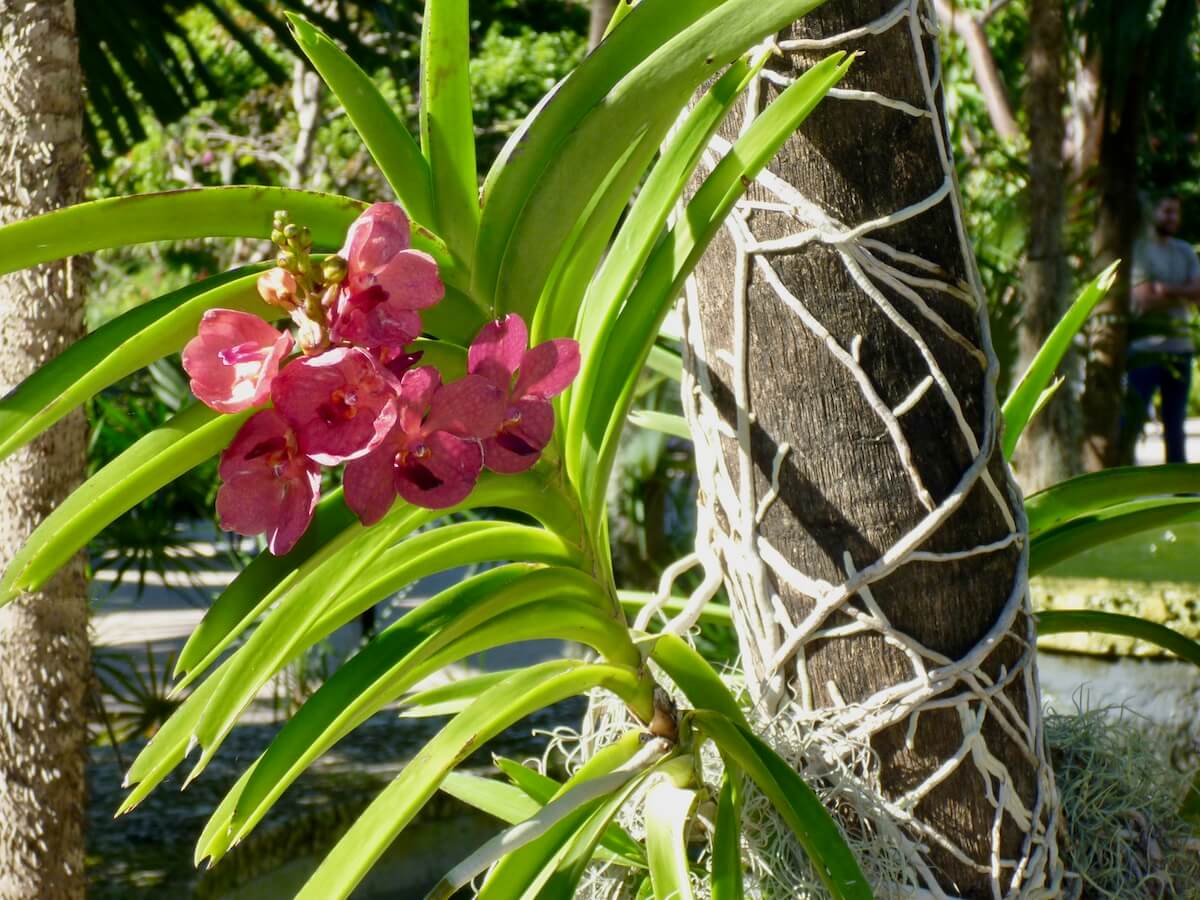
In nature, orchid roots are optimized to capture rainwater quickly
As we saw in an earlier chronicle on the dual personality of orchid roots, epiphytic orchids have developed very peculiar aerial roots, wrapped in a spongy tissue called velamen. This velamen serves at once as a sunscreen, as an absorbent sponge to capture rainwater and as protection against dehydration.
In its natural habitat, the orchid enjoys several advantages that are sometimes hard to reproduce in home culture:
- constant aeration provided by the wind and the tropical breezes,
- frequent showers that hydrate the roots quickly,
- pure rainwater, practically free of dissolved minerals,
- rapid hydration/drying cycles (often in less than 24 hours),
- the presence of mycorrhizal fungi that supplement the nutrient supply,
- a stable anchorage on the bark of their host, dotted with rough spots where the rootlets can work their way in.
In short, the epiphytic orchid is perfectly adapted to an environment where water is intermittent but abundant, where the air circulates freely and where the light is filtered by the canopy. Its roots are designed to breathe as much as to drink.
In a pot, the orchid has adapted to extract its moisture slowly from the growing medium
When we put an orchid in a pot, we force it to deal with an environment radically different from its natural habitat. The medium (bark chunks, sphagnum moss, charcoal, perlite, etc.) tries to simulate the conditions of the natural environment, but there are inevitably compromises to be made.
The first compromise involves aeration. In nature, the roots are bathed in air permanently. In a pot, even with the best-aerated medium in the world, gas exchange is much slower. Several studies and the observations of experienced orchid growers confirm that the quality of the aeration is probably the most decisive factor for root health in a pot.
The second compromise involves the hydration/drying cycle. In nature, an aerial root gets wet quickly during a shower, then dries within a few hours thanks to the wind and the sun. In a pot, this cycle can take 5 to 10 days, which is radically different. The roots therefore have to adapt to a prolonged hydration regime that isn’t in their original genetics.
The third compromise involves the chemical composition of the water and of the medium. Tap water often contains an appreciable quantity of dissolved minerals (calcium, magnesium, sodium, chlorine, etc.), and the medium gradually loads up with fertilizer salts and decomposition products. It’s a cocktail far removed from the purity of the rainwater that runs down the bark in the tropical forest.
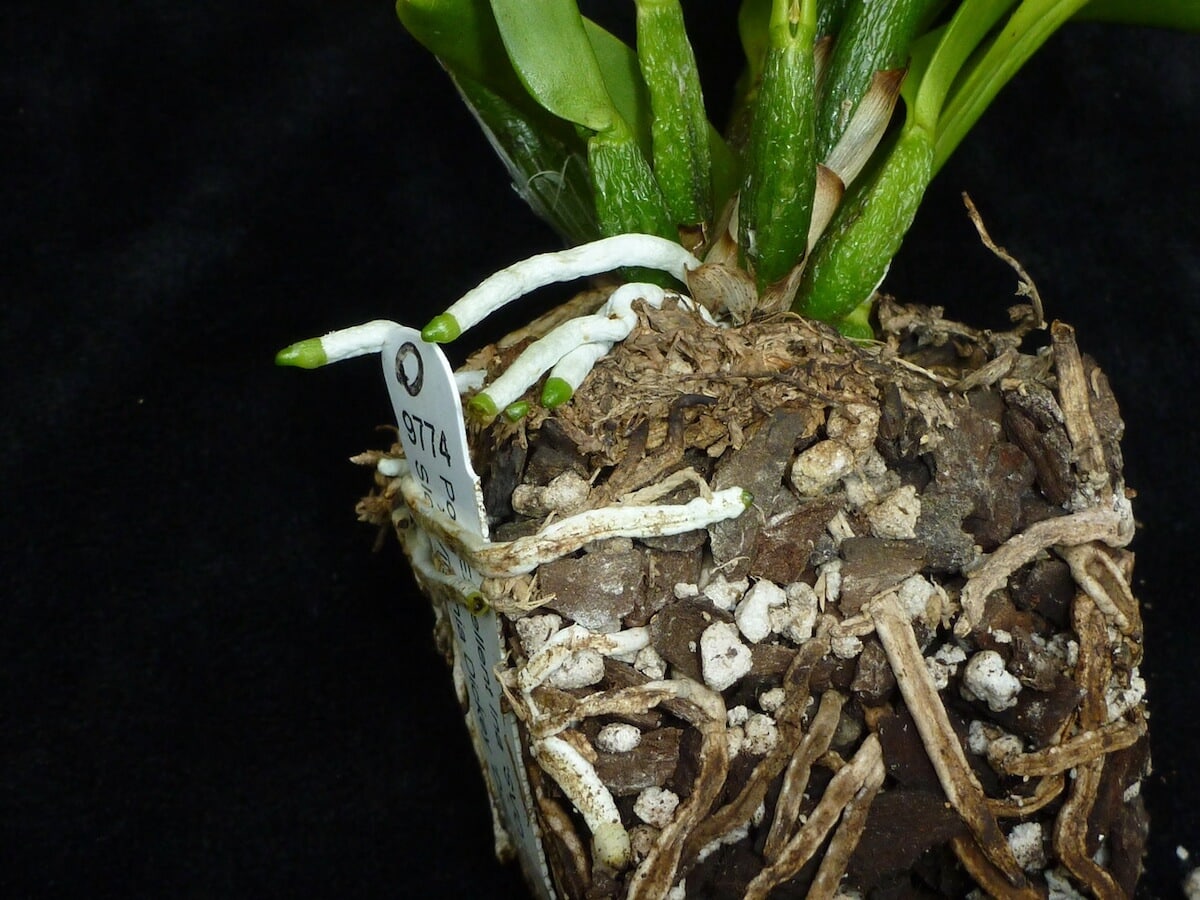
The velamen doesn’t work exactly the same way in a pot
Here’s a slightly more subtle aspect of the paradox. As we explained in the chronicle on the dual personality of roots, the velamen adapts to the surrounding conditions. A root exposed to the light will develop a thicker, more protective velamen, while a root hidden in a medium will develop a thinner, more permeable one.
In a pot, the great majority of the roots therefore end up with a thin velamen, optimized to absorb the moisture stored in the medium. This works well as long as the medium is healthy, well aerated and offers pulsed moisture (that is, alternating between hydration and drying). But as soon as the medium breaks down or stays constantly wet, that thin velamen becomes a doorway for bacteria and pathogenic fungi. The roots will then rot much faster than equivalent aerial roots.
The medium is an artificial habitat that breaks down over time
Unlike a tree branch in the forest, which stays stable for years, the medium in a pot changes constantly. The bark chunks decompose, the sphagnum compacts, the fertilizer salts accumulate and microbial life proliferates in it.
This progressive breakdown has several consequences:
- the porosity decreases, reducing aeration and gas exchange,
- the drying time lengthens, which can suffocate the roots,
- the acidity increases (the pH of a degraded medium can drop below 4.5),
- the pathogens proliferate in an environment increasingly favorable to their development.
That’s why repotting is an indispensable operation for growing orchids in pots. The frequency depends on the type of medium used, but as a general rule:
- a pine-bark-based medium is renewed every 24 to 36 months,
- a sphagnum-based medium is renewed more often, practically every year,
- a medium based on inert materials (LECA, perlite, charcoal) can last longer, up to 4 or 5 years in some cases.
The timing of the repotting is also crucial: you have to step in at the beginning of the annual cycle, just before or during the appearance of the new roots, so the plant can settle properly into its new medium. Repotting out of season can disturb the plant considerably.
Mounted culture is an alternative that comes closer to the natural environment
For those who want to get closer to the natural environment of epiphytic orchids, there’s an interesting alternative: mounted culture. The plant is fixed directly onto a piece of cork, wood or plastic, or onto tree fern, with no medium or with very little moss to hold a bit of moisture.
The advantages of this approach are numerous:
- maximum aeration of the roots, as in the natural environment,
- rapid hydration/drying cycle, about 24 hours,
- no medium to replace, which eliminates repotting,
- an interesting visual display, since you can admire the roots and the plant from every angle.
The drawbacks, however, are notable:
- very frequent watering required (sometimes daily),
- high ambient humidity necessary (60% or more),
- poorly suited to orchids with extensive root systems.
This technique is particularly well suited to small epiphytic orchids such as certain Bulbophyllum and Tolumnia, or to miniature orchids. For the bulkier Phalaenopsis and Cattleya, pot culture generally remains more practical.
A few lessons to remember for growing orchids better in pots
All of this may seem complex, but by keeping a few simple principles in mind, we can greatly improve our chances of success:
1. Imitate nature as much as possible.
The roots of epiphytic orchids need a lot of air, far more than most hobbyists imagine. A very airy medium, a pot with side holes and ambient air circulation are essential elements.
2. Respect the hydration/drying cycle.
You absolutely have to let the medium dry out between waterings so the roots can breathe. A constantly wet medium is enemy number one of orchids in pots.
3. Choose relatively small pots so the roots occupy the whole medium.
Here again, biology is in charge. In a large, poorly occupied pot, there are inevitably zones where no root grows: forgotten pockets of moisture that the plant never draws on. These pockets take much longer to dry than the rooted zones, and they quickly become small hotbeds of uncontrolled infection.
A small pot well filled with roots has several advantages:
- it dries faster and more uniformly,
- it greatly simplifies watering management for the hobbyist,
- it reduces the risk of root rot,
- it respects the natural rhythm of hydration and drying that orchids prefer.
The principle is simple: the size of the pot must be matched to the volume of the root system, not to the apparent size of the plant above the pot. Better a pot that’s a little too small than a pot that’s too big.
4. Keep an eye on the state of the medium.
The medium isn’t eternal and you have to plan the repotting according to the type of material used. A degraded medium is just as harmful as poor nutrition.
5. Careful, some orchids can’t be put in a pot at all.
There are indeed a few notable exceptions to the rule. Some orchids, such as the Vanda, simply can’t be confined in narrow pots. Over the course of their evolution, they lost the morphological flexibility that normally allows an orchid root to transform itself to adapt to a medium. Their roots have remained exclusively aerial, with a thick, plump velamen, designed to capture rainwater and ambient humidity directly.
That’s why we generally grow Vanda in an open-slatted basket, with no medium, or simply hanging from a wire, their long roots dangling freely in the air. These plants do require very high ambient humidity and very frequent watering, though, which makes them harder to grow for the average hobbyist.
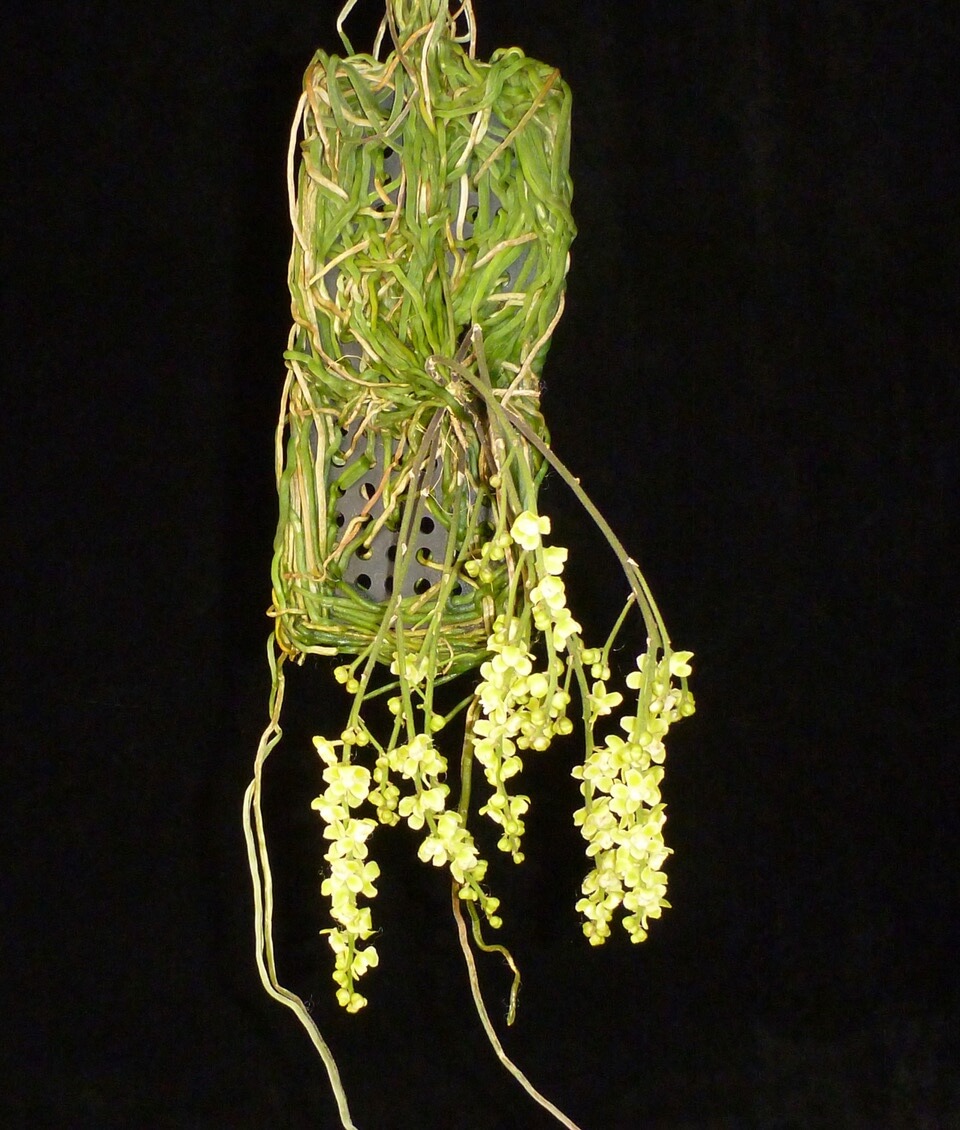
An even more fascinating example of this type of plant is the genus Chiloschista, native to Southeast Asia, India and Australia. This orchid pushes the concept to the extreme: it produces no leaves and no pseudobulbs – only roots!
These flat, greenish roots take care of everything:
- the absorption of water and nutrients,
- the capture of atmospheric CO?,
- photosynthesis, thanks to the chlorophyll present in their structure,
- the transformation into energy-rich sugars,
- the emergence of the flower spikes directly from the roots,
- and finally, the bloom!
It’s the ultimate achievement of adaptation to aerial epiphytic life. Obviously, these roots have to stay out in the open permanently and be well exposed to light so photosynthesis can operate. So we grow Chiloschista mounted on a cork slab, a piece of perforated plastic or a small piece of wood, with no medium. It generally has to be watered daily and kept at high ambient humidity to make up for the absence of a moisture reservoir.
It’s a plant that defies intuition and reminds us just how surprising botanical evolution can be.
In summary
The paradox of roots in nature compared to roots in a pot isn’t really one anymore once we take the time to understand it properly. The plant simply adapts its root morphology to the very different conditions it faces:
- In nature, it’s the aerial roots with their plump velamen that handle hydration. The network is broad, branched and well exposed.
- In home culture, it’s rather the medium roots (related to the anchoring roots) that take over. The network is shorter, more twisted, and the velamen is thinner.
This remarkable plasticity is precisely what allows orchids to survive and thrive in our culture pots. It’s up to us to draw the right practical conclusions: let the medium dry out between waterings, choose pots suited to the size of the root system and recognize the few species that refuse any potting at all.
With these principles in mind, we can greatly improve our chances of success and fully enjoy the beauty and the botanical ingenuity of these fascinating plants.
0 comments on “The Roots of Success with Orchids Part 5 – The Paradox of Roots in Nature Compared to Roots in a Pot”