
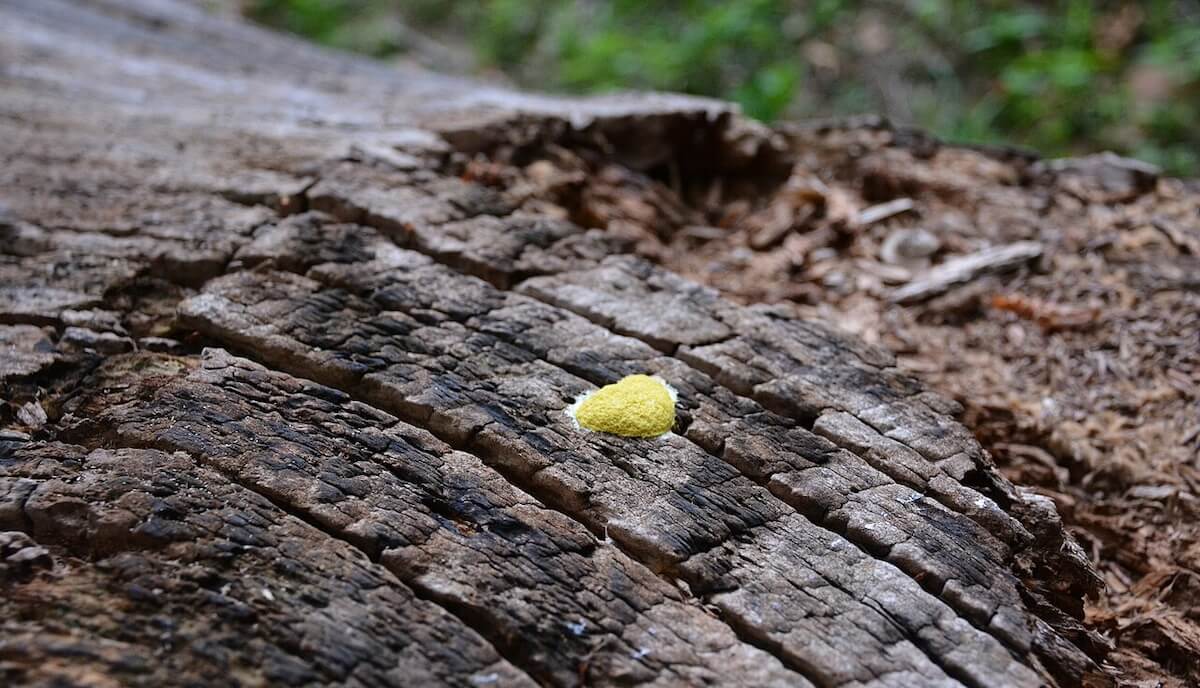
I was checking on my greenhouse one morning when I saw it. Right there, impossible to miss, a bright yellow, spongy mass sprawled out in the garden box near the front door. My first instinct was to crouch down, take a really close look, and tell myself that this thing clearly needed an explanation.
Good news: I managed to identify it all on my own!
Even better news: Facebook and Instagram’s algorithms decided to show my discovery to the WHOLE WORLD, and I went from 300 followers to 1,000 in just one week!
Bad news: not everyone listens to a biologist who did some research before commenting, and there are about a hundred comments saying it’s a blob…
So I’ve decided to set the record straight: that gross yellow thing you may have already come across in your garden is, by far, one of the most fascinating organisms in your yard, and it is NOT A BLOB!
Not a mushroom, not mold, not a plant
Its common name is “dog vomit slime mold” (I imagine you can guess why…) or “tan flower,” and its Latin name is Fuligo septica. Larry had already mentioned it in an article. For a very long time, it was classified as a fungus. It’s an understandable mistake: it appears on the ground, it vaguely resembles a giant mold, and it produces spores. But today, biologists classify it in the kingdom of protists, along with amoebas.
Um… what? We don’t get it!
These are single-celled organisms that are neither animals, plants, nor fungi. They’re in a category of their own. This group is called myxomycetes and includes several species.
The stage we see in our gardens, called the plasmodium, is technically a single giant cell containing thousands of nuclei. Not a colony. Not a tissue. A cell. Which can spread out over dozens of centimeters, like mine, or be very small.
Its life cycle
Fuligo septica spends most of its life quietly in the soil or plant debris, in the form of microscopic spores. Then the right conditions arise: high humidity, readily available decomposing organic matter, and mild temperatures. The spores germinate, and individual cells begin to fuse together to form the famous plasmodium. That’s what you see. And that means your soil is rich: congratulations!
The plasmodium moves slowly (a few centimeters per hour) across the surface of the soil or mulch, feeding by phagocytosis: it literally envelops the bacteria, fungal spores, and organic debris it encounters, and digests them. It has no mouth, no intestines. It feeds by deforming itself around its prey to encircle it on all sides and ingest it.
After a few days to a few weeks, depending on conditions, the plasmodium slows down. It moves on to the next stage: sporulation. The mass dries out, turns brown or gray, and transforms into a light powder full of spores. These spores are then dispersed by the wind or insects, and the cycle begins again, somewhere else, potentially years later.
This organism isn’t one you see very often, because it exists in a plasmodial form for only a few days and isn’t in as much of a hurry to reproduce as an animal with a limited lifespan that has to do so quickly. Spores, on the other hand, can wait a very long time!
Let’s talk about the famous blob
Well, I won’t dwell on dog vomit, since Larry has already covered that, but I was still really shocked to see how many people call it a “blob”… so I figured I’d explain what a blob actually is. Because honestly, it’s like if I showed you a picture of a goldfinch, and hundreds of people commented that it’s an eagle!
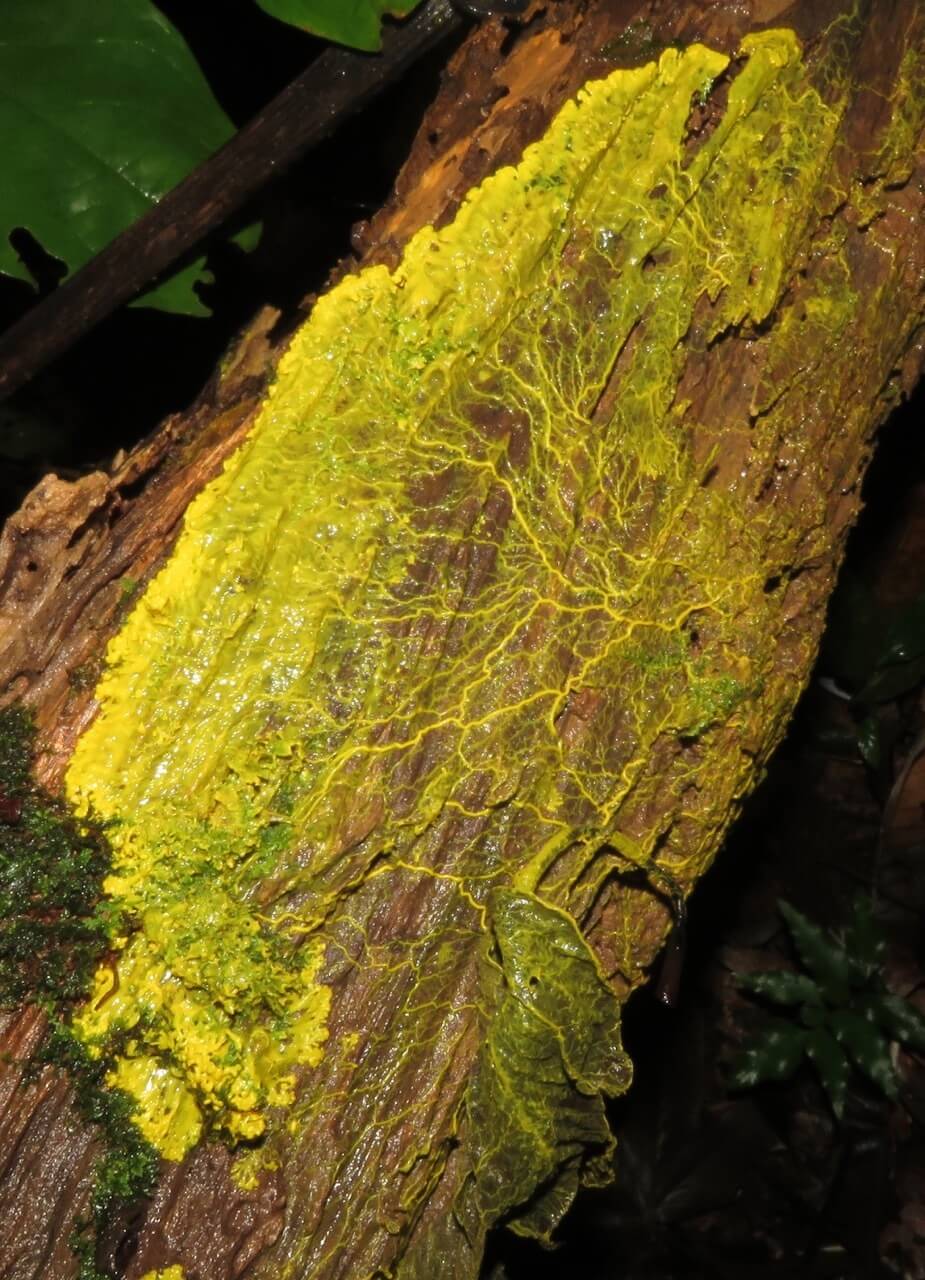
The real blob is Physarum polycephalum. It’s another myxomycete, from the same class as our dog vomit, but a completely different species.
Famous and in the spotlight
What makes it famous is that it does things it has absolutely no reason to do: intelligent things. In 2000, Japanese researchers placed a Physarum at the entrance to a maze, with food at both ends. The blob spread throughout the entire maze, then gradually retreated, leaving only the shortest path between the two ends. No brain. No neurons. A single cell.
It was French researcher Audrey Dussutour, of the CNRS, who popularized the name “blob” and devoted much of her career to this organism. Her team has shown, among other things, that it can learn to ignore substances it finds repulsive, and pass this learning on to a fellow blob by physically merging with it. In 2010, other researchers reproduced the map of the Tokyo area on a laboratory substrate, placing food at the locations of major cities. The network of filaments formed by the blob bore an uncanny resemblance to the region’s actual railway network. No software, no engineers. Just a blob.
In short, you can see why it captured the media’s attention. It’s extraordinary. I won’t deny it!
Distant cousins
But here’s the thing: Physarum polycephalum is just one of about a thousand known species of myxomycetes. A goldfinch isn’t an eagle, a dandelion isn’t an orchid, and the Fuligo septica in your garden isn’t a blob. They’re distant cousins in a huge family, and they don’t look much alike.
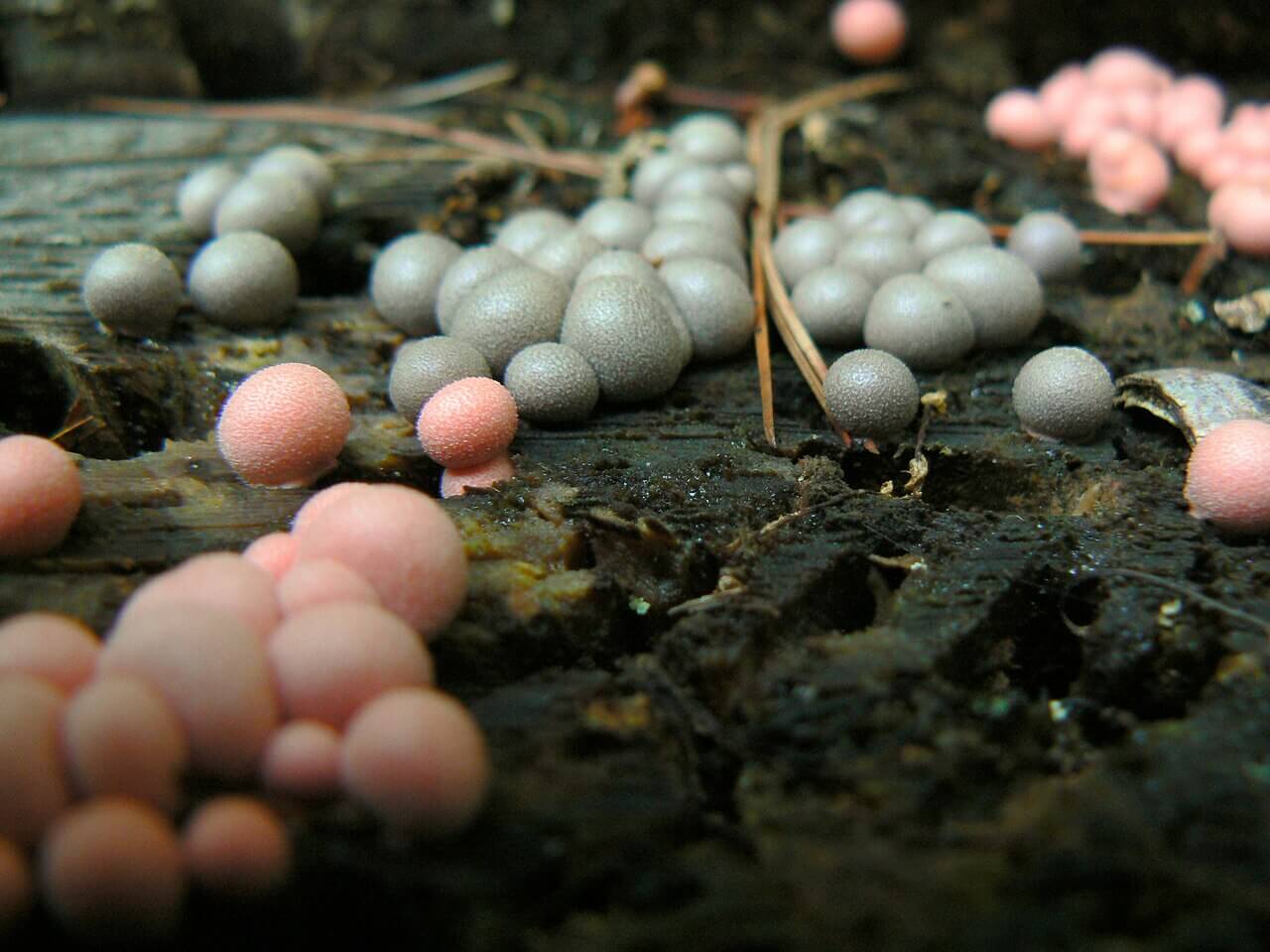
In fact, the diversity of myxomycetes is incredible: some are tiny and brown, others form long, elegant stalks, and still others resemble small pink eggs or orange arabesques. Most spend their lives unnoticed in the forests, under tree bark, and in fallen leaves. Our dog vomit slime mold simply has the bad (or good?) habit of settling where we can see it: in our garden boxes, on our mulch, right out in the open on the sidewalk. It’s an extrovert in a rather discreet family!
What should you do if you find dog vomit slime mold (Fuligo septica) in your yard?
The honest answer: nothing. Fuligo septica is harmless to your plants, and it will disappear on its own within a few days once it has sporulated. Its spores can, however, irritate the respiratory tract of people with asthma, so if that applies to you, it’s best to remove it while it’s still yellow and moist (a quick shovel into the compost, and it’s taken care of). If you want to discourage it from returning, reducing watering in that area helps, but honestly, if your soil is rich enough to attract a slime mold, that’s something you should be proud of.
And the real blob—can we find it in our garden?
That’s the question I asked myself. And the short answer is: maybe, but it’s unlikely. Physarum polycephalum is a forest organism. It prefers shade, damp dead wood, rotting bark, and piles of leaves. It exists in Canada, but it lives mainly in the forest, sheltered from direct sunlight and rain. If you have a very shady spot in your garden, with old logs or decaying stumps, you might theoretically come across one.
It is bright yellow, spongy, and moist like our Fuligo “dog vomit slime mold” but Physarum, the blob, tends to form a network of clearly visible veins, like a road map, whereas “dog vomit” forms a compact, foamy mass.
But whether it’s Fuligo septica or Physarum polycephalum or one of the thousand other myxomycetes living quietly around us, one thing is certain: these organisms deserve our attention. A single cell, without a brain, that moves, eats, sporulates, waits for years in the soil, and reappears at the first rainy spring. It’s hard to be more discreet and tenacious at the same time!
There you go. Now, I really hope you aren’t one of those who commented “blob” under my video. If so… Well, it’s not too late to go back to the original post and edit your comment!
Nature is truly strange; finding a dog vomit slime mold in your garden sounds like quite the discovery. It is amazing how such organisms thrive in rich soil. When I am not exploring the outdoors, I enjoy relaxing with a ??????? to clear my mind and practice mindfulness.
Ick!
I live in Zone 9; Sacramento. I frequently find this in my heavily mulched yard. Cool stuff. Makes me happy to know that the cycle of organic gardening is ‘alive’ and well in my yard
Fascinating. Kind of gross in appearance but then we all can’t be beautiful. Thanks for the explanation.
Fascinating! Thanks.